Oh my.... Check this one out. Just brilliant descriptions.
Saturday, April 05, 2008


Review of article on Concentric Cessationism
Here is an article by conservative Christian professor Dr. Daniel B. Wallace promoting the view of Concentric Cessaionism. In fact, he may be the one who first coined the term. That said, I would not agree totally with the concept as defined in the article, which is
... That is, rather than taking a chronologically linear approach, this kind of cessationism affirms that as the gospel moves, like the rippling effect of a stone dropping into a pond, in a space-time expanding circle away from first century Jerusalem, the sign gifts will still exist on the cutting edge of that circle. Thus, for example, in third world countries at the time when the gospel is first proclaimed, the sign gifts would be present. This view, then, would allow for these gifts to exist on the frontiers of Christianity, but would be more skeptical of them in the 'worked over' areas. (Footnote 1)
The view that Scripture teaches in my opinion does not so readily differentiate between evangelized and unevangelized areas. Instead, it correlates the appearance and giving of these gifts with any possible neccessity of its required manifestations as directed by the Holy Spirit. Therefore, I think it is erroneous to conclude that we must or are more likely to see the Sign-gifts in Third world countries, or that we will never see such gifts in the developed Christianized countries like America for example. Rather, they are more of an aid given under the wisdom of God in situations that demand it; more of supernatural help to babes in Christ and immature churches which will be mostly denied to mature Christians who should by then learn how to walk by faith (and not by sight) in the promises of God. After all, since Christians ARE growing towards perfection as defined in 1 Cor. 13:10, the Sign-gifts would decrease in proportion to our maturation in Christ.
That said, let us look more into Wallace's article.
The first we would look at is Wallace's testimony. The good and the bad of the Charismatic movement practically speaking in the lives of Christians can be seen here, which I have experienced it for myself also. The life and vibrancy always stands in contrast to the deadness of Traditionalism within the conservative churches. In fact, I would even say that Traditionalism is one of the reasons why the conservatives struggle to hold on to their youth, nevermind evangelize the lost. I was one of those also who was not saved under the dead formalism within the churches, as manifested in those who refuse to examine their lithurgy according to Scripture and worst of all, do not preach doctrine.
But just as the passion in Charismatism drives true evangelism which results in the salvation of the lost, and its vibrancy show us the way of true Christian living, the shallowness and error within it slowly destroys the life and faith it once nurtured. Wallace left because the Charismatic group with its error of the Second Baptism of the Spirit and the necessity of speaking in tongues resulted in the resident 'apostle' to question his salvation when he couldn't speak in tongues even after prayer.
Year later, after seminary education and embracing the Cessationist view, a crisis lead him to seriously reconsider his position on this, and thus this lead him to attempt to formulate a third way, which I think is good since neither position (Cessationism as traditionally postulated and Continuationism) is totally satisfactory according to the Scriptures.
Before we look at the 11 theses Wallace has came up with, I would just like to note something mentioned in his personal testimony in this message of his. Wallace dichotomizes a "passion for Jesus" with a "passion for the Bible". If that was his former position, then I think that was sad that he thought such was the case. Perhaps certain Cessationists do try to dichotomize between Jesus and the Word of God, but I for one do not see this in Scripture and I have never held this to be true. Sure, theological, they are two different concepts which are discussed separately (Christology and Bibliology), yet ontologically, there is an insoluble bond between them which cannot and should not be broken. The Word Incarnate (Jesus) and the revealed Word (Scripture) are not two different 'Words', but one (Scripture) is a perfect 'reflection' of the other (Jesus) and therefore share the attributes of the other. We can read in Scripture that Scripture is perfect (Ps. 19:7), it is our delight (Ps. 119:77) and it is forever fixed in the heavens (Ps. 119:89) — attributes that only God should have. God alone is perfect/holy/good (i.e. Mk. 10:18), only He should be our delight and only He is eternally present (after all, nobody except God was around before the Creation). Therefore, the pre-inscripturated Scriptures or Graphe (Γραφε) has the attributes of God, though it does so because it ontologically proceeds out of God. Put is another way, the Graphe come epistemologically before God, but God comes ontologically before the Graphe.
Therefore, it is unfortunate that Wallace has made such a dichotomization between Jesus and Scripture. Though they are people who seem to choose one and not the other, what actually occurs is that they chooose neither but the shell of the one they claim to embrace. For example, Neo-Orthodoxy makes much of Jesus but not Scripture, yet by jetissoning Scripture, it loses Jesus and substitute Him for one of their own reasoning based upon their subjective "interpretation" of the biblical texts and of course their own experiences. The opposite extreme of for example unbelieving Bible scholars treat Scripture as academic texts and reject Jesus and therefore have only the shell of the words written down. And sometimes believing Bible scholars also behave functionally the same way as their secular counterparts. It's like the husband who treasures the words and character and actions of his wife but not his wife herself — a totally schizophreniac way of living. Rephrasing it, such is analogous to saying that a husband loves everything about his wife but not his wife herself. The Neo-Orthodox position is of course similarly nonsensical, for it is analogous to the opposite example of a husband loving his wife but not loving anything about his wife.
What makes Wallace's confusion particularly worrying is the statement he made in the second last paragraph before the presentation of his theses. In his own words:
Through this experience [cancer and near death of his son] I found that the Bible was not adequate. I needed God in a personal way--not as an object of my study, but as friend, guide, comforter. I needed an existential experience of the Holy One. Quite frankly, I found that the Bible was not the answer. I found the scriptures to be helpful — even authoritatively helpful — as a guide. But without feeling God, the Bible gave little solace. In the midst of this "summer from hell," I began to examine what had become of my faith. I found a longing to get closer to God, but found myself unable to do so through my normal means: exegesis, scripture reading, more exegesis. I believe that I had depersonalized God so much that when I really needed him I didn't know how to relate. I longed for him, but found many community-wide restrictions in my cessationist environment. I found a suffocation of the Spirit in my evangelical tradition as well as in my own heart. (Bold added)
Well, I guess perhaps if he equates naked scholarship with knowing God, then perhaps this is what happens. Nevertheless, we can see the worrying language being used. I hope this is indeed careless utilization of language due to his previously mistaken view of Christianity as being purely intellectual. Yet it truly is serious. What does he mean by saying that the Bible was not adequate? Or about the Bible is not the answer? It sure sounds like denying the Sufficiency of Scripture to me. If he wants to say that 'mere head knowledge scholarship' is not adequate, by all means state that truth, but it is hoped that we do not utilize such careless language, nor even believe such falsehood as 'the Bible is not adequate'. Scripture by the way is not just the physical words of the Bible, and neither is it only about analysis and exegesis, though most definitely it includes that. Wallace mentions that there is a suffocation of the Spirit "in my evangelical tradition as well as in my own heart." Perhaps in the latter, and if the former of evangelical tradition has truly contributed to that, I wold be glad to see it go also.
Let's now look at the eleven theses he penned.
(1) Although the sign gifts died in the first century, the Holy Spirit did not.
I agree with this. If 'evangelical tradition' behaves as if there isn't an experiential side to Christianity, then good riddance to it. We don't need dead churches here.
(2) Although charismatics have given a higher priority to experience than to relationship, rationalistic evangelicals have given a higher priority to knowledge than to relationship.
Perhaps so.
(3) This emphasis on knowledge over relationship has produced in us a bibliolatry Since the text is our task, we have made it our God. It has become our idol. Let me state this bluntly: The Bible is not a member of the Trinity. One lady in my church facetiously told me, "I believe in the Trinity: the Father, Son, and Holy Bible."
One of the great legacies Karl Barth left behind was his strong Christocentric focus. It is a shame that too many of us have reacted so strongly to Barth, for in our zeal to show his bibliological deficiencies we have become biblioters in the process. Barth and Calvin share a lot in common: there is a warmth, a piety, a devotion, an awe in the presence of God that is lacking in too many theological tomes generated from our circles.
This irks me, because it is the wrong word and wrong charge to use. It plays into the hands of our Neo-Orthodox enemies, not to mention the Liberals too. The emphasis on knowledge over relationship produces Intellectualism and Rationalism, NOT bibliolatry. Since we deny any functional separation between Jesus and the Word, any attempted emphasis on the Word while denigrating a relatonship with Jesus the incarnated Word is just plainly impossible. It is only possible if the emphasis is NOT on the Word but on the shell or form of the Word; an appearance of it. So therefore theologians who 'know the Bible' but are not having a real relationship with God do not truly know their Bible, only the shell of it; like corpses without life in them.
And no, looking at Karl Barth is not the right way to go. It's like saying that since Hyper-Calvinism is heresy, therefore we should look at what Arminius teaches. Or since Arius was wrong, we should turn to Apolliniarism. Turning fom one heresy to another is never right.
(4) The net effect of such bibliolatry is a depersonalization of God. Eventually, we no longer relate to him. He becomes the object of our investigation rather than the Lord to whom we are subject. The vitality of our religion gets sucked out. As God gets dissected and trisected (in the case of you trichotomists), our stance changes from "I trust in" to "I believe that."
Same answer as the response to point 3.
(5) Part of the motivation for this depersonalization of God is our increasing craving for control. What we despise most about charismatics is their loss of control, their emotionalism. We fear that. We take comfort in the fact that part of the fruit of the Spirit is "self-control." But by this we mean "do all things in moderation"--including worshipping God. But should we not have a reckless abandon in our devotion to him? Should we not throw ourselves on him, knowing that apart from him we can do nothing?
If this truly is 'Evangelical' and 'conservative', even 'reformed' tradition, let it be gone. I add my agreement to getting rid of such Traditionalism. Though I disagree with Piper on various issues, he IS right when he talks about the supermacy of Christ in the life of a Christian, and his whole concept of "Christian Hedonism' is correct, but I detest the term itself (Really, is there such a paucity of words in the English vocabulary such that we cannot use better terms to describe the concept of being totally satisfied in the wonder of the person of our Lord Jesus Christ?)
(6) God is still a God of healing and miracles
Amen. That doesn't make me a Charismatic or a Continuationist in any shape reformed though.
(7) Evangelical rationalism can lead to spiritual defection.
Agreed. And if seminary does not teach that faith is essential, then it is not doing its job.
(8) The power brokers of rational evangelicalism, since the turn of the century, have been white, obsessive-compulsive males.
Perhaps. So what? I thought our obedience was to Scripture, so whose fault is it that a person chose to follow a wrong direction any so-called "power brokers" took?
I am also uneasy over all the talk about listening to the women. Yes, we need to listen to them, but we must caution against over-correction into the feminist heresy. Again, the yardstick should be Scripture, not to focus on correcting a wrong but instead to follow the right path.
9) The Holy Spirit's guidance is still needed in discerning the will of God. The rationalism in our circles makes decision-making a purely cognitive exercise. There is no place for prayer. There is no room for the Spirit. ...
Of course the Holy Spirit's guidance is needed. As stated, if this is conservative, evangelical tradition, may it be abadoned.
(10) In the midst of seeking out the power of the Spirit, we must not avoid the sufferings of Christ.
Amen.
(11) Finally, a question: To what does the Spirit bear witness? Certainly the resurrection of Christ. How about the scriptures? A particular interpretation perhaps? Eschatological issues? Exegetical issues? Don't be too quick to answer. Some of this needs rethinking . . . In fact, my challenge to each of you is this: reexamine the New Testament teaching about the Holy Spirit. Don't gloss over the passages, but wrestle with what they mean. If the Spirit did not die in the first century, then what is he doing today?
Good question. May I suggest a partial answer? The Holy Spirit's job is to be with us and comfort us (Jn. 14:17). He will tell us what is the true and absolute Truth about the Faith (Jn. 14:26; 16:13), bears witness for Christ (Jn. 15:26), convict the world concerning sin and righteousness and judgment (Jn. 16:8), glorify Christ (Jn. 16:14), regenerates and creates faith in the elect (Eze. 37:9, 14; Jn. 3:5-8), and of course help us in our praying (Rom. 9:26-27).
As it can be seen, Wallace's message does have some good points in it. Sterile purely cognitive Christianity is no Christianity at all. However, I am afraid that Wallace's reaction to Intellectualism and Rationalism would swing to the position of the the Barthians. May we therefore come to a better appreciation of the what the orthodox teaching of Sola Scriptura teaches, instead of thinking it teaches that Christianity is only cognitive being no different from rationalistic intellectualism.
Wednesday, April 02, 2008
The necessity of faith
Have been busy and decided to spend more time with God on Sunday, so there's no weekly meditation last week. Anyway, due to certain issues that have cropped up, here is something that would hopefully be edifying.
Now faith is the assurance of things hoped for, the conviction of things not seen. ... And without faith it is impossible to please Him, for whoever would draw near to God must believe that He exists and that He rewards those who seek him (Heb. 11:1, 6)
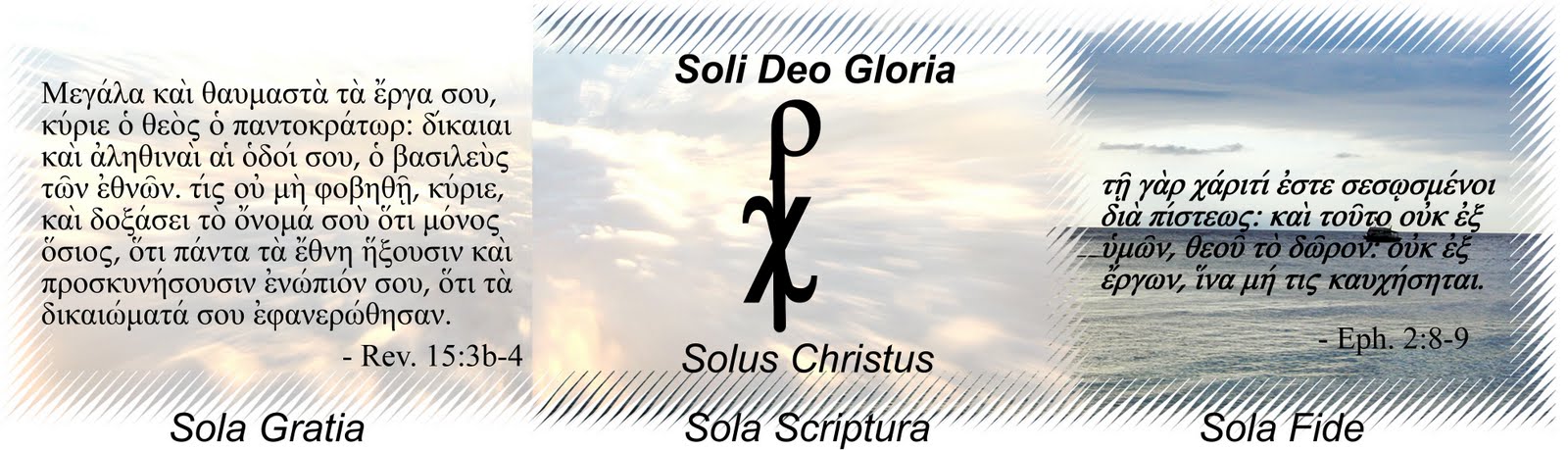
Faith is integral in the life of a Christian. Not only it is vital for salvation (we are saved by faith alone — Sola Fide), it is vital for the entire living out of the Christian life. As it is written, the righteousness of God on our behalf is revealed "from faith for faith" (Rom. 1:17), not only for the initial work of salvation, but also for our whole walk with Christ our Savior and Lord. In fact, whatever is not done out of faith is ... SIN (Rom. 14:23b). As Christians, our whole life should be categorized as living totally and entirely by faith in the promises of God.
Heb. 11 is the classic passage on the topic of faith, and something which tell us a lot about faith. The type of faith presented here is something which perseveres, not the type of flippant "faith" which is here one day and gone the other. This passage describes the faith of our forefathers in the Faith, not to awe us into 'venerating' them, but that we should use them as examples to work towards. And for this verses 1 and 6 are instrumental in their description of true biblical faith; a faith that God is truly pleased with.
In Heb. 11:1, we are told that faith is the assurance of things hoped for, a conviction of things not seen. Note the words 'assurance' and 'conviction'. Faith therefore is not false humility or epistemological agnosticism, as if saying I don't know is a badge of honor, nevermind the fact that such a person is so arrogant in claiming to know for certain that nobody can know the answer or truth either. Rather faith is expressed in assurance and confidence and conviction about its object, never in "humble orthodoxy". The person who shares God's truth as if he/she is embarrassed about it is most definitely not exercising faith, neither is the one who treats God's truth as one opinion to be evaluated by its hearers among other equally valid options.
The object of our faith is stated as being things 'hoped for' and 'not seen'. They are believed in in hope, not that it is some sort of blind faith, but that through the eyes of faith, we know that it would come true. Through our spiritual eyes, the objects of our faith in God are as good as realized, in the same way and even more real than any goods that we have ordered, paid for and have yet to receive their delivery from a very reliable company. They are as real as God, who is in fact our most glorious hope Himself. They are also 'not seen', in the sense that they are not physically present and therefore subject to empirical evaluation. Rather, they are all seen with the eyes of faith, which all true believers in Christ have as part of their new nature in Him.
Verse 6 of Heb. 11 points us to the reason why faith is so important. Without faith, it is impossible to please God, period. Although God can manifest His presence physically, which He did most importantly through His Son in the Incarnation, God has ordained that He should be approached by faith, and faith alone. As we have seen, whatever is not done out of faith is sin, and therefore exercising faith as a child of God pleases our Father who loves us.
Practically speaking, this is where the difficulty comes. For although it is known that we are to live the Christian life by faith, are we really doing so in all that we do? Or are we living by sight instead? (2 Cor. 5:7) An example of this would be when it comes to finding and getting a building for the church. Do we look only at the dollars and cents and plan accordingly, as if this was a purely commercial decison, even making contingencies if 'all else fails'? Where is faith in all this decision-making? Of even about other decisions, especially it seems when money is involved? Is Money god somehow? Yet why do we find it so hard to have faith in God instead of thinking like a financial advisor? Where is the praying, the seeking of God's will, and trusting Him to provide even in the finances? Is God a 'god of small things', and therefore cannot provide $1 million if there is such a shortfall in funds?
Now, of course this is not to say that we shouldn't plan or that we should just presume on the will of God, as if God must provide because I claim His promise by "faith". No, but God will show the way if we just but submit to Him and humbly seek His will. The idea is one of principles and priorities, not of actions. The Christian is to live His entire life by faith, and most definitely corporately as the Church we must live by faith. It is ridiculous, even unbiblical, to claim that we know we must live by faith, and that we will 'sortof' live by faith, but only doing so as a measure of last resort , as if God is the one we turn to only when we have trouble, and not during other preriods of time. How hypocritical! How dare we say we believe in living by faith yet practically live as if faith is not important at all in any and every thing that we do? As it has been said, Some churches function in such a manner that they can continue to function and thrive even if the Holy Spirit is absent from the congregation! Shame!
Let us therefore learn what it is to live by faith — a faith that is living and vibrant in Christ Jesus our Lord. Submit everything to Him by faith, and do not treat Him as a fire-engine. May we grow in our exercise of faith in all that we do, and therefore may it be said of us that 'Therefore God is not ashamed to be called their God, for he has prepared for them a city' (Heb. 11:16). Amen.
Sunday, March 30, 2008
Mid-way compilation of articles on Charismatism and the Gift of the Spirit
The number of articles in the series on the topic of Charismatism and the Gifts of the Spirit have been growing, so here is a partial compilation for easier reference later:
- On Charismatism: Delineating the various subjects involved
- On Charismatism: Delineating the contents involved
- On Charismatism: Scripture, Experience and the Issue of Ultimate Authority
- On Charismatism: Word-faith — Health and Wealth non Gospel part 1
- On Charismatism: Word-faith — Health and Wealth non Gospel part 2
- On Charismatism: Word-faith — Gutting the Centrality of the Gospel
- On Charismatism: Second Baptism of the Spirit?
- On Charismatism: The Gifts of the Spirit
- The Gifts of the Spirit: The Gift of Tongues (part 1)
- The Gifts of the Spirit: The Gift of Tongues (part 2)
- The Gifts of the Spirit: The Gift of Tongues (part 3)
- The Gifts of the Spirit: The Gift of Tongues (part 4)
- The Gifts of the Spirit: The Gift of Tongues (part 5)
- The Gifts of the Spirit: The Gift of Tongues (part 6)
Hope this would be helpful. Oh, and I would need to make a change in the terms; should be continuationist not continualist.
The Gifts of the Spirit: The Gift of Tongues (part 6)
[continued from here, here, here, here, here, here, here, here, here, here, here, here and here]
ARE THE GIFTS OF TONGUES FOR TODAY? (cont')
We have looked at the Gift of tongues from many angles to determine what it is, how it should function in the apostolic times, and the purpose of which it was sent. Also, it has been seen how Scripture itself is not explicit on whether the Gift of Tongues (or any Gift in fact) continues into our non-apostolic age or it has ceases and therefore the question must be answered through deduction from various parts of Scripture and Systematic Theology, not just by demanding a specific text to settle the question once and for all. We have also looked at 1 Cor. 13 and see that the text cannot bear the burden of the Cessationist argument on the topic, though it must be stated that the "leaky canon" charge must be answered for nothing must be allowed to undermine the explicit teaching of the sufficiency of Scripture.
Looking though all the facts, descriptions of the Gift, and the Scriptural evidences, I am of the opinion that neither the Classical Cessationist case nor the Continuationist case is proven. Scripture does not state that the Gifts and the Gift of Tongues would cease as Cessationists typically think that 1 Cor. 13:8-13 teaches. Yet the Continuationists are not better off however.
Knowing the purpose of the Gift of Tongues, that they are to function as a sign for unbelievers to show the global scope of the Kingdom of God in reaching rapidly across languages and cultures, the purpose of the Gift of Tongues have been fulfiled for the most part already during the apostolic times. Also, the knowledge of languages have progressed to such a stage that we can just learn the language without the need of tongues, and God will most definitely not reward laziness on our part. And no, the Bible does not differentiate between different groups of Gentiles in its missiology, so there is no neccessity for God to manifest tongues to show the global scope of His Kingdom to unreached people groups. A related issue is that with the progress in the knowledge of languages, speaing in tongues cannot exactly function as a sign to unbelievers nowdays since people will think you have learned the language and that you have lied if you claim otherwise. So for all these reasons, it can be seen that the purpose of the Gift of Tongues seem to be fulfilled already, and God does not give a Gift just to satisfy our curiosity over the Gift.
Having shown the weakness of both sides, what then should be the biblical answer to the question of the cessation or continuation of the Gift of Tongues? I am of the opinion that the biblical answer is that the Gift of Tongues has by far fulfilled its purpose and therefore is generally not present today. Yet there are still situations whereby the Gifts still retain their purposes, for example an in-promptu evangelistic conversation with a foreigner, especially when they come from one of the unreached people groups. My view therefore can be called the Concentric Cessationist view, which is defined as
Miraculous gifts have indeed ceased in the mainstream church and evangelized areas, but appear in unreached areas as an aid to spreading the Gospel. (Source)
This view therefore is consistent with the text of Scripture as it relates to the purpose of the Sign-Gift, and especially the Gift of Tongues. As it will be seen later, this is my view for all the Sign-Gifts, and therefore it is to be expected that such Gifts are much more operational in the mission field; in places such as the 10/40 window than in 'Christianized' areas. Note that although such gifts are more common in those areas, they still must abide by the biblical definition of the Gifts like tongues, and not just refer to any ecstatic gibberish even in such areas. Also, since the Sign-Gifts are an aid in such regions, they would diminish in frequency and magnitude as the Gospel progresses through the region and people's lives are transformed, and thus not to be celebrated as superior permanant Gifts. (In fact, this could very well explain the decrease in the frequency of such Sign-Gifts during the history of the early Church.) As always, God is supreme in giving the Gifts and we are not to seek such Sign-Gifts, which God will give when they are required.
With the question of tongues answered, let us continue on in looking at the other gifts.
[to be continued]
Saturday, March 29, 2008
The Gifts of the Spirit: The Gift of Tongues (part 5)
[continued from here, here, here, here, here, here, here, here, here, here, here and here]
ARE THE GIFT OF TONGUES FOR TODAY?
As we close on the final question as to whether the Gifts of Tongues are truly for today, we must need address two issues; namely the method of answering and the text of 1 Cor. 13.
To Answer the Question
Many charismatics and other sincere "literalists", when apporaching this subject with an 'open mind', would state that proof-texts from the Scriptre are required to show that tongues (and any Gift for that matter) have ceased. After all, since tongues ARE mentioned in Scripture in the New Testament era, and we are still living in this New Covenant era, shouldn't the Gifts carry on unless the Scripture show otherwise? While the user of this approach seeks to be true to Scripture, this approach is NOT the biblical way of answering the question, for this question has already assumed that any of the Gifts of the Spirit are by default permenant for the Church to begin with; it begs the question. After all, although there are some people who believe this, are there any charismtics or 'literalists' who advocate living in community where all believers have everything in common, selling everything they have to give to those in need (Acts 2:44-45)? Just because something is mentioned/described in Scripture does not necesarily mean that such is a permenant arrangement, more so since they are a Gift/Ministry issue and not a theology proper issue. As an aside, there are no proof-texts for the continuation of the Gift of the Spirit either, so the request for proof-texts can run both ways.
In addressing the topic of the Charismata, we must first realize what they are and what are their purposes — why they were given to the Church at that time before answering whether they are for today. For since God gives everything for a purpose, the question of whether the Gifts are for today must need be answered according to the entire Bible (tota Scriptura) and the entire scheme of the Salvation story. The whole idea of treating the question of whether they have ceased as an issue in isolation is not the biblical way to answer the question, as all truths are linked to each other ultimately in Christ. As an example of what is meant, the doctrine of the Trinity is not stated explicitly in Scripture (and no, I am skeptical of the legimtimacy of the Johannine Comma), and therefore we deduce it from multiple texts of Scripture. In the same way, we cannot treat the issue of the Gifts as if they are a single verse/proof-text question. The question must rather therefore be answered according to the entirety of Scripture and its application to our times rather than just demanding one proof-text as if that proves or disproves anything.
THE QUESTION OF 1 Cor. 13
1 Cor. 13 is a favorite passage of Cessaionists, an amazing proof-text they use to slam the charismatic position, which unfortunately cannot bear the weight the Cessationists place on it.
In 1 Cor. 13, it is written:
If I speak in the tongues of men and of angels, but have not love, I am a noisy gong or a clanging cymbal. And if I have prophetic powers, and understand all mysteries and all knowledge, and if I have all faith, so as to remove mountains, but have not love, I am nothing. If I give away all I have, and if I deliver up my body to be burned, but have not love, I gain nothing.
Love is patient and kind; love does not envy or boast; it is not arrogant or rude. It does not insist on its own way; it is not irritable or resentful; it does not rejoice at wrongdoing, but rejoices with the truth. Love bears all things, believes all things, hopes all things, endures all things.
Love never ends. As for prophecies, they will pass away; as for tongues, they will cease; as for knowledge, it will pass away. For we know in part and we prophesy in part, but when the perfect comes, the partial will pass away. When I was a child, I spoke like a child, I thought like a child, I reasoned like a child. When I became a man, I gave up childish ways. For now we see in a mirror dimly, but then face to face. Now I know in part; then I shall know fully, even as I have been fully known.
So now faith, hope, and love abide, these three; but the greatest of these is love.
We have previously partially exegeted the texts of 1 Cor. 12-14, on the issue of the Gift of Tongues — its nature and its exercise, glossing over the text of 1 Cor. 13 in the process. As this text is used so many times in an attempt to prove Cessationism, it is imperative that we look at it.
1 Cor. 13 starts off with the hypothetical and hyperbolic arguments arguing for the centrality and necessity of love in verses 1-3, to make the argument that without love being the motivation for everything we do, no amount of exercise of the Gifts in its most "powerful" form will avail us any good. Verse 4 to 7 goes on to define what agape love is biblically, which many people, espeically couples on their marriage day, like.
Verses 8 to 13 is the passage in which Cessationists base their arguments. It is first stated that love never ends, and then it is stated that 1) prophecies will pass away, 2) tongues would cease, and 3) knowledge will pass away. And all three of such occurances will happen when 'the perfect comes' (v. 10), with all of these 3 being stated as being partial. Verse 11 then uses the analogy of a child for this partial state, and that of a man for the perfect state, who gives up the childish state. Verse 13 refocus on what is important, which is faith, hope and most importantly love, as compared to the spiritual gifts.
A key issue here is when will this perfection comes. Cessationists typically points to the closing of the Canon of Scripture as that perfection which comes, while Continuationists argue that the perfect is when the Lord Jesus comes again. Cessationists typically argue that such sign-Gifts such as Prophecy, Tongues and Word of Knowledge are referred here as being that of the partial, which we shall do away with when we are a man, which hereby refers to the maturation of the Church now with its complete Bible. To the continuationist charge that knowledge has not gone away, Cessationists reply by stating that this is not referring to knowledge per se, but the Spiritual Gift of the Word of Knowledge (1 Cor. 12:8).
Seen within the context, Paul uses this argument that the Gifts will one day cease to emphasize that the fruits of which he gave 3 examples: faith, hope and love, are the most important, following on after his exposition on the necessity of serving within the Body of Christ and his rejection of the idea that one gift is superior to the other leading to discrimination within the Corinthian Church in 1 Cor. 12: 12-31, his emphasis on love over and above glorifying in the exercise of the Charismata in 1 Cor. 13:1-3 and the description of love in 1 Cor. 13:4-7. After all this emphasis on the importance of love, Paul then addresses the misuse of the Gifts in 1 Cor. 14, and most especially the Gift of Tongues.
It must be noted here that both the Cessationist and Continuationist interpretation of 1 Cor. 13:8-13 makes sense within the larger context of 1 Cor. 12-14. The key question of when the perfect comes still is still not resolved. Earlier on, one Continuationist objection is shown to be false. And now, we shall see that the Cessationist position is not so strong either. For the entire interpretation that the prefect here refers to the completion of the Canon is not found in Scripture either. Is there any correlation between the completion of the Canon and the maturity of the Christian Church? Surely not, for the Visible Church is still as riddled with all manners of problems and plagued with heretics and apostates as were the early church, in fact even more so. So why the linkage with the completion of the Canon?
Appeal may be made to the language of 2 Tim. 3:16-17, especially verse 17 which states
... that the man of God may be competent, equipped for every good work (2 Tim. 3:17)
The word translated 'competent' here is also translated 'perfect' in the KJV, and therefore it may be said that the 2 Tim. 3:17 informs our understanding of what it means to be perfect in 1 Cor. 13:10, which is to say that when we have all the Scriptures making us perfect to do good works as per 2 Tim. 3:16-17. However, there is a problem with this interpretation. Barring the KJVOnly schismatics, the Greek word translated 'perfect' in 1 Cor. 13:10 is teleion (τελειον), while the Greek word translated 'competent' in 2 Tim. 3:17 in the ESV and 'perfect' in the KJV is artios (αρτιος) and the two are obviously not equal. Teleios refers more to the end (result) while artios refers more to capability, and therefore the Cessationist interpretation of 1 Cor. 13:10 as the 'perfect' referring to the perfection created by the closing of the Canon of Scripture is in error, since the closing of the Canon would make us artios not teleios.
This most definitely strikes a blow at the Cessationist camp who utilizes this passage to support its theory. Nevertheless, Cessaionists hit back with the charge of the leaky canon, which is truly potent. For since the Scriptures have made us artios, to believe in the Gifts giving us new revelation is to undermine the doctrine of the sufficiency of Scripture. Undoubtably, there are Charismatics going around making a complete fool of themselves and blaspheming the Word of God while claiming they have certain Gifts like prophecy and tongues and words of knowledge, like the ones on TBN (The Blasphemous Network Trinity Broadcasting Network). But abuse does not mean that the Continuationist position is in error, which must be clearly and carefully examined before such a judgment may be made. As one looks at the charge, the basic question for Continuationists is whether the Gifts can exist and exercised in such a way that is biblical yet without undermining the sufficiency of Scripture. And this we will look at later when discussing the various gifts separately.
So therefore, considering all that we have seen so far, which interpretation of 1 Cor. 13 is more consistent with the text and the context? It can be seen that the difference in both views can be narrowed to when the 'perfect' in 1 Cor. 13:10 occurs. Looking at the Greek, the Cessationist interpretation is not supported and even opposed. Yet the continuationist interpretation is not yet proved, as of yet.
The reason why I am convinced that the Continuationists are right in their interpretation of 1 Cor. 13, besides the Greek word teleois indicating an end perfection, is verse 12 of 1 Cor. 13, which I have ommitted discussing until now. For it is written that now we see in a mirror dimly, but [when the perfect comes] we shall see face to face. What are we said to see dimly, yet later we see face to face, but Jesus Christ our Lord and Savior. Furthermore, such a clear seeing of face to face can only come about at His Second Coming, never while we are still in this present body of sin on this earth. As Calvin commented:
Our faith, therefore, at present beholds God as absent. How so? Because it sees not his face, but rests satisfied with the image in the mirror; but when we shall have left the world, and gone to him, it will behold him as near and before its eyes.
Hence we must understand it in this manner — that the knowledge of God, which we now have from his word, is indeed certain and true, and has nothing in it that is confused, or perplexed, or dark, but is spoken of as comparatively obscure, because it comes far short of that clear manifestation to which we look forward; for then we shall see face to face. Thus this passage is not at all at variance with other passages, which speak of the clearness, at one time, of the law, at another time, of the entire Scripture, but more especially of the gospel. For we have in the word (in so far as is expedient for us) a naked and open revelation of God, and it has nothing intricate in it, to hold us in suspense, as wicked persons imagine; but how small a proportion does this bear to that vision, which we have in our eye! Hence it is only in a comparative sense, that it is termed obscure. (John Calvin, Commentary on Corinthians - Volume 1 - 1 Cor. 13:12. Bold added. As accessed here at http://www.ccel.org/ccel/calvin/calcom39.xx.iii.html
Therefore from this passage, it can be seen that the passage of Scripture in 1 Cor. 13 does not teach that the Gifts have ceased.
With all that, let us tackle the original question, which is: Are the Gifts of Tongues for us today?
[to be continued]
Being Doers of the Word
This is a posted excerpt on CRN from a letter received from the frontlines of the Gospel. And this only confirms my concern over the so-called "reformed resurgence", as stated in the Christianity Astray Today article entitled Young, Restless, Reformed, and as celebrated and paraded by some Evangelical Reformed folks, who I must say in mitigation are truly well-intentioned and genuine in their conviction though.
We must become all things to all people but not sin in doing so. A man can claim to have good theology all day long, he can preach it from the pulpit, but I do not care about that only. If he is living something else, if his mouth is saying other things that contradict Scripture, then I do not care what he says about theology. I have a very, very bad feeling about this ¨new reformed¨ movement of calvinist that I am speaking about. It is nothing less than reformed pragmaticism. It seems that they are taking God and His Word as something casual but true instead of taking it as something irreplacable and the only standard for living. As Driscoll says ¨the traditional methods of evangelism are not working, lost people are not coming as we want them to, there is a problem¨. There is no problem, regeneration is a work of the Spirit and not something that man can bring about. The problem is that no one believes in the work of the Spirit anymore in regeneration and conversion. (Bold added)
And so the Downgrade continues. More to come later.
See related:
Article: Christianity Today ditches Sola Scriptura and takes up Church Tradition
Wednesday, March 26, 2008
The Gifts of the Spirit: The Gift of Tongues (part 4)
[continued from here, here, here, here, here, here, here, here, here, here and here]
After writing for some time on this topic, I have found out that there is an issue which I have overlooked, and therefore let us turn back to it before answering the "million dollar question".
When defining the Gift of Tongues, there seems to be the argument that tongues could also refer to a private prayer tongue — a tongue for the expression of intimacy between the believer and God, and therefore different from the other "public tongues"; a second class of 'tongues'. Related to that of course is that the purpose of such tongues are for self-edification, and thus do not function as biblical signs like the other tongues mentioned in ie Acts 2.
The primary proof-text for this is 1 Cor. 14: 2-4, which is as follows:
For one who speaks in a tongue speaks not to men but to God; for no one understands him, but he utters mysteries in the Spirit. On the other hand, the one who prophesies speaks to people for their upbuilding and encouragement and consolation. The one who speaks in a tongue builds up himself, but the one who prophesies builds up the church. (1 Cor. 14:2-4)
Certainly, a surface level reading seems to suggest what the Charismatics are saying; that there are tongues which are private prayer languages meant for self-edification. Another such proof-text for the private prayer language is Rom. 8:26-27:
Likewise the Spirit helps us in our weakness. For we do not know what to pray for as we ought, but the Spirit himself intercedes for us with groanings too deep for words. And he who searches hearts knows what is the mind of the Spirit, because the Spirit intercedes for the saints according to the will of God. (Rom. 8:26-27)
However, is that what those two verses actually teach, or is this just another case of eisegesis; reading one's own interpretation into the text?
Let us start by looking at 1 Cor. 14:2-4, and this time let us interpret the verses in light of their context.
The arena upon which 1 Cor. 14 plays out is in the Church, or more specifically the Body Life of the Church; to edify the Church. Paul is here exhorting the Corinthians to focus on the Gift of Prophecy rather than to focus on their boasting in Tongues, which they are abusing. Paul therefore utilizes the language of contrasts here, contrasting the Gift of Prophecy with the Gift of Tongues in their usefulness in the life of a Church.
It is in this context that we come to verse 2 of 1 Cor. 14. Verse 2 and 3 form a pair of contrasts, and therefore inform us as to what Paul was getting at in verse 2. As it can be seen, verse 3 mentions the utility of the Gift of Prophecy in upbuilding, encouragement and consolation within the Church of Christ. Verse 2 therefore speaks similarly about the utility of the Gift of Tongues within the Body Life of the Church of God. Thus, when it is stated that the 'one who speaks not to men but to God', this is contrasted with the fact that Prophecy speaks to Man. The phrase 'No one understands him' is contrasted with the fact that all would understand prophecy (we will get to prophecy later), and 'utters mysteries' is contrasted with Prophecy uttering clear and coherent words. Similarly, a pair of contrast exists between verse 4a and verse 4b, with Tongues said to edify oneself contrasted with Prophecy edifying the Church. From all this therefore, 1 Cor. 14:2-4 can be seen to be not promoting a private prayer language after all, but is actually stating that the Gift of Tongues in the Body Life of the Church only edifies the speaker. This is because in general during normal Sunday services, no one except God can understand what they are saying and therefore they are uttering mysteries by the power of the Holy Spirit. Barring the situation which truly warrents it, ie when a person possibly a foreigner who knows the likely obscure language comes thus giving the Tongue-speaker a chance for their tongues to be ueful as a sign, speaking in Tongues during services will only edify oneself and not others.
1 Cor. 14:2-4 has therefore be shown within its proper context to be not promoting or describing a private prayer language after all, but rather the non-utility of Tongues in the Church's Life. So what about Rom. 8:26-27?
Rom. 8:26-27 is talking about the topic of prayer, or rather how the Spirit helps us when we find it difficult to pray. All of us have our points and times of weaknesses, and even when we are stronger does not mean we are actually strong. So in our times of weakness, God has promised to help us by the 'Spirit Himself interceding for us with groanings too deep for words'. Verse 27 is the rationale describing why the Spirit can so help us, where it is stated that he (Jesus cf Jer. 17:10; Rev. 2:23) who searches the heart know the mind of the Spirit and the reason for that is that 'the Spirit intercedes for the saints according to the will of God'. But what does this all mean?
We must always remember that the topic here is on prayer, and how God can help us in prayer despite our weaknesses. In verse 27, the Holy Spirit is said to intercede for the saints according to the will of God, and because the Holy Spirit does that, Jesus who searches the heart knows the mind of the Spirit. The mind of the Spirit refers to the intercession of the saints according to the will of God, so when Jesus searches the heart of the believer who prays, he sees His own will on the matter there. But how can this be unless the Spirit puts the will of God on the matter onto our hearts, since Jesus is here searching the heart of believers, not the heart of the Holy Spirit? Verse 27 therefore states that Jesus who searches the heart of believers will find there the exact will of God, the mind of the Spirit, which is placed there by the Holy Spirit. Together with verse 26, the Spirit is therefore stated as interceding for us by showing us the will of God for that matter so that we will pray God's will.
This of course leaves the phrase "groanings too deep for words", which doesn't seem to fit in. This could however be describing our experience in travailing in prayer, for such describes the emotional state of those who have wept and pleaded for God mightily in prayer, who do not know how to pray as they ought to and therefore seek God to help them even though they do not know how to ask God for aid. This therefore shows also that praying according to the will of God, which is promised here in this passage of two verses, can only be done through serious seeking after God and much hardship even. Do we wonder why sometimes it seems as if prayer is so dry and that nothing happens? Is it because we are not travailing mightily in prayer with groanings too deep for words? (This is a rebuke for me also btw).
As it can be seen, both 1 Cor. 14:2-4 and Rom. 8:26-27 do not in fact support the position of a class of tongues being private prayer languages, when interpreted correctly within its contexts. There is therefore only one type of tongue in the whole of Scripture — the biblical Gift of Tongues, and it is only of known human languages and does not function as a private prayer language.
[to be continued]
Tuesday, March 25, 2008
The Gifts of the Spirit: The Gift of Tongues (part 3)
[continued from here, here, here, here, here, here, here, here, here and here]
THE PURPOSE OF THE GIFTS OF TONGUES
God does not do anything by chance; everything He does is purposeful (Prov. 16:4). When the Charismata are given out at Pentecost, the Holy Spirit gives and uses them for a purpose, and it is this purpose which we look at now.
Gifts are stated first of all as being given for the building up of the universal Church of our Lord Jesus Christ (1 Cor. 12:7). This is definitely much needed in the early church while the Scriptures were still in the process of inscripturation, and the Church was still small and weak set in a hostile environment (both the Jews and the Greeks detested the Gospel). The Gift of Tongues therefore was also meant to be used to build up the Church of our Lord Jesus Christ, and we can see one way it was used was in drawing the attention of the Jewish Diaspora in Acts 2 by its undisputable miraculous nature so that Peter could give his first Christian sermon resulting in the salvation of 3000 Jews.
As we look at the Gift of Tongues, besides functioning as the most visible manifestation of Spirit baptism (Acts 10:44-47; 19:4-6), one important purpose can be seen in 1 Cor. 14:22a:
Thus tongues are a sign not for believers but for unbelievers, .... (1 Cor. 14:22a)
The context of 1 Cor. 14 shows Paul attempting to correct the immature Corinthian Christians in their abuse of their gifts, and especially the Gift of Tongues. As we have seen earlier, Paul gave them instructions of how to exercise the gift so as to build up the Church. 1 Cor. 14:22, however, sits right in the middle of his instructions, seeingly breaking up Paul's line of thought. Furthermore, it doesn't make much sense in such a context, for didn't Paul say that if unbelievers enter and all [the believers] speak in tongues, the unbelievers will be convinced that the Corinthian believers were out of their mind? (v. 23) So how can Paul state that they are a sign for unbelievers since Paul clearly tell the Corinthian Christians that their exercise will conversely convince the unbeliever that they are mad and subject the Gospel to scorn? (We will discuss the part about prophecy later)
To answer this question, it would be helpful to retrace the stated apperances of tongues through Scripture. In Acts 2 at Pentecost, tongues were the acknowledged miraculous sign which cause the unbelieving Jews from the Diaspora to be amazed and perplexed (Acts 2:12). In Acts 10, tongues functioned as the symbol which prove that the Holy Spirit has converted even the Gentiles. In Acts 19:1-7, tongues were given to mark the entry of Old Testament devout Jews who weren't around and thus missed out the birth of the New Covenant community. In all three accounts, only Acts 2 has anything to say about being a sign for unbelievers, whereas Acts 10 and Acts 18 function more as the visible manifestation of being baptized by the Spirit (at conversion), and we would therefore look at these two passages in more detail.
Juxtaposing Acts 2 with 1 Cor. 14:22a shows us that tongues are a sign to unbelievers that something miraculous was going on. No doubt these Jews may have heard the pagan priests mutter in false tongues and general gibberish and chants, but this was truly someting astonishing because it was in their own tongue, something they can understand, and the words that came out were words of praise to God. These tongues attracted their attention and they were perplexed at what this miracle meant, paving the road for Peter to give his Pentecostal sermon to a receptive audience.
From this, we can see that tongues seem to function as a sign to those unbelievers whose native language it is, as in Acts 2, that 1 Cor. 14:22a hold true. This therefore help us to understand more clearly what Paul is trying to say in 1 Cor. 14 in general. For since tongues are meant as signs to unbelievers, in the sense that the unbelievers who understood it will be astonished at this undisputed miraculous feat, the proper use of tongues as a sign to unbelievers occurs only when such people are around to witness this true miracle. Tongues therefore are a sign in a manner similar to other miracles, to put forth the truly miraculous as support for the fledgling church which would find it hard to expand to other cultures speaking other languages from a base of around 500 Jews and 0 Gentiles at the time of Pentecost (1 Cor. 15:6).
The reason why Paul regulated the speaking of tongues in the Corinthian church is due to their abuse. Whereas tongues were meant to be use as the Spirit leads as a sign to unbelievers, especially those from other cultures who were visiting, the Christians at Corinth were abusing their Gift of Tongues as a sort of spirituality contest, and thus all were speaking in tongues to prove their spirituality. With such chaos, unbelievers who enter will think that the church is a madhouse instead of a church, and therefore tongues are not functioning as the sign it was meant to be in such situations, earning Paul's stern rebuke for their abuse of their gift.
The giving of tongues could also function as a sign that Christianity is for the world, and certainly the book of Acts traces the outward spread of Christianity from Jerusalem, to Judea and Samaria, and onwards and outwards into the gentile world. Church Tradition also tell us of the deaths of the various Apostles in various places, from India to Ethopia to Britain (Foxes' Book of Matyrs Chapter 1), which proves the missionary focus of the Christian faith. Incidentally, the gift of tongues will prove most handy then, for unlike now when we can learn almost any language we desire to, the vast diversity of languages in the areas the Apostles ministered to was almost certain to create insurmountable difficulties for the proclamation of the Gospel unless the Holy Spirit enabled the Apostles to preach and teach in tongues there, and interpret that particular tongue too. And in those days, you can dream on about even finding someone who can translate between Hebrew and let's say Sanskrit, and even if there were, they were all employed by the kings and rulers of nations.
We can therefore see that tongues have a variety of purposes, but mainly based on them being signs pointing to a larger reality. They function as signs to unbelievers by their miraculous nature to point them to God (Acts 2; 1 Cor. 14:22a), as definite signs of regeneration and conversion showing God's manifestation of the global scope of His Kingdom (Acts 10:44-47; 19:4-6), and they pracically aid Christians in the proclamation of the Gospel throughout the earth without having to learn other languages, especially the apostles who are destined to move and minister in various diverse areas, cultures and languages.
With this settled, let us look into the pertinent question: "Are the Gift of Tongue for today or not?"
[to be continued]
Sunday, March 23, 2008
Sola Scriptura and Epistemology
After praying over this, I have decided that I needed to start tackling this issue, though I will officially start only after I finish the ongoing series on the Charismata. The subject? Epistemology? The object? Neo-Orthodoxy. It grives me even to write this because I know doing so would mean pitting myself against someone whom I counted as a friend for some time, even though he has hurt me more times than I can count, and I was naive enugh to believe that someone from a conservative Calvinistic church (Metropolitan Tabernacle) was orthodox.
I was directed towards this blog post by my friend and brother in Christ Vincent Chia. Normally, it is much easier for me to ignore heretics, but my former friend was on this blog doing as much damage as he can and hurting me in the process. [Update: He has since apologized, so I have decided to let bygones be bygones]
In this post, this particular Emergent from Malaysia (who utilizes the F-bomb —a typical Emergent trait) gets all riled up in denouncing those who believe in the biblical doctrine of Sola Scriptura. More specifically, the video he linked to is done by one of those people who denounce the doctrine of the Inerrancy and the Verbal Plenary Inspiration of the Scripture; cardinal doctrines of which the denial is most definitely heresy and brings the salvtion of that particular person into question. The tired old carnad of "biblio-idolatry" is thrown out again, as if the Church of our Lord Jesus Christ has not dealt with this misnomer at all. I do not wish to reinvent the wheel, so here is my article proving the doctrine of Sola Scriptura in all its fullness. To summarize, to be a Christian is to believe in the doctrines of total inerrancy of Scripture and the Verbal Plenary Inspiration of Scripture, otherwise one is believing and living something contrary to their professed religion. If you don't want to believe in the full-orbed view of Sola Scriptura as outlined here, please do us a favor and go find for yourself another religion to believe in.
With this, let us look more into the charge of "bibliolatry". As expected, the liberal that produced this video posits a false dichotomy between the Spirit and the Word, as if the Spirit will contradict the Word. Of course, since the written Word (Logos) is the Word made flesh (Jn. 1:14), and the Spirit is the one who inspired the Word in the first place, this objection is plain ridiculous. The Spirit speaks through the Word and therefore to disregard the Word is to disregard the Spirit.
And we now turn to the issue of Epistemology. Up till now, we have been talking about the inerrancy of Scripture; that Scripture is inspired and without error in all its parts. However, the main issues that are actually being attacked by this Emergent is the Authority of Scripture, and the Perspicuity of Scripture. The part on inerrancy was just the tip of the iceberg.
The doctrine of the Authority of Scripture is one that is fundamental to Christianity, without which there is no Christianity at all. Jesus Himself refered back to Scripture as authority, often using the phase "It is written". Joshua was told to meditate on the Scripture at that time (the Torah or Law) as his rule for life (Josh. 1:8). Obviously, since the Word was made flesh in the person of Jesus (Jn. 1:14), to obey the Word of God is to obey Jesus, and most definitely Jesus is the centre of Christianity. In the book of Revelation, Jesus is directly called the Word of God (Rev. 19:13) again, showing complete identification of the Logos with our Lord Jesus Christ.
Now, Scripture does not mention much to prove its own authority; it is simply assumed. Epistemologically however, the issue is forced to its logical conclusion. For if Scripture is not the ultimate authority, then something else is. It can be yourself (Self-worship), human reason (Humanism), Community (Cosmic humanism) or other teachers (Idolatry of those teachers). Of course, some people will throw out the inane carnard of being lead by the Spirit. However, as stated, the Spirit DOES NOT lead without the Word, since the Spirit inspired the Word in the first place. After all, in Greek, the word used is theopneustos (θεοπνευστος), which is literally translated God-breathed. The spoken Word of God (Rhema) is the written Word of God (Logos). And who determines what the Spirit teaches anyway, if it is stated that He speaks apart from the Word? What if someone states that the Spirit states that Jesus is not God? Obviously, those who detest Sola Scriptura; the ultimate authority of Scripture, have created their own idols to bow down to, which is probably their own reasoning.
In my latest weekly meditation, I exposited on the second part of Is. 5. I have stated there that Is. 5:21 is an attack on the entire principle of Humanism, which is the belief in human reason (whether individually or collectively) as the ultimate authority. The Christian life is based on faith; faith in our Lord Jesus Christ and taking what He says as our supreme authority. I also state that:
The attitude of true believers is one of submission to the Word of God, not sitting in judgment of it, as if God is our slave who must obey us, and not the other way around.
And Is. 5:21 pronounces woe to those who attempt to live the Christian life with themselves as lord:
Woe to those who are wise in their own eyes, and shrewd in their own sight! (Is. 5:21)
Those who disdain and will not submit to the ultimat authority of Scripture are actually in fact making themselves or the human community 'god', and this is the rankest idolatry ever! Christians submit themselves to the authority of God who spoke through the Scriptures, whereas false believers place theselves in judgment over Scripture and refuse to submit to it.
The Emergent Apostate in his comments on his own blog revealed himself to be in the Neo-Orthodox camp, following the teachings of the heretic Karl Barth in his view of Scripture. Neo-Orthodoxy is heresy, period. That this need to be prove just show the depths to which he has fallen. For Neo-Orthodoxy separates the Word of God (Christ) from the Word of God (the Bible), a distinction which is utterly alien from the Scriptures. As Dr. C. Matthew McMahon states:
Neo-orthodox theology teaches that the Bible is not the Word of God in that it is a series of true verbal propositions to be believed. Rather, it is an existential encounter with Jesus. There is no standard of truth and no absolutes. Jesus is God and Jesus is not God are equally true. God is represented as wholly other. He is completely transcendent and unknowable. Neo-orthodoxy teaches universalism, and sees Jesus as God’s divine messenger of love to the masses. Neo-orthodoxy also rejects the Fall (following Pelagius) demonstrating that people are not sinners when they are born. Rather, they become sinful when they sin. (An overview of Contemporary Theology: Neo-Orthodoxy)
One does not need to be a theologian to see that Neo-Orthodoxy is total nonsense and utterly heretical. Epistemologically, it shifts the burden of ultimate authority onto "subjective" truths from the letters of Scripture, and who is to say what is true and what is false? Therefore, in the end, what we have is full-blown humanism where the human reasoning reigns supreme in being the "authoritative" receptacle upon which the revelation of God descends. Is. 5:21 thus pronounces woe upon such heretics, who have the apalling impunity to sit in judgment over the Word of God.
The next topic is the perspicuity of Scripture. The typical postmodern objection given by the Emergent church, which is just the stepson of Neo-Orthodoxy really, is that since Scripture requires interpretation, therefore whose interpretation is correct? Of course, they would need to gloss over the facts of history, for church history has shown us that there is great agreement on many major and even some minor doctrines within those who profess to believe in Sola Scriptura, and those who are heretics base their arguments more on philosophy than on Scripture, like Arius, Pelagius and Socinus for example. Nevertheless, then how can we interpret the Scriptures correctly, since we are but human? (Curiously, the Emergents are very sure that the correct interpretation is not your interpretation. How they know that is anyone's guess.)
The key to that is the person and work of the Holy Spirit. For it is written:
Yet among the mature we do impart wisdom, although it is not a wisdom of this age or of the rulers of this age, who are doomed to pass away. But we impart a secret and hidden wisdom of God, which God decreed before the ages for our glory. None of the rulers of this age understood this, for if they had, they would not have crucified the Lord of glory. But, as it is written,
“What no eye has seen, nor ear heard, nor the heart of man imagined, what God has prepared for those who love him”—
these things God has revealed to us through the Spirit. For the Spirit searches everything, even the depths of God. For who knows a person's thoughts except the spirit of that person, which is in him? So also no one comprehends the thoughts of God except the Spirit of God. Now we have received not the spirit of the world, but the Spirit who is from God, that we might understand the things freely given us by God. And we impart this in words not taught by human wisdom but taught by the Spirit, interpreting spiritual truths to those who are spiritual.
The natural person does not accept the things of the Spirit of God, for they are folly to him, and he is not able to understand them because they are spiritually discerned. The spiritual person judges all things, but is himself to be judged by no one. “For who has understood the mind of the Lord so as to instruct him?” But we have the mind of Christ. (1 Cor. 2:6-16)
As it can be seen, because believers have the mind of Christ, we can through careful study and prayer come to have the correct interpretation of Scripture. Those who say otherwise blaspheme the Holy Spirit who lives in all true believers. More likely of course is the fact that these people are in fact false believers who therefore cannot understand the things of God, since the truths of God are spiritually discerned. Yes, they can intelectually grasp the truth, but to them it is folly, utter foolishness (1 Cor. 1:18; 2:14). Just like the unbelieving seminary professor, they intellectually grasped the Truth (the Truth is always intellectually graspable cf perspicuity of Scripture), but to them it is foolishness and they cannot accept it.
And we can see that even in the person and the very question they ask. For they ask us how can we know what is the correct intepretation of Scripture, yet I have yet to see those same people questioning the correct interpretation of a comprehensive roadmap, and most definitely their bank statements. Fact is, how do they even know what is the correct interpretation of the material they are criticizing? Yet, why the double-standard in interpretation? What we have here is rebellion, plain and simple. They rebel against God's authority because they would not submit themselves to it, and therefore they will try by all means and methods to discredit the message and (the easiest) the messenger. After all, character assassinations are the easiest to do, and no one will continue a conversation with someone who perpetually insults them and perhaps even use vulgarities on them, so they will win by default.
In conclusion, we have seen the devious anti-Christian tactics of one Emergent who detests God and His Word. The Word of God stand supreme as the final authority of Christians, and the objections against it fall as they would. With this, I call on the Emergent Edmund to repent of his continued rebellion against God. For while there is still time, God will receive you if you will but repent of your heresies. However, if you continue to spurn the mercy of God and blaspeme Him who is upon the throne, then be fearful, very fearful.
For if we go on sinning deliberately after receiving the knowledge of the truth, there no longer remains a sacrifice for sins, but a fearful expectation of judgment, and a fury of fire that will consume the adversaries. Anyone who has set aside the law of Moses dies without mercy on the evidence of two or three witnesses. How much worse punishment, do you think, will be deserved by the one who has spurned the Son of God, and has profaned the blood of the covenant by which he was sanctified, and has outraged the Spirit of grace? For we know him who said, “Vengeance is mine; I will repay.” And again, “The Lord will judge his people.” It is a fearful thing to fall into the hands of the living God.
Amen.
Weekly Meditations: Is. 5 (2)
Woe to those who join house to house, who add field to field, until there is no more room, and you are made to dwell alone in the midst of the land. The Lord of hosts has sworn in my hearing: “Surely many houses shall be desolate, large and beautiful houses, without inhabitant. For ten acres of vineyard shall yield but one bath, and a homer of seed shall yield but an ephah.”
Woe to those who rise early in the morning, that they may run after strong drink, who tarry late into the evening as wine inflames them! They have lyre and harp, tambourine and flute and wine at their feasts, but they do not regard the deeds of the Lord, or see the work of his hands.
Therefore my people go into exile for lack of knowledge; their honored men go hungry, and their multitude is parched with thirst. Therefore Sheol has enlarged its appetite and opened its mouth beyond measure, and the nobility of Jerusalem and her multitude will go down, her revelers and he who exults in her. Man is humbled, and each one is brought low,and the eyes of the haughty are brought low. But the Lord of hosts is exalted in justice, and the Holy God shows himself holy in righteousness. Then shall the lambs graze as in their pasture, and nomads shall eat among the ruins of the rich.
Woe to those who draw iniquity with cords of falsehood, who draw sin as with cart ropes, who say: “Let him be quick, let him speed his work that we may see it; let the counsel of the Holy One of Israel draw near, and let it come, that we may know it!” Woe to those who call evil good and good evil,who put darkness for light and light for darkness,who put bitter for sweetand sweet for bitter! Woe to those who are wise in their own eyes,and shrewd in their own sight! Woe to those who are heroes at drinking wine, and valiant men in mixing strong drink, who acquit the guilty for a bribe, and deprive the innocent of his right!
Therefore, as the tongue of fire devours the stubble, and as dry grass sinks down in the flame, so their root will be as rottenness, and their blossom go up like dust;for they have rejected the law of the Lord of hosts,and have despised the word of the Holy One of Israel. Therefore the anger of the Lord was kindled against his people, and he stretched out his hand against them and struck them, and the mountains quaked; and their corpses were as refuse in the midst of the streets. For all this his anger has not turned away, and his hand is stretched out still.
He will raise a signal for nations far away, and whistle for them from the ends of the earth; and behold, quickly, speedily they come! None is weary, none stumbles, none slumbers or sleeps, not a waistband is loose, not a sandal strap broken; their arrows are sharp, all their bows bent, their horses' hoofs seem like flint, and their wheels like the whirlwind. Their roaring is like a lion, like young lions they roar; they growl and seize their prey; they carry it off, and none can rescue. They will growl over it on that day, like the growling of the sea. And if one looks to the land, behold, darkness and distress; and the light is darkened by its clouds. (Is. 5:8-30)
The subtitle for this entire passage in the ESV is 'Woe to the Wicked', and it is very fitting. In this passage, Isaiah proclaims his last series of woes and the judgments of God against the people of God before his terrifying and awesome experience with the LORD of glory Himself in Is. 6. The sins of Israel are here exposed in greater and greater measure. Isaiah denounces through the Spirit greed which exploits people and take over their land (v. 8), hedonism or the seeking after carnal plasure (v. 11), those who sin delibrately and mock God's justice (v. 18-19), those who take pride in themselves and their own wisdom and learning (v. 21), those who pride in drunkenness (v. 22) and those who pride in practising injustice (v. 23). And all of these sins God takes note of and He will repay them in full, in utter destruction.
To the sin of greed, exploitation and oppression of the poor, God proclaims the judgment of desolation so that they will be robbed of the comfort of enjoying their purchase (v. 9). Though they have such large and beautiful houses, because they rejected God and oppressed the people of God, God will remove them such that they will not enjoy what they purchase. God will subject them also to His much more drastic version of the Law of dimishing returns, that although they have more land, they will yield even less crops, even less crops than was yielded when they formerly had less land in fact! For ten acres of land to yield one bath (about 22 liters worth) of crops is very little indeed, and for one homer (about 220 liters worth) of seed to give a yield of 10% (one ephah = about 22 liters worth) shows the utter economic devastation that the LORD will bring about on such people.
Turning to the hedonists, God condemned them, both in verses 11-12 and in verse 22. These people desire only their own carnal pleasure, rising early to indulge in pleasures and continuing/ tarrying late into the evening while enjoying the pleasures of wine (v. 11) and of the arts (v. 12a). Yet they neither regard God nor praise Him for the abundance they are abusing at that very moment in living for their pleasure. They similarly brag about their ability to drink and hold their liquor (v. 22), and God's wrath burns against those who waste their lives living for themselves.
Isaiah then hereby pronounces their destiny, as the LORD will bring judgment upon His sinful people. Because of their rebellion, they will go into exile (v. 13), and such a judgment extends to even the honored men who will grow hungry and all will grow thirsty for lack of water. It must here be noted that Isaiah proclaims that they suffer jugment in going into exile for 'lack of knowledge', thus showing forth that the people do not know the Word of God, and such is a fact both because of the lack of godly teaching, and a general apathy to knowing the Word of God which is easily accessible to them. Sure, they still have official priests and prophets, but these priests and prophets are only being religious (cf Is. 1:11-14) and doing their 'jobs'. Neither are the people interested to know about God also anyway. And therefore God pronounces His judgments by sending these reprobates all to hell/ Sheol (v. 14a) as it figuratively enlarges to accomodate its new inmates. All those who take pride in their sinful ways will go there, including the nobles who lead the way in apostasy (v. 14b). The Lord will punish the proud and the wicked, humbling them and bringing them low (v. 15), and through His justice He exalts Himself (v. 16), and once done giving the spoils of the destroyed to His people (v. 17), and letting those with little (ie Nomads) enjoy what the wicked have 'toiled for'.
As we can see so far, this has many implications for our situation today. The Visible Church now, as was then, is filled with preachers who treat their jobs as a profession. Rather than tending and feeding the sheep, they are interested in being "professional", "scholarly" and of course "uplifting", "positive" and "nice". God has became a tool of the religious industry, it seems. And the flock wants it that way! Dare criticize the popular preachers like Joel Osteen, Creflo Dollar and Joseph Prince? Oh no, you are so negative, so judgmental, and besides how dare you criticize someone who is doing the work of God?! After all, I benefit from their ministry! And on and on goes the merry-go-round. The dearth of theological knowledge and soundness in today's churches is appalling by the standards of the early post-apostolic churches who do not have the rich heritage of doctrine which we have, and is matched perhaps only by the pre-Reformation era of the Roman Catholic Church-state. And 'my people want it so' (Jer. 5:31). Both priests and prophets have abdicated their responsibilities before God, and that is what the people of God desire! No wonder they have a lack of knowledge, which is both a present reality and a chosen reality, and such will lead to their destruction. Anti-intellectualism after all is a sin and no excuse for leniancy before the judgment seat of Christ! So, Christian, are you pursuing after God and His Word, or are you trying to cop-out by playing the Spirit versus the Word card? God will not allow you to do so, and He will hold you accountable for not reading and obeying the Word of God. And no post-modern plea of "But we don't know what is the correct interpretation" will help you then either, for this only proves the hypocrisy of those who say that yet at the same time they know perfectly well how to interpret all other sayings (and those "Fundamentalists" they critique), and most especially their bank account statements. (Ever heard of the Emergent that will tolerate anyone using their post-modern 'logic' to alter the figures in their bank book?)
Verses 18-19 calls out those who mock God, who deny the existence of God and His justice and through sarcasm call on God to show His work so that they may see it, and that God will deliver His counsel in front of them so to speak so that they hear it (v. 19), scoffing and mocking a God they think is not there, and thus wanting Him to perform as if they are the judge who God must appear before as the convict (cf 2 Peter 3:4). They flagrantly continue on in their sin, even delibrately with 'cords of falsehood' and sin so much that cart ropes are used as an analogy to show the many sins they perform — so many that cart ropes must be used to carry them around (v. 18). Those who attempt to sit in judgment of God, like for example Richard Dawkins representing the atheists and Brian McLaren representing the Emergents, will one day face the full wrath of Almighty God who will repay them their due in punishment, unless they repent. The attitude of true believers is one of submission to the Word of God, not sitting in judgment of it, as if God is our slave who must obey us, and not the other way around.
Isaiah next tackle those who pervert righteousness, who call evil good and good evil. Calling darkness light and light darkness, bitter sweet and sweet bitter, the Scriptures pronounce judgment on such people. Such people attack those who serve God and defend those who pervert the Word of God, as with all the so-called "watcher of watchmen ministries" all around the world. Attacking those who believe in the Word of God and contend earnestly for the faith (Jude 4), they call them bigots, attackers of the brethren and liken them to extremists, yet they extoll the heretics like Doug Pagitt, Brian McLaren, Rob Bell and others like them. Even within Neo-Evangelicalism, those who exercise discernment and denounce the heretics within the midsts are treated as non-Christians, while the ones who are so 'loving' and 'broad-minded' that they are able to be nice to everybody including heretics are welcomed into their midsts. All of such is calling good evil and evil good, and both alike are an abomination against the Lord who is perfectly righteous without any taint of evil, and abhors any attempt at Hegelian dialetical synthesis.
The foundational principle of Humanism is next attacked in verse 21. The Christian life is lived ultimately by faith, a faith which is intellectual yes, but faith nonetheless. As Anselm says, Faith seeks understanding (fides quaerens intellectum), which is to say that the foundation of true knowledge is faith in Jesus Christ, and thus without faith, there is no true knowledge. Therefore, Isaiah proclaims woe on those who are 'wise in their own eyes', and those who think they can gain any true knowledge without basing it on a foundation of faith. As my friend Mike Ratliff states:
Unbelief, which is rooted in spiritual blindness, is deceitful. We must never forget that spiritual blindness is the product of idolatry. These nominal Christians never walk by faith. ... Genuine Christianity is of faith. ... (The Root of Liberal Theology)
Humanism in any form is antithecal to true Christianity. There is thus no such thing as 'Liberal Christianity'; Liberal yes, Christian no! Those who trust in themselves and their reasoning are thus under the very wrath and judgment of God, regardless of whether they come in under the banner of Christianity or not. For as it is written:
For the word of the cross is folly to those who are perishing, but to us who are being saved it is the power of God. (1 Cor. 1:18)
The natural person does not accept the things of the Spirit of God, for they are folly to him, and he is not able to understand them because they are spiritually discerned. (1 Cor. 2:14)
Without faith, not only is it impossible to please God (Heb. 11:6), but it is impossible to have any true knowledge of God. Understand they can, since Scripture is perspicuous, but it is folly to them; they cannot see the truth in it! And those who continue on in their humanism God will judge most severely.
Verse 24 starts the pronouncement of judgment against the people of God. Like a tongue of fire which spreads very quickly through dry grass is the judgment of God against those who reject and despite His Law and His Word. God Himself will turn His hand against them to destroy them, leaving their corpses in the streets (v. 25), and yet God's anger is not turned away. God will summon the pagan nations as judgment against His people, strong and mighty, determined and totally prepared to kill and destroy His people (v. 27-29) and none can stop them (v. 29). And the darkness of judgment will fall upon the land as they are forsaken by God to their enemies, and they can find no help wherever they look. (v. 30)
Dear Christian, as we look at this, let us come with trembling before our God. Let us learn to live by faith, and base all our knowledge on faith. Let us submit to God and His Word, never learning from the devil and ask "Has God said?" (Gen. 3:1 — NASB). For God is not a God who will allow us to continue sinning. Though He is patient with us, yet judgment will still come in the end for those who stubbornly remain in their sins. While we still can, let us turn to God in true repentance and follow Him in faith, learning God's definition of good and evil so that we would not pass false judgment on another.
Saturday, March 22, 2008
Article: Discernment or criticism
Excellent article here by Roger Oakland of Understanding the Times Ministries.
Signs of growing apostasy in the American church
Friday, March 21, 2008
Blessed Good Friday and Easter
To all my readers, have a blessed Good Friday and Easter Sunday too. Let us continue to recall the sacrifice of our Lord Jesus Christ on our behalf, and to bask in the sovereign, particular and free love he has for each one of His people.
At last, one of the few vids without any images of Jesus. As I have grown, I am starting to detest all such imagery, be it the Passion or otherwise, but most especially in such Music video format. It is a violation of the Second Commandment you know, and we all know that the actor is not Jesus anyway.
The Gifts of the Spirit: The Gift of Tongues (part 2)
[continued from here, here, here, here, here, here, here, here and here]
LINKAGE BETWEEN THE BAPTISM OF THE SPIRIT AND THE GIFT OF TONGUES?
Historic Pentecostalism and many modern Charismatics, especially those in non-Western parts of the world, (though not the Reformed Charismatic movement — really, can they get for themselves a better name to describe their position!?) link their doctrine of the Baptism of the Spirit to the Gift of Tongues. However, such a position is untenable. Even in the narrative book of Acts which is the "holy grail" of Charismatism, not all desciption of 'Spirit baptism' are accompanied with the speaking of tongues, most significantly the Samaritan revival in Acts 8:4-17. At Pentecost too, it can be seen that the 3000 who believed after Peter's sermon (Acts. 2:41) were promised Spirit baptism, yet it was never stated that they spoke in tongues, surely an ommission of great significance since these were the earliest converts straight after Pentecost; after all Acts 2:42 can always be written:
And they devoted themselves to the apostles' teaching and the fellowship, to the breaking of bread and the prayers, and the speaking of tongues. (Bold part added)
But of course, that wasn't the case at all, showing that the speaking of tongues was not deemed to have such a significance as how the Pentecostals deemed it.
An objection might be raised as to the case of the Apostle Paul himself, who is in Acts 9:17-18 mentioned as being baptized and promised the infilling of the Spirit. Yet in Acts it was not stated that he has received the gift of tongues at all, yet we do know from 1 Cor. 14:18 that he spoke in tongues, even frequently. So therefore, since the mere absence of being given the Gift of Tongue in Acts does not necessarily mean that the person was not given the Gift of Tongues, does it therefore mean that absence of mention of the Gift of Tongues in Scripture does not necessarily mean that the Gift was not given? Yes. But it is a non-sequitur fallacy to say that therefore the absence of mention of the the Gift of Tongues means that the Gift of Tongues is indeed given. What it does say is that the absence of mentioning of the Gift of Tongues means that the Scripture in such instances is silent on whether the Gift of Tongues is given or not, and that's it. To infer anything else is fallacious and unbiblical.
With all of this being said, we can see that there does not seem to be a link between Spirit baptism and the Gift of Tongues. The narrative does not state so and is in fact overwhelmingly negative towards such a linkage, though it could be the case (cf Paul's case in Acts 9 and 1 Cor. 14:18).
As we look at the didactic passages of Scripture, it can immediately be seen that such a linkage is denied. For if there is such a linkage, then all believers who are Spirit baptized should be able to speak in tongues, but as we will see, such is not the case. And to this topic we turn to: The distribution of the Gift of Tongues in the Apostolic Age.
DISTRIBUTION OF THE GIFT OF TONGUES IN APOSTOLIC TIMES
The distribution of the gift of tongues in apostolic times can be easily seen within the pages of Scripture, if we but take them at face value. The non-narrative teachings of Paul in 1 Cor. 12: 4-11 has already estalished that the various charismata are NOT given to all but to those whom the Spirit pleases to give. Verse 30 by the use of rhetoric denies the fact that all believers do speak in tongues, and those who claim otherwise are making nonsense of the entire flow of Paul's arguments here. Appeal to the Acts narrative proves nothing here, for there are only 3 circumstances whereby the Gift of Tongues is mentioned, and it is not mentioned in other instances of Spirit baptism (and infilling too cf Acts 4:31)
We can therefore see that the Gift of Tongues are not given to every believer even in Apostolic times. Therefore, there is no link between Spirit baptism (regeneration and conversion) and the Gift of Tongues, or any of the various gifts for that matter. Those who therefore emphasize on the Gift of Tongues as if that define whether someone is baptized by the Holy Spirit or not is therefore is serious error.
EXERCISE OF THE BIBLICAL GIFT OF TONGUES
Paul in 1 Cor. 12-14 has many instructions on how to exercise the biblical Gift of Tongues, for those who have it of course. Writing to the Church at Corinth, a severely immature church (1 Cor. 3:2), Paul had to patiently teach them a lot of the basics of the Christian life, including how to use the gifts they were given. Apparently, the Corinthian Christians were behaving like a lot of the Pentecostals/Charismatics who use their supposed Gift of Tongues in public and without interpretation, and as a mark of spiritual pride and a source of boasting.
In 1 Cor. 12, Paul started the entire topic of spiritual gifts by reminding the Corinthian Christians that God gave them all for the common good (v. 7), and no gift is superior to another. He then follows up using the analogy of the body to show that no one part is superior to the other. Although we normally use this to show that each part of the Body of Christ need each other, the original context is in the manner of the spiritual gifts and Paul's intention is to tell the Corinthian Christians that because each part of the body needs each other, therefore they have no right to look down on others because they have an "inferior" gift as opposed to their "superior" gifts. All gifts therefore are equal before God, and therefore the Pentecostal/Charismatic infaturation with the Gift of Tongues and the more visible Gifts like healing and miracles is rebuked by Paul. After all, I don't think I have heard anyone emphasizing the goodness of the Gift of Service, Exhortation or Acts of Mercy the way these people do! And no, it is not right to swing to the other extreme of praising these gifts even IF the perception that they were neglected in the past is correct; Paul certainly did not argue that way — Paul did not ask them to cease speaking tongues just because the Corinthian Christians were abusing the Gift of Tongues (1 Cor. 14:39)
In 1 Cor. 13, of which we will look at in more detail later, Paul continued to remind the Corinthian Christians that they should focus on love, and faith and hope too. In other words, Paul is hereby pointing them to the first principles of Christian living, which is not to focus on the gifts to serve themselves but on the Christian walk we are supposed to live. In Paul's own words, 'If I speak in the tongues of men and of angels, but have not love, I am a noisy gong or a clanging cymbal.' (1 Cor. 13:1). Therefore, Paul's main emphasis is to refocus their priorities and not to focus on the gifts which are temporary (who need the Gift of Tongues in heaven anyway, or prophecy, or healing?), but on the life they are called to walk in Christ Jesus.
1 Cor. 14 gives us the most practical advice as to the speaking of tongues. Those who can speak in tongues are told that they should do so only if there is interpretation (v. 28) so as to achieve the intended purpose of edifying the church of God (v. 5). They should pray for the power to interpret also (v. 13), otherwise they are to keep silent and not talk. They should also not pray in tongues in public, for how can anyone else therefore say Amen to such a prayer (v. 16)? Paul further states that there shouldn't be a case whereby all speak in tongues at the same time (v. 23). Although in general Paul forbade any prohibition against speaking in tongues (v. 39), Paul regulates the speaking of tongues such that if the conditions do not present themselves, those who speak in tongues should not speak in tongues in public but rather do so privately. Above all, everything should be done decently and in order (v. 40).
As it can be seen, most of these rules and injunctions have been broken by many within the Pentecostal/Charismatic movement. I have personally been to a meeting whereby the pastor decided that he should in the middle of a prayer switch to tongues, and how does he expect anyone to say Amen to such a prayer is beyond me! Similarly, how does one justify the madness of having a "tongue speaking seasion" during the service whereby the pastor just tells everbody to start praising and praying in tongues, and obviously everybody there seems have their own unique tongue so there are as many tongues as there are people, all being spoken aloud at the same time? And yes, I have been to such meetings, and it was terrible! Even if the tongues were real, there is no excuse whatsoever for such unsciptural, unruly and highly inappropriate behavior and the Apostle Paul would be horrified even if they were real tongues.
Having looked at this, let us continue to consider the question of the purpose of the Gift of Tongues.
[to be continued]
Subscribe to:
Posts (Atom)