Showing posts with label Faith. Show all posts

Tuesday, October 13, 2015

Musings: Do RCs believe in faith as mere assent?

One issue which I find puzzling is that many Reformed theologians claim that in Roman Catholicism, faith is defined as knowledge and assent, while Protestantism defines faith as including knowledge (notitia), assent (assensus) and trust (fiducia). Now that might be in interaction with Counter-Reformation apologist Robert Bellarmine, who is certainly a valid opponent and a premier scholar against the Reformation. But supposing that Bellarmine did in fact teach faith as consisting of mere assent, it only proves that at least a number of RC theologians taught thus. In practice, it does not seem to me that such is the case even in Tridentine Catholicism.

Consider the issue of implicit faith (fides implicita). In implicit faith, the parishioner is not required to have any knowledge whatsoever, but wholly assents and trusts that whatever the church says or teaches is true. We note here that there is indeed trust, but such is blind trust in the veracity of Rome, thus fiducia in ecclesia (trust in the church) and Sola Ecclesia (the Church alone). Furthermore, it is not as if Roman Catholics are called to merely trust the Roman Church, but rather they are called to trust in Christ, through the mediation of the Roman Church. Statement 154 of the Catechism of the Catholic Church states that Catholics are to be "trusting in God and cleaving to the truths he has revealed," thus showing forth that the assertion that Roman Catholicism denies fiducia is rather doubtful.

It seems therefore that in Roman Catholicism, faith is defined as assent and trust, with knowledge being optional. Now of course the claim can be made that what Protestant theologians mean by fiducia is different from what Rome means by trust, but that is really besides the point. The point is that Rome does in fact believe in fiducia- that one should place one's trust in God. That such trust is to be worked out through the mediation of Rome shows the difference between theirs and our understanding of trust, but it cannot be denied that they do embrace some version of the necessity of trusting in God.

In conclusion, it is best to not say that Roman Catholicism believes in faith as mere assent, but rather as blind assent. They do "trust" in God, but it is a God who is essentially unknown and made known only through Rome's mediation. Faith therefore in the Roman scheme has two parts: blind assent, and blind trust, and not mere intellectual assent.

Thursday, July 30, 2015

Faith, Assent, Volition and Emotion

b. An emotional element (assensus). Barth calls attention to the fact that the time when man accepts Christ by faith is the existential moment of his life, in which he ceases to consider the object of faith in a detached and disinterested way, and begins to feel a lively interest in it. It is not necessary to adopt Barth's peculiar construction of the doctrine of faith, to admit the truth of what he says on this point. When one embraces Christ by faith, he has a deep conviction of the truth and reality of the object of faith, feels that it meets an important need in his life, and is conscious of an absorbing interest in it, — and this is assent. [Louis Berkhof, Systematic Theology, 504-5; in Louis Berkhof, Systematic Theology: New Combined Edition (Grand Rapids, MI: Eerdmans, 1996)]

On the nature of faith, the Reformed tradition do not have a consensus until recently (see Witsius and Turretin for example), and even then it seems no one knows exactly what to make of the 3 elements which are claimed to make up faith. Berkhof in later sentences admitted difficulties in drawing the various distinctions between the elements, albeit towards a reduction into the two elements of knowledge and trust, omitting "assent" altogether.

In his Systematic Theology, Berkhof defined assent as an emotional state, a state of feeling an interest in the subject of Christ. This is certainly interesting, if only that defining assent as emotions seem suspect. Does a person have to be in a certain emotional state ("assent") in order to trust ("fiducia") Christ?

What are some synonyms with "assent"? Doing a simple Google search will show results like "agree to," "accept," "approve," "consent to," and so on. In other words, "assent" is defined volitionally, not emotionally. I agree ("assent") with what I know ("notitia"), and thus I as an actor by an act of my will move from a state of "neutrality" or "disagreement" to a state of "agreement." It does not seem that any emotions are necessary for this act of the will.

As I had argued, the supposed third element "fiducia" has not always been the "third" element. I think part of the confusion over the elements of faith results in creative interpretation of even "assent" here. But if we define [saving] faith as being knowledge and an assent that leads to confidence (plerophoria), then I think we would have solved the confusion over the constitution of saving faith, without having "fiducia" become "faithfulness" as the Federal Visionists would want it, or, in Berkhof's case, making assent into an emotion.

Thursday, January 03, 2013

Paper: Fiducia and the Anatomy of Faith

What is faith? In a recent paper of mine here, I have decided to interact on the issue of the definition of faith, interacting with Gordon H. Clark's definition of faith in dialogue with the Reformed tradition. An excerpt:

What is faith? Faith can refer to the objective faith to be believed (fides quae creditur), or the subjective element of faith (fides qua creditur) believers are to exercise. In the Reformation, the description and definition of the subjective element of faith was a matter of contention between the Reformers and the Roman Catholics. Traditional Roman Catholicism with its view of fides implicita or implicit faith made faith out to be a mere unknowing assent to whatever the church teaches. ...

[more]

Thursday, September 01, 2011

Paper: The Receiving of the Spirit: Monergism in Gal. 3:1-5

For my exegetical paper last semester, the passage I have chosen is Gal. 3:1-5. As most of us would probably know, many passages in Romans and Galatians lie at the heart of the controversy over the so-called "New Perspective on Paul." While the interpretation of this particular passage, Gal. 3:1-5, is not as hotly contested as passages such as Gal. 2:16, the implication of the teachings of Gal. 3:1-5 I am convinced has a lot to speak to us to the issues involved.

In this light, now that my exegetical paper has finally been released, I would like to share it with everyone here. Do note that as this is just a paper not a book, so do not expect me to interact and refute every single argument related to the New Perspective on Paul or anything along that line. The goal of the exegetical paper is to exegete the passage, not primarily to exegete it as a polemic against the New Perspective heresy.

An excerpt:

The book of Galatians is a fascinating polemical work from the pen of the Apostle Paul. According to New Testament Scholar James D.G. Dunn, in Galatians we have “theology in the raw, red-blooded theology, quintessential paulinism.” F. F. Bruce states that Galatians widely holds “primary of importance among the writings of Paul,” having close affinity with Paul’s letter to the Romans.

The still ongoing debate engendered by the New Perspective on Paul has focused on various texts in Romans and Galatians especially with regards to the phrase εξ εργων νομου. This phrase as well as the parallel phrase πιστεως Ιησου Χριστου has been much debated. In the midst of this debate, the significance of the passage of Gal 3:1-5 has been less noticed. In this light, I would like to look at the passage of Gal. 3:1-5 and see what it teaches us with regards to the issue of salvation and the law.

[more]

Thursday, August 12, 2010

Faith: Heb. 11

Now faith is the assurance of things hoped for, the conviction of things not seen. For by it the people of old received their commendation. By faith we understand that the universe was created by the word of God, so that what is seen was not made out of things that are visible. ... And all these, though commended through their faith, did not receive what was promised, since God had provided something better for us, that apart from us they should not be made perfect (Heb. 11:1-3, 39-40)

Hebrews 11 is a classic passage on faith. From a practical definition of faith in verse 1, the hall of faith gives us living examples of what faith works in the lives of saints throughout the Old Testament. Each of these examples (i.e. Abel, Enoch, Noah, Abraham etc) can be shown to have exercised faith in God, trusting and hoping in him.

In the cell group bible studies, we have gone through Heb. 11 in order to learn more about faith. After going through the various examples given for us, at the last part I have decided to place the beginning and the end of Heb. 11 together, so that we can indeed see in a more summarized form the manner of how faith should work in our lives.

We can see that faith has as its orientation the future. The things that are yet unseen will one day be manifest in reality. Faith looks forward to the future when God will fulfil his promises made beforehand to us. In the economy of the Covenant of Grace, God has made promises to his people, and God who is always faithful (2 Tim. 2:13) will fulfil them.

In Heb. 11, a key point of the narratives is that the saints trusted in God for what He has promised them. They looked forward to the fulfilment of what God has promised them. Abraham for example was looking forward to the eternal heavenly city "whose builder and designer is God" (Heb. 11:10), the promise God made to him which was shown in the type of the promised land Canaan. Many of these saints died without receiving what was promised in their lifetimes, a reality starkly portrayed in verses 35b to 38. Yet their faith was commended despite them not having received what was promised to them.

The essence of the practical outworking of faith is this hope in the promises of God, knowing that they would be fulfilled in the end. Such hope should transcend the grave, for God did not promise that his promises would be necessarily fulfilled in our life times. In this life we can expect persecution and suffering (2 Tim. 3:12) but our faith looks forward to the end of days whereby all would be made right and our faith in God will be vindicated.

Faith is thus receiving and with full confidence trusting in the promises of God, with this attitude transforming how we live our lives in light of eternity. It is not a vacuous hope against all hope or any existential "blind faith", but it is substantive (ύποστασις , cf Heb. 11:1) because its basis is on the solid rock of God's faithfulness which is always sure. Our spiritual eyes see the spiritual reality of God's Word and His promises as being more certain than even our physical reality, and on that basis we "see" eternal reality and order our lives accordingly.

I would close off with this quote from Michael Horton's book The Gospel-Driven Life (Grand Rapids, MI, USA: Baker Books, 2009) on p. 134 which deals with this aspect of God's promises.

... “After these things the word of the LORD came to Abram in a vision, ’Do not be afraid, Abram, I am your shield; your reward shall be very great’ ” (Gen. 15:1). Abram and Sarai had been called out of the barrenness of moon worship in the city of Ur by God’s powerful word which created faith in the promise (12:1). There is the reward of the land of Canaan, but ultimately the whole earth (“father of many nations”), of which the land of Canaan will serve as a type. The New Testament even tells us that Abraham himself was looking through the earthly promise to its heavenly reality (Heb. 11:10, 13-16). The earthly land of promise would be a small-scale copy of what God would one day bring to the whole earth from heaven forever.

The message that God delivers is sheer promise. This covenant is not like the one with Adam or, later at Sinai, with Israel, which was conditioned on their personal fulfillment of the law. It was a gift to be received, not a task to be undertaken. God simply declares, “I am your shield. Your reward shall be very great.” …

...

Faith does not create; it receives. It does not make the invisible visible or the future present or hope reality. It receives that which is already given. Grace precedes faith. It is not finally accepting the goodness toward me in spite of the way things really are with me and with the world.

Further, this passage tells us that Abram believers God and was then and there declared righteous. Abram is not exactly the perfect picture of moral integrity. He routinely argues with God, questions God’s promise, and in his own effort to secure his own future, has a child by his servant Hagar even though God had declared that the promise would come through Sarai. Trying to save his own neck, at one point Abram even lies to a king, telling him that Sarai is his sister rather than his wife! This is hardly the moral character we would hold up to our children for imitation. Yet God preaches the gospel – the utterly one-sided Good News of what he has done and will do – and Abram suddenly finds himself believing.

Trusting God’s promise, Abram is “justified” then and there. The Hebrew word for justification (chashav) is right out of the legal terminology of the courtroom. If the accuse is “righteous” (i.e., in the right before the law), then he or she is acquitted – more than that, actually judged to be a fulfiller of all righteousness and therefore the rightful heir of his kingdom. It is clear enough from the story (before and after this event) that Abram is not personally righteous, yet he is declared righteous.

This doctrine of justification is at the core of the divine-human paradox: How can I have the assurance that I am accepted before God as righteous when I continue in sin How can I trust God for ultimate relief when, right now, my life is full of hopelessness? It all seems like pie in the sky. I see my life. I know my circumstances and the possibilities for my future. Nevertheless, by pronouncing Abraham just, Abraham is just. The promise makes it so, and it is received through faith. If we can get this right in our understanding of justification – our standing before God – it will radically alter every other aspect of life. So decisive is this event in the patriarch’s life that he is literally renamed. No longer Abram (“father”), he is now Abraham (“father of many”) and Sarai is Sarah – even while Sarah herself is still barren. We already begin to see that the promise itself – the word spoken by God as “Good News” or “gospel” – gets the ball rolling and keeps it rolling. It not only speaks of a new world, but already creates it.

May we indeed learn to live by the spiritual "eyes" of faith and live in light of God's promises. Amen.

Sunday, August 01, 2010

Tacit faith versus implicit faith

Tacit:
1. understood without being openly expressed; implied (Dictionary.com)

Implicit:
2. unquestioning or unreserved; absolute (Dictionary.com)

Therefore,

Tacit faith: a faith that understands truths without being able to express all of it and their implications

Implicit faith: a faith that trusts unquestioningly in whatever is being taught (by the church)

...

Witsius' quote:

... it must be confessed, that in the present dark state of our minds, even the most illuminated are ignorant of a great many things; and that many things are believed with an implicit [tacit] faith, especially by young beginners and babes in Christ, so far as they admit, in general, the whole scriptures to be the infallible standard of what is to be believed; in which are contained many things which they do not understand, and in as far as they embrace the leading doctrines of Christianity, in which many other truths concenter, which are thence deduced by evident consequence, and which they believe in their foundation or principle, as John writes concerning believers, that they knew all things, 1 John ii. 20. ...

[Herman Witsius, The Economy of the Covenants between God and Man – Comprehending A Complete Body of Divinity. (trans. William Crookshank; Original printed 1822; Reprinted Kingsburg, CA: den Dulk Christian Foundation, 1990; Distributed Phillipsburg, NJ: P&R Publishing), III.7.9. - Vol. 1, 376]

Calvin's quote:

.. they [the Roman Catholic scholars] have invented the fiction of implicit faith, with which name decking the grossest ignorance, they delude the wretched populace to their great destruction. Nay, to state the fact more truly and plainly, this fiction not only buries true faith, but entirely destroys it. Is it faith to understand nothing, and merely submit your convictions implicitly to the Church? Faith consists not in ignorance, but in knowledge – knowledge not of God merely, but of the divine will. We do not obtain salvation either because we are prepared to embrace every dictate of the Church as true, or leave to the Church the province of inquiring and determining; but when we recognize God as a propitious Father through the reconciliation made by Christ, and Christ as given to us for righteousness, sanctification, and life. ...

[John Calvin, Institutes of the Christian Religion (trans. by Henry Beveridge; Grand Rapids, MI: Eerdmans, 1989), 3.2.2]


While we should certainly not be doctrinal minimalists, especially since growth in Christ would correlate with growth in knowledge of His truth, yet it is just as much certain that Christians are not born [again] mature in faith and knowledge. In fact, since God is infinite and we are not, we can never perfectly know Him. We think God's thoughts after Him, yet never exhausting God's truths even throughout eternity.

Knowledge of the Gospel is required for salvation, yet how much exactly of this knowledge must we have? Are the 4 spiritual laws sufficient? Maybe the "Roman Road", or the "2 ways to live" booklet have nailed the Gospel down to its bare essentials? Or maybe we can just reduce the Gospel to "God loves you", since after all simple village folks in 3rd world countries do not have the mental capacity to grasp abstract concepts?

In pre-Reformation times, the developing Roman church was just as adamant of the general stupidity of the populace and the concept of "implicit faith" was invented. Given the perceived stupidity of the laity, the Roman church had decided that faith in the Church was all that was necessary and the laity did not need to pay too much heed to Scripture. The Church became the mediator between Christ and the laity, dispensing grace to the faithful and nurturing them throughout life.

When the Reformation broke out, one of the Romish teachings that was attacked was this idea of implicit faith. Calvin in his Institutes attacked it viciously as a fiction which destroys true faith, "delud[ing] the wretched populace to their great destruction". Rather than making faith 'simpler', such 'faith' was no faith at all. It is not alright to merely believe in the church, but faith must have God as its object. Incidentally, this shows the emphasis on individual salvation is foundational to Protestantism, but I digress.

So faith must consist in knowing God and the Gospel, yet we are still no clearer to the answer to our query. How much knowledge is required for salvation? If one were to think that such is a mere academic exercise, consider this: Can one reject inerrancy and still be a Christian? Can one reject the humanity of Christ (Docetism) and still be a Christian? Can one reject the doctrines of grace (aka Calvinism) and be a Christian? Certainly, a Christian can be premillennial, postmillennial or amillennial in eschatology, but how about differences on other doctrines?

Such a question is furthermore not a way whereby we take on the prerogatives of God and decide who is saved and who is not saved. Rather, such is necessary in order to obey Scripture on evangelism, church discipline, and fellowship. If we do not know that a person who is unsaved is not actually saved, how can we seek them out to evangelize them? If we cannot recognize a false believer from a true one, how can we obey Titus 1:11 and Acts 20:28-31? And if we cannot discern the true from the false to some extent, how do we obey 2 Cor. 6:14-18?

A century or so after John Calvin, the Dutch pastor and theologian Herman Witsius wrote his magnum opus The Economy of the Covenants between God and Man. In his section on faith (III.7), the phrase "implicit faith" strangely crops up again, this time in a positive light. Yet reading the entirety of the section in context soon resolves this apparent contradiction between John Calvin and Herman Witsius. Having dispensed with the darkness of Romanist ex opere operato fideism, Witsius lived in a more peaceful time compared to the exigencies during the Reformation. The quetion of the basic truths that a Christian ought to embrace come to the fore.

In his Economy of the Covenants therefore, Witsius uses the term "implicit faith" to describe the faith young believers have. Such a faith is one which wholly rests upon Christ despite the little actual knowledge they currently have. Witsius then states the three fundamental doctrines which all Christian must believe in as 1) The divinity of the Scripture, 2) the message of the Gospel, 3) the divinity of Christ and the Godhead (III.7.10), with the understanding of course that such doctrines are to be understood as how the Scripture teach them to be.

Since there would be a clash in terminology between Calvin and Witsius, I have opted to use the term "tacit faith" to describe the Witsian idea of "implicit faith", based upon the dictionary definition of the word "tacit" as being a good fit for the concept. Baby Christians (not necessarily Christian babies or children) know little truth. Yet if we are to do justice to Scripture as quoted by Witsius in 1 Jn. 2:20, then we must insist that ALL who are Christians know the truth, even baby Christians.

The concept of tacit faith is thus a helpful aid to resolve this conundrum. All Christians have tacit faith, which is like faith and knowledge in seed form (cf Faith like a mustard seed — Lk. 17:6 cf Mk. 4:30-32). Believers would therefore naturally grow in faith and knowledge just like a seed naturally grows into a tree. If a professed Christian "grows" into error despite correction, then it is certain that the seed of faith and knowledge; the seed of regeneration, was never there in the first place.

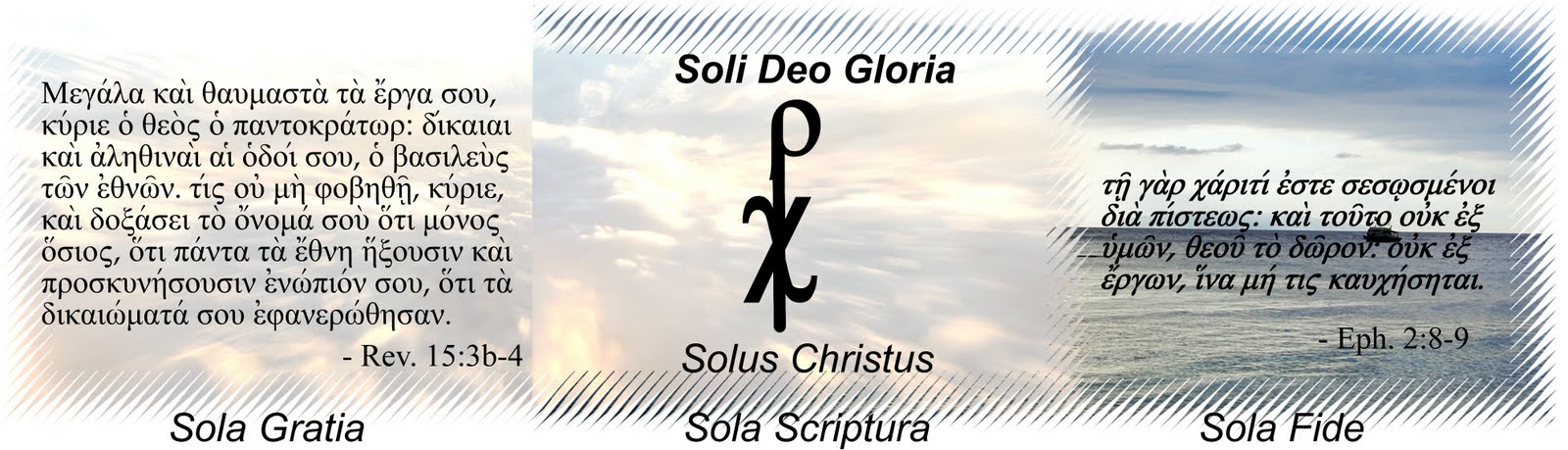
Applied to the issue of doctrines, new believers need to know about Scripture, the Gospel and God. Yet because their faith is tacit, this means that their knowledge would conform to the orthodox understanding of all these despite being shallow versions of them. There would however be no baby Christians, in fact no Christians at all, who will hold to heretical views on any of these three points. While baby Christians do not understand what is homoousis and homoiousis, they would not hold to the Aryan position once they understand what it actually teaches. Similarly, no Christian would willingly embrace Pelagianism or Semi-Pelagianism (being denials of the Gospel), and no Christian would knowingly attack the inerrancy of Scripture and embrace Neo-Orthodoxy. Scripture, Gospel and God — embraced in the five solas, remain the definitive line diving Christianity from all false religions. Neo-Orthodoxy deny Sola Scriptura, Pelagianism and Semi-Pelagianism deny Sola Gratia Sola Fide, while Aryanism/ Jehovah Witnesses deny Solus Christus.

One consequent of this teaching is that there are probably more saved laity than saved clergy in heaven since the clergy "have educated themselves into perdition". It is thus possible for laity in Word-faith churches to be saved while their pastors are not. Not only is theological education fraught with inherent difficulties, it may even be the means by which professing believers enter perdition especially if they enter a liberal or neo-orthodox seminary, otherwise nicknamed "cemetery". [HT: Joel Tay]

It is therefore submitted that this idea of tacit faith (as opposed to implicit faith) is a useful Witsian concept to enable us to understand how faith and knowledge relate to salvation. Tacit faith is biblical, while implicit faith is not. The seed of faith (regeneration) within us germinates and brings forth good fruit of which growth in knowledge of God is one.
Truth a necessary fruit of true faith

But we ought always to give thanks to God for you, brothers beloved by the Lord, because God chose you as the firstfruits to be saved, through sanctification by the Spirit and belief in the truth. (2 Thess. 2:13)

We have previously seen that true biblical faith (as opposed to mystical "faith") consists in trusting wholeheartedly in Christ and His Word as found in the Scriptures. On the other hand, true knowledge is possible despite our fallen-ness, and knowledge of the Gospel is essential for salvation. The question is then raised, what is the relationship between faith and truth?

The secular idea of faith is the existential or Kierkegaardian one, whereby knowledge is not only not related to faith but inimical to it. Faith is considered a "blind leap" whereby we believe regardless of the facts (and possibly even contrary to it — "leap of faith"). If however biblical faith is to submit to God and His Word as we have previously seen, then such a conception of faith is not only suspect, but even dangerous to believers. In point of fact, the two concepts of faith (Kierkegaardian and biblical) are antithetical to each other, such that embrace of the one would exclude the embrace of the other.

We have already established that some knowledge of Christianity, i.e. the Gospel, is necessary unto salvation. Yet, we are being saved by faith alone, not faith plus knowledge. A contradiction seems inevitable, until we peek into the mechanics of faith itself.

Modern Reformed theologians define faith as being made up of knowledge (cognitio), assent (assentia) and trust (fiducia). While disputes over the third element remain (mainly between Van Tillians and Clarkians, since historically Reformed theologians have not been so clear cut over the exact ontology of faith — See Herman Witsius' discussion on the subject for example in his Economy of the Covenants III.7.8 - III.7.24, or John Calvin in his Institutes of the Christian Religion, III.2), the focus here would be on the first two parts of faith in light of Scripture,

In 2 Thess. 2:13, we are told that we are "to be saved"... "through... belief in the truth" (πιστει αληθεια). If our salvation comes through the instrument of believing the truth, then faith if it is alone must include the element of "belief in the truth". In fact, since "faith" and "belief" have essentially the same Greek root (πιστις), we see that "truth" is the object of faith. Knowing however that Christ is the object of our faith (ie. Acts 20:21) and that Christ is the incarnated Logos (Jn. 1:1,14), we see therefore that Christ and truth are linked (Jn. 17:17). To belief in Christ is to believe in truth, and to believe in truth is to believe in Christ; to believe in Christ is to trust His Word in Scripture (Jn. 1:1, 2 Tim. 3:16, 2 Peter 1:21) as truth, and vice versa.

Since such is the case, faith includes a preliminary belief in the truths of the Gospel, and a progressive growth in knowledge and assent to the truths of the Christian faith. Epistemologically, Christ can only be known through His Word the Scriptures, and therefore to claim to know God more yet not to know more truths regarding Him is a self-contradiction in terns. Faith and truth are therefore not existential. While certainly they are more than intellectual, they are not less than that.

Truth therefore is a fruit of true faith. Without faith it impossible to please God (Heb. 11:6). Knowing the correlation between faith and belief in the truth, we can also say that "without understanding and assenting [and trusting] the truth it is impossible to please God". Mysticism in whatever form is therefore not of God. Even if supposed 'great men of God' (i.e. the Desert Fathers) taught and practiced them, such practices are not of faith.

Wednesday, July 28, 2010

Faith and the problem of perspectivalism

When the Spirit of truth comes, he will guide you into all the truth, for he will not speak on his own authority, but whatever he hears he will speak, and he will declare to you the things that are to come. (Jn. 16:13)

Scripture is truth (Jn. 17:17). [Absolute] truth is therefore available to us in the pages of Scripture. However, even if truth is available to us, how do we know whether we are reading it alright in the pages of Scripture?

One basic notion of perspectivalism lies in the fact that human beings are subjective creatures. All facts are interpreted by us through the lens of our distinctive culture, context and worldviews, and nowhere is this seen more than the case of the usage and interpretation of language. Each of us therefore frame our own individual perspective on things, and it is this subjective human element of interpretation that plaques the quest for truth. Even if absolute truth is present, can we as finite creatures attain it?

The knowledge of absolute truth thus hits a stone wall. How can we as finite subjective humans attain to objective truth? In the case of Christian knowledge, how can we interpret Scripture to get absolute truth, knowing that our interpretation is necessarily tainted by our perspectives?

Scripture gives us the answer to this question. In Jn. 17:8, the words of Christ establish the truth in us regarding Him. The words of Christ are now mediated by the Holy Spirit (Jn. 15:26) who will lead us into all the truth (Jn. 16:13). The Spirit therefore guides our interpretation of Scripture and enable us to understand what He has previously breathed-out (2 Tim. 3:16). In this way, we can come to know absolute truth.

The problem of perspectivalism therefore does not affect Christianity. Rather, knowledge is attainable because the only objective person (God) has condescended to tell us the truth. By biblical child-like faith (as opposed to mysticism), we submit to God and His Word and are able to know the truth as the Spirit guides us.

Sunday, July 25, 2010

Faith and Knowledge against Inclusivism

In the 5th session of the Faith and Knowledge series, the relation between knowledge and truth was examined. In this light, we looked briefly at the teaching of Inclusivism — which in its most generic form teaches that people can be saved apart from conscious belief in Jesus Christ, and rejected it as heresy.

In Jn. 17:3, it is written:

And this is eternal life, that they know you the only true God, and Jesus Christ whom you have sent (Jn. 17:3)

The motif of eternal life in the Gospel of John always refers to salvation from sin and eternal damnation. In Jesus' high priestly prayer, Jesus explicitly tells us what eternal life is and will thus be manifested as. Eternal life or salvation is manifested in knowing God and Jesus Christ who is sent by God.

If that is indeed the case, then some knowledge of God and of Jesus Christ which is personally embraced by the knower (the biblical idea of knowledge includes personal and relational acceptance of the truth of such knowledge - cf Amos 3:2) must be seen in salvation. If the two are correlated as Jn. 17:3 shows it to be, then there cannot be any salvation/eternal life for those who do not intellectually know and personally accept the truths of the Gospel. Without conscious knowledge of Jesus Christ and His Gospel (nevermind belief), they can be no salvation for anyone at all.

Heb. 9:27 is the final nail in the coffin for the heresy of Inclusivism. Judgment comes immediately (not temporarily but experientially) after death, and thus there are no second chances for anyone to have a "postmortem conversion". Those who do not have conscious faith in Christ in this life do not have eternal life, and do not have any second chance to "gain" eternal life after their earthly life have passed.

Once we see that salvation is linked to knowledge and truth (one of the key points for that session), the error of Inclusivism is easily disposed of, no matter how nuanced and sophisticated the heretics made Inclusivism out to be. Salvation always is by faith which must always include knowledge (cognitio) and assent (assentia), and therefore Inclusivism is most certainly wrong in that light. It is only when faith is made out to be some mystical "spiritual" thing that the door to Inclusivism is opened, which it seems happens in some supposed and so-called Evangelical circles.

Saturday, July 24, 2010

Faith: Childlike faith

While in the process of adjusting to a different life over in Escondido, I think it would be good to go through some concepts that I have gone through in the Faith and Knowledge Bible study series for my cell group.

One of the concepts that we looked at was the concept of child-like faith. In evangelical circles, it has been heard that we should have child-like faith and not question too much. Instead, blind faith is sufficient. Just like a child does not know a lot but just blindly trust parents and those in authority, so we should not be too critical and instead just accept all that our pastors teach us. The sheep are then focused on "practical applications", while eschewing doctrinal truth which are meant for "theologians", a supposed ultra-elite class of super-Christians who are near infallible in their doctrinal pronouncements, functioning as the de facto mediator between Christ and the laity.

Of course, the Scriptures teach nothing of that sort — a fiction which is sadly prevalent in many authoritarian societies (especially in Asia) where those in authority are respected almost to the point of unquestioning obeisance.

So what exactly is this child-like faith as taught in Scripture?

At that time the disciples came to Jesus, saying, “Who is the greatest in the kingdom of heaven?” And calling to him a child, he put him in the midst of them and said, “Truly, I say to you, unless you turn and become like children, you will never enter the kingdom of heaven. Whoever humbles himself like this child is the greatest in the kingdom of heaven (Mt. 18:1-4)

In this passage, the main quality highlighted by Jesus is that of humility, as stated in verse 4. To become like children or to have child-like faith in this context means to be as humble as children. While of course there are proud children in this world, the focus is on the nature of young children in general. Young children trust their parents' word as truth, and act upon it as such. They do not think that they know it all, but rather admit what they do not know and fall back on their parents.

In the same way, the essence of child-like faith is humility before God. Humility before God means trusting in Him and obeying His Word, not questioning it and rebelling against it. Instead of thinking that we know what is best, we should submit to God and His Word even when it doesn't make sense at the moment.

Child-like faith therefore implies humility before God's Word. With regards to knowledge therefore, child-like faith means that the believer holds to God's Word as true even though Scripture is being attacked by many unbelievers some of whom may even be within the churches. Christians take God's Word as the axiom of all of life, knowing that regardless of what men say, 'Let God be true though every one were a liar' (cf Rom. 3:4).

Instead of promoting anti-intellectualism therefore, the essence of child-like faith is not ignorance but rather humility before God in using His Word as the basis of our knowledge. Child-likeness therefore relates to the attitude which we bring to God's Word and the foundation of our knowledge rather than the quality or quantity of knowledge gained. Far from discouraging knowledge, child-likeness is the godly attitude for the building up of true knowledge of God, of Man and of the world. Such would yield good fruit that conforms with true godliness and salvation.

In this light, to cause "one of these little ones" to sin as stated in verse 6 is indeed a terrible thing indeed. Since the essence of child-like faith is humility before God and His Word, the sin in verse 6 is to question God's Word and undermine its authority. Higher criticism, Liberalism and Neo-Orthodoxy all destroy or gut the Word of God of its authority in the lives of believers. By making the thoughts and prejudices of men the arbiter of which Scripture is inspired (ie. inerrant, infallible in every jot and tittle) and which are not, such "scholarship" destroys child-like faith in those who accept and believe them. For those who propagate such doctrines of demons, it would be better for them to have great millstones thrown around their necks and to be drowned in the sea (Mt. 18:6).

In conclusion, child-like faith is not what many have made it out to be. It is humility before God and His Word, and nowhere inimical to growth in knowledge but rather the only godly basis for growth in true knowledge.

Sunday, January 17, 2010

The marks of true faith: Fiducia? Or?

[continued from here and here]

In Reformed circles, there has been a controversy regarding the nature of saving faith — whether it be dipartite (two parts) or tripartite (three parts). Both sides accept cognitio and assentia in the definition of faith. Those who follow Van Til (the majority) tend to add fiducia as a third element of faith, while Gordon Clark denied fiducia as being a proper element, not disagreeing with the concept but subsuming it under the element of assentia, noting that adding it as an element is tautological, since the root of Fiducia is Fide, which is basically Latin for "faith".

While the debate would properly not go away any time soon, no matter how much Van Tillians would like that to be, where does Witsius land on this issue?

According to his The Economy of the Covenants, Witsius does not put trust (Fiducia) as one of the elements of faith. Following on knowledge (cognitio) (III.7.8) and assent (assentia) (III.7.11), the next "acts of faith" are "love of the truth" (III.7.17), then followed by "a hunger and thirst after Christ" (III.7.18), "a receiving of Christ the Lord for justification, sanctification, and so for complete salvation" (III.7.19), "recline and stay itself upon him [Christ]" (III.7.21), "surrender to Christ" (III.7.23), and to "conclude, that Christ with all his saving benefits are his" (III.7.24). A careful reading of Witsius however show us these other acts of faith are indeed ACTS of faith, not elements of faith. Starting from the third act of the "love of the truth", we read thus:

It is indeed true, that love, strictly speaking, is distinguished from faith; yet the act of both virtues, or graces, are so interwoven with one another, that we can neither explain nor exercise faith without some acts of love interfering; ... (III.7.17. Vol. 1, p. 381)

These other acts of faith therefore are rather the fruits of faith, not the elements of faith strictly speaking.

However, between discussing the second and third acts of faith, it can be seen that Witsius qualifies the assentia of saving faith by linking them with the idea of it having substance, using the Greek word ύποστασις (of which the nuance cannot be fully expressed when translated) to modify the assent that is required. In Witsius' words:

XIII. The term, ύποστασις hypostasis substance, is also very emphatical, which the apostle makes use of when he speaks of faith, Heb. xi. 1. Nor have the Latins any word that can fully express all its force and significancy. 1st Ύποστασις hypostasis denotes the existence, or, as one of the ancients has said, the extantia, the standing up of a thing; in which sense philosophers say that a thing that really is has an ύποστασις, that is, real existence, and is not the fiction of our own mind. An indeed faith makes the thing hoped for, though not actually existing, to have, notwithstanding, an existence in the believer's mind, who so firmly assents to the promises of God, as if the thing promised was already present with him. ... And [John] Calvin's interpretation looks this way; faith, says he, is hypostasis, that is, a prop or possession on which we fix our feet. ... And indeed there is something in faith that can with intrepidity sustain all the assaults of temptations, and not suffer it to be moved from an assent to a truth once known. Now it we join all this together, we may assert, that faith is so firm an assent to divine truth, as to set things future before us as if they were present, and that it is a proper to the soul on which it fixes its foot without yielding to any assault whatever. (III.7.18. Vol. 1, pp. 378-379. Emphases original)

From what can be seen, Witsius does not seem to fit any of the two categories. Maybe we should change the term "fiducia" (trust) to "hypostasis" (substanced confidence?)??

The marks of true faith: Assentia

In a previous post on the nature of saving faith, I have expounded a bit on the element of cognitio which is basic to the concept of saving faith. In this post, I would continue with Witsius' second element of saving faith: Assentia, which has been alluded to already in the previous post.

XI. To this knowledge must be joined assent, which is the second act of faith, whereby a person receives and acknowledges as truths those things which he knows, receiving the testimony of God, and thus setting to his seal, that God is true, John iii. 33. This assent is principally founded on the infallible veracity of God, who testifies of himself and of his Son, 1 John v. 9, 10. On which testimony revealed in scripture, and shedding forth all around the rays of its divinity, the believers relies with no less safety than if he had been actually present at the revelation of these things. For when the soul, enlightened by the Spirit, discerns those divine truths, and in them a certain excellent theoprepy, or beauty worthy of God, and a most wise and inseparable connection of the whole, it cannot but assent to a truth that forces itself upon him with so many arguments, and as securely admit what it thus knows, for certain, as if it had seen it with its own eyes, or handled it with its own hands, or had been taken up into the third heavens, and heard it immediately from God's own mouth. Whatever the lust of the flesh may murmur, whatever vain sophists may quibble and object, though perhaps the soul may not be able to answer or solve all objections, yet it persists in the acknowledgment of this truth, which it saw too clearly, and heard too certainly, as it were from the mouth of God, ... . And this faith is accompanied with ύποστασις, substance, and βεγχος [sic] evidence, Heb. xi. 1. and πληροφορια, full persuasion or assurance, Rom. iv. 21. (III.7.11. Vol. 1, pp. 377-378. Emphases original)

Assent according to Witsius consists in "receiving the testimony of God, and thus setting to his seal, that God is true". Not only is there knowledge of what is true (cognitio), but such knowledge must be taken to be sealed in the person who knows that truth based upon the "infallible veracity of God", not mere human reasoning. In other words, saving "assent" does not function in the same manner as the "assent" which functions according to the framework of humanistic rationalism — that "assent" which only accepts whatever is true based upon what seems "rational" to fallible human presuppositions. Rather, saving "assent" functions out of the axiom of God and of His Word, and receives Christianity as true because that is its epistemic foundation. (ie. Christianity is not be argued for, but argued from).

This assentia manifests in new believers in an interesting way, which Witsius utilizing 2 Peter 1: 16, 18 speaks of: that believers "perhaps ... may not be able to answer or solve all objections, yet it persists in the acknowledgment of this truth, which it saw too clearly, and heard too certainly, as it were from the mouth of God". Just as cognitio does not require complete knowledge of God and the Faith, neither are they required for the aspect of assentia. Ironically therefore, assentia has the dubious honor of making new believers (and believers also) seemingly stupid and foolish in the eyes of the world. Barring the few Christians scholars and theologians and philosophers, who through Spirit-given wisdom silence the unregenerate and earn their hatred, most Christians will look like anti-intellectual fools in the eyes of the world. Nevertheless, as Scripture says, "For the foolishness of God is wiser than men", it is better to be foolish on God's side, than wise on Man's side.

Friday, January 15, 2010

The marks of true faith: Cognitio

I have been laboring through Herman Witsius' The Economy of the Covenants between God and Man: Comprehending a Complete Body of Divinity recently. This two volume work is Herman Witsius' (1636-1708) magnum opus, and reported to be one of the best volumes of Covenant Theology from the continental Dutch Reformed tradition.

In volume 1 Book III, Chapter VII — Of Faith, Witsius writes about what faith actually is. The first component of faith is what is typically termed cognitio or knowledge. On this aspect, Witsius wisely states:

... it must be confessed, that in the present dark state of our minds, even the most illuminated are ignorant of a great many things; and that many things are believed with an implicit faith, especially by young beginners and babes in Christ, so far as they admit, in general, the whole scriptures to be the infallible standard of what is to be believed; in which are contained many things which they do not understand, and in as far as they embrace the leading doctrines of Christianity, in which many other truths concenter, which are thence deduced by evident consequence, and which they believe in their foundation or principle, as John writes concerning believers, that they knew all things, 1 John ii. 20. ... (III.7.9. Vol. 1, p. 376. Bold added)

Witsius in this instance addressed the issue of "implicit faith", which is the faith of new believers who would know little of the Christian faith. If faith does includes cognitio, then saving faith must have certain cognitive contents in it in order for a person to be saved. No doubt new believers know little about the faith, yet they cannot be saved without some amount of knowledge.

Witsius thus distill the faith to two things mentioned here: 1) a belief in the Scriptures as the Word of God, and 2) "leading doctrines of Christianity". What are these "leading doctrine of Christianity"? According to Witsius, who in the next paragraph explains himself:

Moreover those things which are necessary to be known by the person who would believe, are in general, the divinity of the scriptures, into which faith must be ultimately resolved; more especially, those things which regard the obtaining of salvation in Christ; which may summarily be reduced to these three heads: 1st To know, that by sin thou art estranged from the life of God, and art come short of the glory of God, Rom. iii.23. That it is not possible, that either thou thyself, or an angel from heaven, or any creature in the world, nay, or all the creatures in the universe, can extricate thee from the abyss of misery, and restore thee to a state of happiness. 2dly. That thou shouldst know Christ this Lord to be full of grace and truth, John i.14. who is that only name given under heaven, whereby we can be saved, Acs. iv. 1. and in the knowledge of whom consists eternal life, John xvii. 3. 3dly. That thou shouldst know, that, in order to thy obtaining salvation in Christ, it is necessary that thou be united to Christ, by the Spirit and by faith, and give up thyself to him, not only to be justified, but also sanctified, and governed by his will and pleasure, proving what is that good, and acceptable, and perfect will of God, Rom. xii. 2. (III.7.10. Vol. 1, p. 377. Bold added)

The "leading doctrines of Christianity" is nothing more than the Gospel; the "obtaining of salvation in Christ". The two things that all Christians, even new born believers, are to believe in are 1) that the Bible is the Word of God, 2) the Gospel of salvation.

If cognitio includes that, therefore by deduction those who deny one or the other cannot be true believers since they do not have true faith. For the first, while new believers certainly do not know the intricacies of the doctrine of Scriptures and its inspiration, yet they have a childlike trust that the Bible is indeed the Word of God. In the second, they do not have to know the intricacies of salvation either, of depravity, election etc, but they know that they are sinners and God saves them through the Cross of Jesus Christ.

According to Witsius' criteria therefore, all peoples and groups who deny the above two criteria are false believers in danger of the fires of hell. Denials of the first criteria would include the Neo-Orthodox, the Romanists, the Eastern Orthodox, the Liberals, Neo-Liberals and Post-Liberals and Post-Conservatives and Emergents. Denials of the second criteria include many if not all of the above groups as well, as well as Classical Arminians, Pelagians, Semi-Pelagians, Socinians, Universalists etc. Furthermore, since the Gospel message has as its object God, those who distort the doctrine of God are out as well since they cannot believe the true Gospel. That throws out all the Sabellians, Nestorians, Arians and all who do not subscribe to the Definition of Chaceldon.

"Implicit faith" or the faith of new Christians is indeed simple. Yet, a multitude of errors exist which destroy through denial or redefinition the simple "faith statements" in the cognitio element. It is indeed a sad reality that many professing believers educate themselves into hell instead of heaven, proving in themselves that "For the gate is wide and the way is easy that leads to destruction, and those who enter by it are many." (Mt 7:13b). May we therefore keep watch over our life and doctrine and so manifest that we have the true saving faith in Christ instead of the false faith which damns. Amen.

Sunday, December 13, 2009

Understanding essential to faith

Q. 72. What is justifying faith?

A. Justifying faith is a saving grace, (Heb. 10:39) wrought in the heart of a sinner by the Spirit (2 Cor. 4:13, Eph. 1:17-19) and Word of God, (Rom. 10:14-17) whereby he, being convinced of his sin and misery, and of the disability in himself and all other creatures to recover him out of his lost condition, (Acts 2:37, 16:30, Jn. 16:8-9, Rom. 6:6, Eph. 2:1, Acts 4:12) not only assenteth to the truth of the promise of the gospel, (Eph. 1:13) but receiveth and resteth upon Christ and his righteousness, therein held forth, for pardon of sin, (Jn. 1:12, Acts 16:31, 10:43) and for the accepting and accounting of his person righteous in the sight of God for salvation (Phil. 3:9, Acts 15:11)

(Westminster Larger Catechism)

Over on the meta of the post on the further compromise of J.I. Packer, a comment has been made on the salvation status of Roman Catholics in general and Mother Theresa in particular. In order to defend that, a statement has been made to the effect that "Prescribing a level of understanding for salvation is in fact salvation by works". However, is that so?

When we come to the Scriptures, we can see the motif of faith and belief (basically based upon the same root word in Greek - pistis) being essential to salvation. Salvation is by believing in Christ - by having faith alone in Christ apart from works (Eph. 2:8-9, Rom. 4:4-6). Works have no part in saving us, though of course salvation would manifest itself out in good works (Eph. 2:10, Jas 2: 14-26), but the two must be distinguished and not confused.

However, what exactly is faith? Our distractor has said that faith excludes a level of understanding. However, is that really biblical? Is faith a leap in the dark like what the existentialist Soren Kierkegaard has maintained? Or is it something else?

In traditional Reformed parlance, faith is said to be made up of three parts: cognitio (knowledge), assentia (assent), and fiducia (trust). While there is dispute over the usage of the third term fiducia, a look at Gordon Clark's book The Johannine Logos (Jefferson, MA, USA: Trinity Foundation, 1989), pp. 99-117, would show that the contention is more with regards to psychology than the actual meaning of faith itself. Regardless, our focus here is the idea of cognitio, which means understanding of the propositions of the faith. In the area of salvation, this would of course mean understanding of the propositions of the Gospel. Is understanding of the Gospel essential to salvation?

As the Westminster Larger Catechism puts it, faith is "being convinced of his sin and misery, and of the disability in himself and all other creatures to recover him out of his lost condition, (Acts 2:37, 16:30, Jn. 16:8-9, Rom. 6:6, Eph. 2:1, Acts 4:12) not only assenteth to the truth of the promise of the gospel, (Eph. 1:13) ..." Faith thus includes the idea of cognitio, or understanding the propositions of the Gospel, as the proof-texts also show. There is thus absolutely no way to be saved without knowing and understanding the Gospel, which is part of faith itself. Since that is so, it is anti-intellectual and blatantly unbiblical to say that "Prescribing a level of understanding for salvation is in fact salvation by works". To be saved, one must have a level of understanding of the Gospel, and such is not works but the way in which faith is expressed in the believer.

Some may attempt to refute that by saying that faith is belief in Christ, not believe in propositions. But what exactly is "belief in Christ"? In Jn. 11-14, the Word was made flesh in the person of Jesus Christ, thus belief in Christ IS belief in the Scriptures. To separate the Logos theopneoustos (the Inscripturated Word) and the Logos ensarkos (the Incarnate Word) is thus a grievous error.

Faith thus include belief in the propositions of the Gospel. As such, we can know for sure that all who do not believe in the Gospel, much less those who had not heard of it, cannot be saved. It is supremely irrational and unbiblical to state that those who have not heard the Gospel in false churches can be saved, of which the Roman Catholic church is the epitome of false teaching, with the Pope being the Antichrist (WCF, Chapter XXV Of the Church, Paragraph VI).