Showing posts with label Textual Criticism. Show all posts

Tuesday, September 01, 2015

Warfield on Inerrancy and Preservation of Scripture

It is another curiosity of the controversial use of a phrase, to find the Church's careful definition of the complete truth and trustworthiness of the Scriptures as belonging, as a matter of course, only to the genuine text of Scripture, represented as an appeal from the actually existing texts of Scripture to a lost autograph—as if it were the autographic codex and not the autographic text that is in question. Thus, we have heard a vast deal, of late, of "the first manuscripts of the Bible which no living man has ever seen," of "Scriptures that have disappeared forever," of "original autographs which have vanished"; concerning the contents of which these controversialists are willing to declare, with the emphasis of italics, that they know nothing, that no man knows anything, and that they are perfectly contented with their ignorance. Now, again, if this were to be taken literally, it would amount to a strong asseveration that the Bible, as God gave it to men, is lost beyond controversy; and that men are shut up, therefore, to the use of Bibles so hopelessly corrupted that it is impossible now to say what was in the original autographs and what not! [B.B. Warfield, "Inerrancy of the Original Autographs," in Selected Shorter Writings, 2:583]

(1)There is nothing new under the sun. Warfield could have been describing Bart Ehrman if we didn't know the time period he was writing it.

(2) Preservation of Scripture pertains to the text of Scripture, not to the codex of Scripture. Therefore, the absence of the original autographs are not a problem at all. Since we have so many textual evidences, there are few issues with establishing the original text of Scripture among the many variants.

(3) The KJVO (King James Version-Only) position accepts the liberal axiom that an authoritative Scripture require an authoritative codex of Scripture. Whereas the liberals denies the existence of an authoritative codex, and thus they deny the authority of the text of Scripture, KJVOnlyism asserts that there MUST be an authoritative codex (i.e. the King James Version) because otherwise there would not be an authoritative text of Scripture.

Tuesday, October 28, 2008

Mistranslations in the NIV and TNIV?

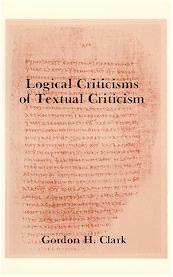
Logical Criticism of Textual Criticism

In my review of the book Logical Criticism of Textual Criticism, Dr. Gordon H. Clark has pointed out the mistranslation of two texts in the book of Hebrews in the NIV — namely Heb. 1:5 and 11:11. I had then decided to check out the bible versions themselves electronically on the Biblegateway website. What I saw confirmed the claims of Dr. Gordon Clark and places serious doubts on the fidelity of the NIV and TNIV (which claims to be an improvement over the NIV) at least at those two verses.

Here are the verses in the different versions:

For to which of the angels did God ever say, “You are my Son, today I have begotten you”? (Heb. 1:5a — ESV)

For to which of the angels did God ever say, "You are my Son; today I have become your Father"? (Heb. 1:5a — NIV)

For to which of the angels did God ever say, "You are my Son; today I have become your Father"? (Heb. 1:5a — TNIV)

and

By faith Sarah herself received power to conceive, even when she was past the age, since she considered him faithful who had promised. (Heb. 11:11 — ESV)

By faith Abraham, even though he was past age—and Sarah herself was barren—was enabled to become a father because he considered him faithful who had made the promise (Heb. 11:11 — NIV)

And by faith even Sarah, who was past childbearing age, was enabled to bear children because she considered him faithful who had made the promise. (Heb. 11:11 — TNIV)

As I have said in my review:

As it can be seen, the NIV and TNIV in Heb. 1:5a changed the traditional phrase "begotten you" to "have become your Father", which alters the meaning of the text rather significantly. There is a footnote there giving the rendering of "begotten", but the question then is why is the phrase "have become" used here, since there is no textual variant that can be translated "have become" here? Furthermore, this footnote is found only in the NIV not in the later TNIV, so why is that the case?

With regards to Heb. 11:11, the distortion of the text in the NIV and the TNIV is simply amazing. The NIV comes up with a complete novel proposition and places the correct rendering in a footnote, all done without any textual rationale for doing so. The TNIV which is later and supposed to be better reverts back to the correct rendering of the passage (which is good), but inexplicably it places the false rendering of the passage in a footnote for the text! So much for improvement of the NIV! Oh well, I guess swapping the text and footnote text is an improvement after all, but still in error.

So what do the NIV and TNIV supporters have to say about this?

Book reviews

I have just finished reviews of two interesting books that I have read recently. The first is a review of the book The Market Driven Church by Udo W. Middelmann, which can be found here.

The second review is of the book Logical Criticism of Textual Criticism by Gordon H. Clark, which can be found here.

Logical Criticism of Textual Criticism

As it can be seen from this book, anyone with even a bit of knowledge on textual issues can see that there is a difference between the textual critical methodology as utilized by Westcort, Hort, Metzger, Aland etc, and the text-types (Byzantine, Alexandrian, Western etc) contributing to the variant readings of the texts.

[Btw, if anybody discovers any link whatsoever that I have missed out to the blog of that irrational, cowardly and reprobate anonymous idiot who calls himself Antithesis (fulfilling Jude 1:10 and 2 Peter 2:12), please inform me so I can delete those links.

But these people blaspheme all that they do not understand, and they are destroyed by all that they, like unreasoning animals, understand instinctively. (Jude 1:10)

But these, like irrational animals, creatures of instinct, born to be caught and destroyed, blaspheming about matters of which they are ignorant, will also be destroyed in their destruction, (2 Peter 2:12)]