Showing posts with label Bible versions. Show all posts

Tuesday, February 21, 2017

The Vulgate, the King James Version, and the natural propensity towards venerating a single Bible version

II. True, there are varying opinions among the papists as to the sense of this decree [Council of Trent, Session 4, Decree 1 –DHC]. Some maintain that no comparison is made between that version and the source, but only with other Latin versions then in use; … Others maintain that it is absolutely declared to be authentic (so that there is no better) and is to be preferred to all editions in whatever language and, even by it the original codices (as corrupt) must be emended; as Cano, Valentia, Gordon, Gretser, Suarez and others. But whoever attentively considers the words of the decree will easily perceive that it leads to the latter opinion. … [Francis Turretin, Institutes of Elentic Theology, 2.XV.2]

It is interesting to note here that Tridentine Roman Catholicism suggests correcting the original codices (Greek and Hebrew) according to the Latin Vulgate. Such a move is what we see today in Fundamentalist King James Version Only (KJVO) circles. Evidently, it seems to be a human impulse that shifts from treasuring the Bible in the translation one knows or studies, into venerating that particular translation as being THE only Bible, even to the extant of correcting the ancient manuscripts according to the Bible version one is elevating, be it the Vulgate, or the King James Version.

Thursday, February 02, 2017

The ESV and Genesis 3:16

To the woman he said, “I will surely multiply your pain in childbearing; in pain you shall bring forth children. Your desire shall be contrary to your husband, but he shall rule over you.” (Gen. 3:16 ESV 2016)

The ESV committee has recently, last year, proposed an amendment to Genesis 3:16 that caused quite a bit of an uproar among those who see the changes as being not driven by the text but for ideological reasons. The insinuation, being that the change came temporally after the bulk of the EFS (Eternal Functional Submission) controversy, was that it was to prop up some version of EFS. How should we deal with this text and, more broadly, what should we make of the ESV?

Concerning the text itself, the changed text is one possible translation of the original Hebrew, that interprets the preposition ל as "contrary to," which is A possible interpretation. For me, personally, I prefer the more ambiguous translation "to." That said, since the amended text is A possible translation, based upon Susan Foh's interpretation in her WTJ (Westminster Theological Journal) article, that translation is plausible and thus there is no reason at all to kick up a big fuss over the issue.

The only reason why certain segments of the Reformed world kicked up such a big fuss over the issue is because it came upon the heels of the EFS controversy. The hysteria in certain segments the Reformed blogosphere over the changes in the ESV (here's one example) is really a sad thing. For those of us who are interested in the truth, there is no reason to subscribe to such hysteria, especially since those who attack EFS continually misrepresent their opponents. Since that is the case, the question concerning the ESV is this: Does the change in Genesis 3:16 compromise the translation of the original Hebrew? I would say not. At the same time, by making it less ambiguous, the change makes the ESV less literal. For those who want to study the Bible deeply, this change is one strike against the amended ESV. But for pastors and preachers, such changes are less important to us since, after all, we are supposed to be focused on the text in the original languages, and amend the English versions in our preaching as and when the occasion arise. Pastorally, such amendments should not be done too often lest we undermine the congregation's trust that they have the Word of God in English, which is why a more literal translation is preferred. But one amendment in Genesis 3:16 is not going to be a lot. As long as we are not correcting every other word in the Bible translation, which is why we need to use a good faithful English translation in the church's corporate worship, the people's trust in their Bibles will be preserved. The interpretation of one preposition in Genesis 3:16 does not take away from the fact that the ESV is still a good faithful translation of the text, and thus there is no reason why it should not continue to be used by English-speaking Christians.

As for me, I will continue to use and to support the use of the ESV as an excellent bible translation in English. I also hope that the Reformed world will not succumb to hysteria and continue using this translation. For me also, my ESV Bible app on my smartphone continues to give the original translation of "to" while my printed ESV bible is of the older version, so I do not have to deal with this issue for the foreseeable future, and hopefully never will.

Tuesday, May 28, 2013

A New NAR "translation" of the Bible

If you can't get around what the Scriptures say, it seems the next best way is to change what the Scriptures says. NAR (New Apostolic 'Reformation') "apostle" Brian Simmons has produced his own Bible "translation," the Passion Translation, which is exposed as altering the actual words of Scripture (See here, here, here and here).

The advertising blurb advertises it as "A dynamic-equivalent translation of the Holy Scriptures — From the ancient Hebrew, Aramaic, and Greek into modern English." Notice that it advertises itself as a dynamic-equivalent translation. In other words, it is supposed to translate the meaning from the original language to the target language. Therefore, a D-E (or F-E "functional equivalent") translation only has to preserve the meaning of the Hebrew, Aramaic and Greek texts, and can disregard the actual original words.

I have been against the Dynamic Equivalence methodology ever since I dealt with Rick Warren's Scripture twisting through the use of multiple translations. This "translation" of the Bible is the perfect example for my objections, even better than the Message translation paraphrase. While one can blame NavPress for hyping up the Message while Eugene Peterson actually intended it to be a paraphrase, one cannot do the same for the Passion "translation," which is both intended and marketed as a Bible version.

The D-E/ F-E methodology is flawed because meanings are taken to have no real relations with words. In their attack against the Formal-Equivalent methodology, which looks day by day more like a strawman based upon positivism (aka the early Wittgenstein), F-E advocates emphasize the importance of meaning over form, and claim that Formal Equivalence leads to wooden translations. The problem is that no one who actually knows more than one language (as languages, not code) does "wooden" translation. No one who translates languages like languages actually prioritize form over meaning. Rather, we reject the Platonic idea that one can divorce meaning from form, and then do translation as if form is totally irrelevant to meaning. When one divorces meaning from form, you get "translations" such as the Passion Translation. Upon what basis can a D-E/ F-E advocate dispute that the Passion Translation is not a legitimate translation, since Simmons will just claim that, although the words are not the same, yet the meaning is there? With the endorsement of Che Ann and James W Goll, this "translation" will go places within the Charismatic circles.

Do not be deceived! Instead of getting around what the Scriptures teach, it seems the new trend is to just produce one's own translation, and then claim that one is actually translating the true meaning of the text of Scripture. Most Christians don't read the original languages anyway, so claiming that the teachings in one's Bible 'translation' is actually found in the original text will confuse many of these Christians.

Thursday, July 12, 2012

The Message Study Bible?!

It has been said that Eugene Peterson's The Message is a paraphrase, and thus it has no say in the discussion over translational methodology. Well, somebody should inform the guys over at NavPress then. Introducing ... The Message Study Bible which is described as a "best-selling contemporary translation" of the Bible, not a paraphrase.

I content that The Message, and others like them, are the logical consequent of the Dynamic-Equivalence methodology. Since only the meaning is important, D-E proponents can only object to the Message by disputing that the meaning has actually been properly translated and conveyed. But upon what basis are we to prefer their interpretation of the meaning over the interpretation of Eugene Peterson's? Peterson after all is not a mere layman and had taught at Regent College! Are we going to stay at the level of word games?

Only when we repudiate this flawed philosophy and realize that meanings are not Platonic forms which exist apart from words (and is derived from them) can we properly repudiate the Message as a distortion of the Scriptures. Words and forms are important, even though we do not translate them woodenly. If we disregard them as accidental to the meaning, as the D-E translational methodology does, we have severed the link between language and meaning, and end up with neither.

Tuesday, July 10, 2012

The pastoral implications of translational choice and philosophy

In preparing sermons, the preacher's goal is to exegete the meaning of the text in the original languages, communicate the sense to the congregation, and apply the text for the edification of the congregation. The choice of the Bible translation to use is thus very important for the task of preaching.

Since the goal is to exegete and expound the text, using a good translation of the Bible in the vernacular is very important. Practically speaking, does anyone wants to read the Bible text in, let's say English, and then correct it later in his sermon by saying, "Actually, a better translation would be ....," and then change the English text? Such would erode the confidence the people in the pew have over their Bibles. The impression given is that the Bibles they use do not actually convey the true sense of God's Word since the pastor is frequently correcting it. Therefore, what the Bible actually says is not available to them since most lay people don't know Greek and Hebrew.

But must the preacher change the English text? Since we are to proclaim God's Word, how can we not do so when something that the Bible teaches cannot be seen if one uses a non-literal translation of the Bible? Must we then omit teaching a truth of the Bible if it cannot be seen in a translation of the Bible that the people happen to be using? I hope not.

An alternative method promoted by the proponents of the Dynamic-Equivalent translation methodology is to use many versions and commentaries. Such would allow a person to get a much fuller sense of what a certain verse actually teaches. To this we ask: Is this even feasible in the context of preaching a sermon? Is doing a Rick Warren, in using multiple "translations" of the Bible, actually a good thing?

Utilizing many translations of the Bible in a sermon sound great initially. When one wants to teach a certain truth, one just finds the Bible translation that best teaches that truth. One therefore will not be seen to be correcting the Bible in order to expound the teaching of the biblical text.

Such reasoning however is flawed. First of all, not all Bible "translations" actually states what God's Word says. How can one know whether the pastor is choosing a particular translation because it happens to teach what he wants to say, which is not actually found in the Scriptures? Rick Warren uses "translations" such as the Message to give his teaching legitimacy, although the Bible does not actually teach what the Message claims it teaches. So how can the normal lay person in the pew actually discern if the pastor is using a particular version because that version actually expresses the sense of Scripture, or if the pastor is using that version because that version actually says what the pastor wants to teach regardless of whether the Scriptures actually teach it? To be able to discern, the lay person needs to know the original languages, and so we are back to ground zero.

The second flaw in such reasoning is this: How can one know which translation for which verse expresses the sense that is most accurate to that in the original text? Perhaps for one verse the NASB expresses the sense best, while for the next verse the NLT best expresses the sense, but how can the average layperson decide? In a sermon, presumably one can trust the pastor's choice of translation for a passage or verse. But not having any knowledge of the original languages, how can a normal person discern when he studies the Bible for himself? Use a commentary? So which commentary is the lay person supposed to treat as his personal magisterium to tell him what the Scripture teaches?

The fact of the matter is that the translational philosophy and methodology of Dynamic or "Functional" Equivalence actually erodes the confidence believers have in Scripture. It practically destroys the idea that Scripture is perspicuous, and creates new magisteria for the individual believer. Of course, the choice of a good translation utilizes the wisdom of scholars and theologians. But the role of scholars and theologians is to be an instrument to hand the lay people the Word of God so they can read it on their own for their own understanding. It is not the role of scholars and theologians to hand the lay people many "translations" and then tell them they have to return to them in order to understand what the Word of God actually teaches, since these "translations" are sometimes very diverse in what they claim the Word of God teaches. Scholars and theologians mediate the Word of God by preparing the Word of God in the language of the common people, and then the Word of God is to do its work! They are not to usurp the authority of the Spirit of God in making themselves the magisteria and the ones who will guide you through the maze of translations they have themselves created.

That is why it is very important to choose a good literal translation. The whole objection by the progressive "Functional Equivalence" promoters that all translation is interpretation totally misses the point! It misses the difference between lexical interpretation, which seeks to preserve as much of the original words as possible, and no-holds-barred interpretation, where whole phrases are interpreted according to what one *thinks* the Bible is actually teaching. It is the difference between holding that the Scriptures are above us and we should not presume to fully understand all the Scripture is saying, therefore preserving the text as much as possible, and between thinking that one has already fully comprehended the words of the text and thus is able to alter the words to make the meaning explicit. The former understands that our manner of knowing of God's truth is analogical. The latter thinks that our manner of knowing God's truth (not the content of God's truth itself) is univocal.

If we desire to expound God's truth while keeping the confidence of lay people in the Bible translation that they have, we should use an accurate translation of the Bible so that we do not have to change the wording every so often. True, some nuances cannot be seen because of the nature of translation, but it is one thing to explicate a nuance, and another thing to change the wording of a translation altogether.

Such therefore is the crux of the difference in translational philosophy and methodology. It is for the love of Christ's church that I stand for essential literal translations such as the ESV. We do not want any magisterium of scholars to stand between God's people and God's Word. True, God's people need guidance to understand God's Word, but guidance (through Bible study, tradition and their pastor) is not the same as being the foundation! We guide them by showing them how Scripture teaches what it teaches, and through the instrument of guidance the Spirit of God reveals the truths taught by the Word of God. Instrument is not grounds. Scholars, theologians, pastors are all instruments for the communicating of God's truth, not the grounds for its communication.

The Church must therefore seriously consider the Bible translation they are to use. Seriously consider the issue, so that scholars, theologians and pastors continue to be instruments for communicating the truth of God's Word, and God's people continue to be confident in their ability to read and understand the Scriptures.

Saturday, February 11, 2012

Presbyterian Church of Pakistan rejects "contextualized" versions removing "Father" and "Son"

The Presbyterian Church of Pakistan (PCP) has produced a statement denouncing the attempt by SIL (Summer Institute of Linguistics) or Wycliffe Bible Translators to produce a translation removing the words "Father" and "Son." As Rev. Dr. Altaf Khan, Acting Moderator of the PCP, wrote,

I, Rev. Dr. Altaf Khan, the Acting Moderator of Presbyterian Church of Pakistan [PCP] would like to bring into your attention the recent translation issues brought by Summer Institute of Linguistics [SIL] or Wycliffe Bible Translators.

The controversy arose when the idea of contextualization was first floated by SIL. In the name of contextualization, SIL intended to remove Father or Son from the future translated versions citing that some local Muslims can only see sexual connotations to these terms. PCP in its General Assembly held in November 2011 [around 200 Church leaders participated], executive meeting [around 30 Church leaders] and multiple gatherings in different cities where Christian leaders from all denominations participated, has publicly condemned such justifications for the sake of convenient translation.

[more]

As I have said many times before here, the root cause of such mis-translations is the erroneous translational philosophy of Dynamic-Equivalence/ Functional-Equivalence. If you embrace the D-E philosophy and methodology, since all translation is interpretation, therefore the translators gets to decide what they think is the meaning of the word/phrase/sentence. When there is conceived some form of abstract "meaning" that is not bound to the words themselves, then the translator is cut free from the idea of fidelity to the text. Instead of fidelity to the text, the fidelity is to the "meaning" of the text whatever that is conceived to be.

In this case, the translators of Wycliffe have evidently thought that the normal words "Father" and "Son" have a sexual connotation, and therefore it is not suitable. Since the idea is to translate the "essence" or "meaning" of the term "Father" and "Son," therefore any word which they perceive to communicate that meaning will do the job, even if they in fact do not communicate that meaning.

Absent fidelity to the text, fidelity to "meaning" means that the translators gets to interpret the text and translate the perceived meaning. D-E translations therefore are highly subjective interpretations of the biblical text, where the imagination can literally run wild as happened in "translations" such as the Voice. D-E advocating conservatives who object to the translation choices as not translating the meaning are merely pitting their interpretation against the interpretation of the translators, and why should one be held out as closer to the truth over the other? After all, the translators I would think genuinely think that their translation choice IS the one which best express the meaning of the word/phrase/sentence that they are translating! Absent connection to the text, no objective ground can be appealed to.

Let us look at the poisoned fruit of D-E philosophy and methodology, and reject it.

[HT: Apprising Ministries]

Tuesday, November 15, 2011

Dynamic Equivalence and its practice

Those who read my blog would know that I am against the practice of Dynamic Equivalence (D-E) or Functional Equivalence (F-E) in the practice of Bible translation. To prove my point that the entire translation philosophy is flawed, here is another mess which shows why F-E translations turn out to be neither functional nor equivalent.

"And a voice came,'You are my beloved Messiah; with you I am well pleased.'" This declaration is the familiar pronouncement of God's favor upon Jesus, at the time of his baptism.

Well, not quite. That verse is actually from the Injil Sharif.

The group in Bangladesh represents what is known in missions circles as an "Insider Movement." Advocates of these initiatives say their followers believe Jesus as Savior, yet remain inside their families, networks and communities, retaining the socio-religious identity of that group." The idea of encouraging believers to "remain" within Islam and "retain" their identity as a Muslim is one of the most controversial issues in missions today. Arguably the most contentious practice of some of these groups is to produce Bible translations that remove familial language for God, due to the offense Muslims have towards the idea that God is Father and Son. Thus, "Son" is removed from Mark 1:11 to read in the Bangladeshi translation, "You are my beloved Messiah."

...

When translators take it upon themselves to decide what the meaning of the text is apart from the words of a text, we will get only the interpretations of the translators about what THEY think the text mean, not what the text actually mean. From my experience however, the F-E proponents just cannot get this point, thinking that just because lexical interpretation is necessary therefore every form of interpretation is necessary in translation.

Sunday, May 09, 2010

Problems with Funcational Equivalence in the translation of sarx

In the book How to Read the Bible for all its Worth by Gordon Fee and Douglas Stuart, the authors attempt to aid the ordinary layperson in reading the Bible. For all its good intentions however, the book is a mixed bag, and problems creep in when the authors decide to confuse guidance with interpretation.

In Chapter 2 on the need for a good translation, Professor Gordon Fee attempts to guide Christians through the plethora of English Bible translations available on the market. The problems however arise when translation and interpretation become confused. Fee in this book heavily promotes the TNIV, a much more liberal version than the NIV (which can be termed the Nearly Inspired Version), and it is in this aspect that we see in sharper detail the error of Functional Equivalence.

I have addressed the issue of Bible translations in the past briefly, and it is my view that "Functional Equivalence" translations mostly are not functional and are most definitely not equivalent. Prof. Fee provides us with an example which I would like to look at: the Greek word σαρξ.

On page 43, Fee compares the translations of the phrase κατα σαρκα (kata sarka) in 2 Cor. 5:16 and made the claim that the TNIV/NIV correctly translate the verse. However, is that really so?

Therefore from now on we recognize no one according to the flesh; even though we have known Christ according to the flesh, yet now we know Him in this way no longer (2 Cor. 5:16 - NASB)

From now on, therefore, we regard no one according to the flesh. Even though we once regarded Christ according to the flesh, we regard him thus no longer (2 Cor. 5:16 - ESV)

So from now on we regard no one from a worldly point of view. Though we once regarded Christ in this way, we do so no longer (2 Cor. 5:16 - NIV)

So from now on we regard no one from a worldly point of view. Though we once regarded Christ in this way, we do so no longer (2 Cor. 5:16 - TNIV)

Ὥστε ἡμεῖς ἀπὸ τοῦ νῦν οὐδένα οἴδαμεν κατὰ σάρκα: εἰ καὶ ἐγνώκαμεν κατὰ σάρκα Χριστόν, ἀλλὰ νῦν οὐκέτι γινώσκομεν (2 Cor. 5:16 - UBS 3rd Ed.)

The two literal translations (ESV and NASB) have translated the phrase κατα σαρκα literally as "according to the flesh". The NIV and the TNIV however have decided to translate this as "from a worldly point of view". Fee and other advocates of Functional Equivalence (F-E) believe that this is the best conceptual interpretation of the phrase "according to the flesh" since they deem that phrase incomprehensible to the majority of people today.

Let us discuss the translation for the moment, ignoring the philosophy behind it which I have discussed before. According to the F-E own standards, does the newly minted phrase "from a worldly point of view" is even the meaning taught in 2 Cor. 5:16? The answer is sadly no. The "flesh" in Scripture has nothing to do with "sinful nature" or "worldly point of view". In fact, the "flesh" refers merely to the idea of physical humanness — that which is physically of humans. The entire contrast in 2 Cor. 5:16 is not about God and the world, but about true reality and the the appearance conveyed by our physical bodies. 2 Cor. 5:16 therefore can be better interpreted to teach that we regard no one as seen from their physical status, and that though we had once judged Christ based upon the physical appearances, we do so no longer.

The NIV and TNIV mis-translation for this particular verse with its rendering into the term "worldly" subtly introduces the idea of worldliness and evil into the text. The "flesh" however as used in Scripture is not necessarily sinful but just the physical nature component of men, for otherwise Christ himself would be sinful (cf 1 Tim. 3:16). In like manner, 2 Cor. 5:16 does not say that the flesh is necessarily worldly or anything of that sort, but is is merely stating that we are not to regard people according to their human characteristics and physical appearances. Such mis-interpretations of sarx have more in common with Gnostic ideas about the evil of physical bodies rather than that of biblical Christianity.

The NIV/TNIV translation of 2 Cor. 5:16 is in error. According to F-E's own criteria, the NIV/TNIV translation fails. In a bid to "simplify" and "clarify" Scripture, the F-E translators have instead become the de facto new Magisterium by which they interpret Scriptures on our behalf (sometimes wrongly too as in the case of sarx). Even if one follows their own stated Bible study method of using multiple translations, by virtue of the fact that the F-E translations claim to translate the "sense" of the passage means that their interpretations would be regarded as the default and even best interpretations of the text, which may not be the case.

In ending, the rest of the book suffers from a similar problem. Fee in his chapters frequently conceptually interprets where exegesis should be done, promoting his characteristic doctrines as he move through Scripture. This became intolerable when he starts pontificating on controversial topics such as his promotion of Egalitarianism in pages 82-86, contrary to the biblical position of Complementarianism. While we can respect his desire to promote his position on this topic in his egalitarian books, it is morally repugnant that he does so in a book that is supposed to be teaching Christians how to read Scripture, as if his interpretation of Egalitarianism is THE way to read Scripture and all others are not. It is for such conceptual interpretations which permeate sections of the book that this book is not recommended for young Christians wanting to know how to read the Bible, a pity since such books would be really helpful.

Wednesday, December 10, 2008

Poll: Gender-neutral 'bible translations'

gender neutral bible versions

It has been some time since the last poll (and there wouldn't be a new one for some time). Anyway, the poll question was "What is your view on 'Gender neutral' or inclusivist Bibles ie the TNIV?" The response is indeed good and shows that at least most of the readership are not for such "versions" of the Bible, with 37/65 or 56% stating that it panders to the feminist agenda and anther 9/65 or 13% stating that such a translation is less literal. The 6 people that stated that such versions would be better translations entered the poll early and are probably the anything-goes group who are supporters of the theory of Dynamic Equivalence which I was interacting with then. All in all, a good poll.

Thursday, November 27, 2008

Response to Mike regarding the flawed methodology of Dynamic Equivalence

Over at the meta of the post on Extreme Theology about The Voice perversion, a fellow by the name of Mike left a rather lengthy reply to my attack on the Dynamic Equivalence (D-E) translational methodology. In this post, I would like to interact with what he has said about the topic and defend my position on this issue. Mike said:

Fact #1: There is a difference between translation and interpretation.

Fact #2: All Dynamic Equivalence (D-E) translations distort God's Word in some way or another

Fact #3: The Voice is the logical conclusion of the D-E philosophy as worked out through the interpretative matrix of the Emergents.

Fact #4: All that the D-E proponents can say is that they disagree with the interpretation and think that it is in error, but their position commits them to arguing about conceptual error without having anything to say about translational error.

As a linguist who has studied Greek, language in general, communication theory, translation theory, semantics, and meaning, I must say that these "facts" reflect very little knowledge of what it takes to transfer the meaning of the original text into another language. I am also not any sort of postmodernist or emergent anything. I am a translator. I do not care for the voice - I think its crap, but that doesn't give anyone the excuse to think that dynamic (which is the wrong word, the correct one is "functional") translation distort scripture. Please forgive me for saying so, but that's show a complete lack of awareness of how language and meaning function.

Fact #1 is false. Any change from one language to another requires interpretation - ANY CHANGE. When you translate even a single word someone always interprets. Since we're in John, let's look at λόγος (logos). What does it mean? One might say that it means word. That's it, right? No interpretation there. Not a chance. To accurately translate the word from Greek, we must look at its usage. Let's see what the lexicon says about λόγος.

Louw & Nida suggest there are ten different senses of the word:

  1. "that which has been stated or said, with primary focus upon the content of the communication—‘word, saying, message, statement, question.’"
  2. "the act of speaking—speaking, speech.’"
  3. " the content of what is preached about Christ or about the good news—‘what is preached, gospel.’"
  4. "a relatively formal and systematic treatment of a subject—‘treatise, book, account.’"
  5. "a title for Jesus in the Gospel of John as a reference to the content of God’s revelation and as a verbal echo of the use of the verbs meaning ‘to speak’ in Genesis 1 and in many utterances of the prophets—‘Word, Message.’"
  6. "a record of assets and liabilities—‘account, credit, debit.’"
  7. "a reason, with the implication of some verbal formulation—‘reason.’"
  8. "a happening to which one may refer—‘matter, thing, event.’"
  9. "that which is thought to be true but is not necessarily so—‘appearance, to seem to be.’"
  10. "a formal declaration of charges against someone in court—‘charges, accusation, declaration of wrongdoing.’"

Now when a translator chooses one of these definitions to apply to a given instance of the word in the text, he makes an interpretive decision. "Now wait a moment," you say, "Look at definition #5." I'm not making an interpretation, the lexicon says what John means. Now that's true, if a translator follows that route and simply takes the definition that the lexicon uses, he's not making an interpretation. But someone still is. And in this case, its the the compile of the lexicon. If the translator goes that route, then he's simply allowing the authors who dug through the usage of λόγος to make the decision for them. That's still interpretation. Its just someone else's. Let's hope they got it right - for the sake of the people using your translation.

Fact #2 is false. Or I should say, its too limited. ALL translation of any kind distorts the source text. Our Greek commenter in the comment above could surely tell you that even the ESV fails to convey all the meaning of the original text - And I'd being will to say that even translations that update the New Testament into Modern Greek loose some of the original meaning. That's because language is culturally conditioned. There is not good way to translate the Greek phrase typically rendered "casting lots" into English because we don't have "lots." The closest cultural equivalent is "drawing straws." But translating such phrases that way would misrepresent the cultural activity. Or consider an example from the ESV - Psalm 1:1

"Blessed is the man who walks not in the counsel of the wicked, nor stands in the way of sinners..."

In English the phrase, "stand in the way of sinners" conveys the idea of blocking someone from going somewhere or doing something. We stand in people's way as a preventative measure. But in Hebrew, the idiom means the exact opposite. To stand in the way of someone in Hebrew means to follow along after them, doing what they do. Now you might say that someone whose been in the church will be taught that. But why should the meaning of a translation have to be explained or taught? If you have to explain the meaning after you translate, doesn't that destroy the point? Isn't the purpose of translation to convey meaning? All translations distort meaning.

Fact #3 is false. The claim that The Voice is the logical conclusion of Dymanic translation simply proves that the person wrote the "fact" doesn't truly know what Dymanic translation is. And in fact, that term "dynamic" itself hasn't been used by translators since the 80's because the term caused so much misunderstanding for those who weren't professional translators. The correct term is "Functional Equivalence Translation." And this method (not philosophy) of translation is based on the work of hundreds of translations in hundreds of languages around the world. Here are the fundamental principles of Functional Equivalence translation theory:

  1. Each language possesses certain distinctive characteristics which give it a special character, e.g. word-building capacities, unique patterns of phrase order, techniques for linking clauses into sentences, markers of discourse, and special discourse types of poetry, proverbs, and song. Each language is rich in vocabulary for areas of cultural focus and the specialties of people.
  2. To communicate effectively [which, I hope everyone can agree is the goal of translation] one must respect the genius [see #1] of each language.
  3. Anything that can be said in one language can be said in another, unless the form is an essential element of the message. For the average person the potential and actual equivalence of languages is perhaps the most debated point about translation. He does not see how people who have no snow can understand a passage in the Bible that speaks about "white as snow." If the people do not know snow, how can they have a word for it? And if they do not have a word for it, then how can the Bible be translated? ... The point is that snow as an object [grammatically speaking] is not crucial to the message.
  4. To preserve the content of the message the form must be changed. This is quite apparent when we look at words λόγος "word, message, etc." No English word looks or sounds like that Greek word and has the same meaning. The form of words must be changed. It follows quite easily that the form of phrases much be changed and that the form of clause must be changed. Translators must as the question, how do native speakers of the target language express this meaning. What if a language doesn't have participles? Does it become harder to translate Paul's letters which are full of them? No, because the meanings expressed by participles are expressed by other forms - the forms must be changed.
  5. The languages of the Bible are subjct to the same limitations as any other natural languages. Greek and Hebrew are sipmly languages, like any other languages, and they are to be understood and analyzed in the same manner as other ancient tongues. They both possess extraordinarily effective means of communication, even as all languages do.
  6. The writers of the Biblical books expected to be understood (even the author of Psalm 1:1).
  7. The translator must attempt to reproduce the meaning of a passage as understood by the writer. This is true regardless of the form of the target translation. And this foundational principle of Functional translation theory make makes it impossible for a translation such as The Voice to be the logical conclusion of the D-E philosophy - regardless of who is working it out emergent or otherwise the Voice cannot be a Functional translation if it fails to convey the passage as understood by the writer.

All these points were directly taken (with commentary) from Eugene A. Nida and Charles R. Taber's The Theory and Practice of Translation (Leiden: Brill, 1974), 3-8.

Fact #4 is false I find it interesting that this claim is made when the writer show so little awareness of what Functional Equivalence translation truly. The fact is, the F-E translation process, as performed by such international translation organizations such as Wycliffe/SIL, the United Bible Society, Pioneers Bible Translators etc., have multiple error checking sessions where translations are checked and checked for translation errors for every single book of scripture. This results in probably hundreds of translation error check even for s single New Testament, much less the Old!

Get your facts straight about F-E translation before you talk about it. Go reading something written about translation from someone who studied linguistics, translation, and communication.

Before I begin my response, I will freely admit that in terms of academic qualifications and competence in the original languages, I am not as good as Mike. I am currently in the process of learning Greek and my knowledge of Hebrew is non-existent. Yet, regardless of the topic, all doctrine must be logically coherent and consistent with the rest of the doctrines of Scripture, and it is my opinion that the translational methodology called Dynamic Equivalence by itself is flawed because it undermines the doctrine of the authority and essence of Scripture, which I will hopefully show as we go along.

The first issue to deal with is Mike's insistence on using the term "Functional Equivalence" as opposed to "Dynamic Equivalence", since the methodology embraced by the D-E/F-E proponents claims to translate the funtional meaning of the original languages into the text in the receptor language. The reason why I refuse to do so is because I do not agree that such a methodology does actually fulfil its goal. Therefore, while they claim that they are translating the functional meaning of the text, I disagree that their methodology does in fact translate the functional meaning of the text. Since I disagree that their methodology can indeed achieve their goal, I would rather use their previous nomenclature of "Dynamic Equivalence" which I think is a better description of what they are actually doing.

Without further to do, let's logically analyze Mike's points, and then I will wrap up the issue with the theological aspect of the issue.

Fact #1 is false. Any change from one language to another requires interpretation - ANY CHANGE.

It seems that Mike has not realized yet the difference between lexical interpretation and conceptual interpretation. Of course, any change from one language to another requires interpretation. That is NOT the issue I was driving at. Lexical interpretation requires that each individual word or phrase is translated from one language to another and string together according to the grammer of the receptor language in a manner that parallels the structure of the source language as closely as possible. In other words, lexical interpretation tries not to change or alter any of the words/ expressions in the sentence being translated. Conceptual interpretation however tries to make theological/ philosophical sense out of the sentence and renders it in such a way that the essence of the sentence shines through. THAT is the issue, not whether any type of interpretation is required at all.

Mike follows through with a look at the translated meaning of the word logos in John 1:1. Before touching on the difficult-to-translate words however, can it be agreed firstly that simple words are to be translated literally? The issue here is this: Is Mike trying to use difficult-to-translate Greek words and phrases as a case study in order to make a conceptual translation the norm, instead of making such cases an exception? The Greek word logos after all is a word utilized in Greek philosophy among others, and thus is NOT an easy word to translate. But what about relatively simple words like kai, huios or machaira?

So even if (not that it will be) some form of conceptual interpretation is required to translate the Greek word logos, that does not prove Mike's point at all. Our contention has always been that as little conceptual translation should be done at all times, and thus pointing to exceptions in order to invalidate the norm is plainly in error.

As a bilinguist myself (English and Chinese), and having learned a bit of Japanese and German before, let me just say that there is indeed a world of difference between lexical translation and conceptual translation. Just as an example using Chinese (a language very different from any of the Western languages in many ways), here is how you can translate the following phrase from the Nicene Creed:

And in one Lord Jesus Christ, the only begotten Son of God, begotten of his Father before all worlds, God of God, Light of Light, very God of very God, begotten, not made, ...

Translated lexically:

和一主耶稣基督,上帝的独生儿子,全部星球之前而上帝所生,神之神,光之光,实在的神之实在的神,受生,非创造出来的,...

Translated conceptually:

和独一主耶稣基督,上帝的独生子,在万世之前为天父所生,出于神而为神,出于光而为光,出于真神而为真神,是受生,乃非被造,...

For those who know Chinese, the first sentence should sound strange but it is still perfectly understandable. Unfortunately, I do not know any other language good enough to do translation in such a manner so I will not attempt any example for those who cannot read Chinese; you just have to take my word for it that the first example IS indeed what is considered an essentially literal translation from the English (not Latin) which utilizes only lexical translation. Note also that the fact that the languages (English and Chinese) are very much dissimilar does not mean that lexical translation is NOT possible.

So let us look at Mike's argument regarding logos (λόγος):

Since we're in John, let's look at λόγος (logos). What does it mean? One might say that it means word. That's it, right? No interpretation there. Not a chance. To accurately translate the word from Greek, we must look at its usage. Let's see what the lexicon says about λόγος.

Louw & Nida suggest there are ten different senses of the word:

  1. "that which has been stated or said, with primary focus upon the content of the communication—‘word, saying, message, statement, question.’"
  2. "the act of speaking—speaking, speech.’"
  3. " the content of what is preached about Christ or about the good news—‘what is preached, gospel.’"
  4. "a relatively formal and systematic treatment of a subject—‘treatise, book, account.’"
  5. "a title for Jesus in the Gospel of John as a reference to the content of God’s revelation and as a verbal echo of the use of the verbs meaning ‘to speak’ in Genesis 1 and in many utterances of the prophets—‘Word, Message.’"
  6. "a record of assets and liabilities—‘account, credit, debit.’"
  7. "a reason, with the implication of some verbal formulation—‘reason.’"
  8. "a happening to which one may refer—‘matter, thing, event.’"
  9. "that which is thought to be true but is not necessarily so—‘appearance, to seem to be.’"
  10. "a formal declaration of charges against someone in court—‘charges, accusation, declaration of wrongdoing.’"

Now when a translator chooses one of these definitions to apply to a given instance of the word in the text, he makes an interpretive decision.

As I have mentioned earlier, the word logos is a difficult-to-translate word. Dr. Gordon H. Clark has written an entire book primarily focused on it especially as it is used in the first chapter of John, in the book The Johannine Logos, 2nd Ed. (Trinity Foundation, Jefferson, Maryland, USA, 1989). So pointing out that there are difficult Greek words to translate which thus require interpretation does not mean that requiring interpretation is the norm.

However, Mike's example fails to even prove an exception to the rule since the word logos is only one Greek word, and thus the interpretation needed here is restricted to lexical interpretation. Whatever the interpretation of the word logos, the translated verse in any good English translation would read: "In the beginning was the ____, and the ____ was with God, and the ____ was God". Mike's example is therefore refuted.

Fact #2 is false. Or I should say, its too limited. ALL translation of any kind distorts the source text. Our Greek commenter in the comment above could surely tell you that even the ESV fails to convey all the meaning of the original text

Mike here equivocates on the meaning of the word "distorts". "Distort" as a word implies that the translation alters the meaning in such a way that the new meaning is contary to the original meaning, not the losing of certain minute nuances and distinctions in the source langage which is a new definition of the word "distorts" Mike uses.

As I have mentioned in earlier posts, so I will raise this issue again. Upon what basis can D-E versions like the NLT remove the word "sword" (Greek machaira) found in Rom. 13:4? Doesn't this not distort the message of the verse if indeed Rom. 13:4 is suppsed to teach capital punishment and just war theory? We will re-visit this particular verse later.

There is not good way to translate the Greek phrase typically rendered "casting lots" into English because we don't have "lots."

Context! Context! Context! I remember understanding the meaning of "casting lots" when I was a young boy about 20 years or more ago without being taught what it was, and nobody I knew cast lots then. The problem is that few wants to read the passage in context first before trying to decipher and understand what any particular verse and phrase means.

"Blessed is the man who walks not in the counsel of the wicked, nor stands in the way of sinners..."

In English the phrase, "stand in the way of sinners" conveys the idea of blocking someone from going somewhere or doing something. We stand in people's way as a preventative measure. But in Hebrew, the idiom means the exact opposite. To stand in the way of someone in Hebrew means to follow along after them, doing what they do. Now you might say that someone whose been in the church will be taught that.

Again, Context is key! I do not particularly see why translations have to be done such that any lazy person can choose a verse at random and is supposed to be able to understand what it says without reading the context and anything else!

But why should the meaning of a translation have to be explained or taught? If you have to explain the meaning after you translate, doesn't that destroy the point? Isn't the purpose of translation to convey meaning? All translations distort meaning.

If the person refuses to learn for himself and wrestle with the text to get the answers, then that he has to be taught is his own fault. Intellectual laziness is not a virture, and I do not see why we have to ammend our translational philosophy to accomodate such lazy people! Just by the way, the ESV did not distort the meaning of the verse Ps. 1:1; it is the intellectually and spiritually lazy people who refuse to do their homework who eisegete the text.

Fact #3 is false. The claim that The Voice is the logical conclusion of Dymanic translation simply proves that the person wrote the "fact" doesn't truly know what Dymanic translation is. And in fact, that term "dynamic" itself hasn't been used by translators since the 80's because the term caused so much misunderstanding for those who weren't professional translators. The correct term is "Functional Equivalence Translation."

As I have mentioned, I refuse to call it Functional Equivalence because functionally equivalency is not truly acheived. Previously, I have raised the issue of Rom. 13:4, of which the verse reads as follows:

for he is God's servant for your good. But if you do wrong, be afraid, for he does not bear the sword in vain. For he is the servant of God, an avenger who carries out God's wrath on the wrongdoer. (Rom. 13:4 — ESV)

The authorities are God’s servants, sent for your good. But if you are doing wrong, of course you should be afraid, for they have the power to punish you. They are God’s servants, sent for the very purpose of punishing those who do what is wrong (Rom. 13:4 — NLT)

As it can be seen, the NLT omits the word "sword" in its translations, instead rendering it as the phrase "power to punish you". Now, the Greek word machaira which means sword is present in the Greek New Testament, so there is no good reason why it should be altered since there is no ambiguity over what machaira is.

Enters the D-E translational philosophy. According to their express goal, they desire to translate the verse in such a way that the verse in English should accurately and functionally represent the meaning in the receptor language. However, what if the idea of capital punishment for example is meant to be taught by Paul in Rom. 13:4? Has the D-E philosophy as practiced in the NLT succeeded in " reproduce the meaning of a passage as understood by the writer"? No, it doesn't and as such the functional equivalence is not present in the verse in translations such as the NLT.

It may be objected that capital punishment is not taught in Rom. 13:4 at all. However, that is only the objector's interpetation of Rom. 13:4, but others have interpreted the verse differently to teach capital punishment. So therefore, is this case of Rom. 13:4 a matter of one's personal theology driving one's translation? In their bid to translate so as to reproduce the meaning of a passage, doesn't the D-E philosophy give rise to the spector of the translators' views on various matters and doctrines to drive their translation, as it has apparently happened in Rom. 13:4 in the NLT? The D-E philosophy therefore facilitates placing one's theology before the text, instead of deriving one's theology from the text.

And this foundational principle of Functional translation theory make makes it impossible for a translation such as The Voice to be the logical conclusion of the D-E philosophy - regardless of who is working it out emergent or otherwise the Voice cannot be a Functional translation if it fails to convey the passage as understood by the writer.

Again, who or what determines what is the meaning as understood by the writer? The Emergents who penned this Bible certainly and truly believe that they are "reproducing the meaning of passages as understood by the writers"! Is this going to be a battle of competing authorities then? Or maybe something along the lines of "I know Greek and Hebrew better than you" type of argumentation?

Fact #4 is false I find it interesting that this claim is made when the writer show so little awareness of what Functional Equivalence translation truly.

Mike here does not seem to understand what is the difference between translation, lexical interpretation and conceptual interpretation and thus misses the entire point of fact number 4. Contrary to what he says, I do know about F-E translational philsophy, but I reject the name because it is a misleading term which does not deliver at times like the example of Rom. 13:4 seen above, and therefore I revert back to the proper description of D-E.

The fact is, the F-E translation process, as performed by such international translation organizations such as Wycliffe/SIL, the United Bible Society, Pioneers Bible Translators etc., have multiple error checking sessions where translations are checked and checked for translation errors for every single book of scripture. This results in probably hundreds of translation error check even for s single New Testament, much less the Old!

Nobody is saying that D-E translations are choke full of errors. Yet also, the appeal to committees is fallacious becuase numbers mean little when it comes to truth. It has been said that if you dislike what one scholar says, just find five scholars from the opposite camp to endorse your position or translational choice to counter the influnce of that one negative vote. In the making of such D-E versions, has there been any consultations from scholars of the essentially literal camp (not scholars who work on essentially literal translations)? Probably not! When a group of scholars who are already committed to the D-E philosophy engage in error-checking, the only thing that can be surmised is that that group of scholars share the same opinion on that one verse. Imagine if a group of Arminian/Semi-Pelagian D-E scholars come together to translate Rom. 9 for example? Instead of saying "Jacob I loved, but Esau I hated", the translation would read "Jaboc I loved, but Esau I loved less"!

Now we go on to the theological aspect of this issue. I have mentioned in the beginning that the D-E philosophy undermines the doctrine of the authority and the essence of Scripture. How this is true is apparent especially when we look at the case of Rom. 13:4. How can the NLT version of Rom. 13:4 be trusted to teach all of God's truth when it has already narrowed the interpretative options of the text and omit the possibility of capital punishment from being considered as a legitimate interpretative option? If capital punishment is part of God's truth, then the NLT version of Rom. 13:4 has removed this aspect of God's truth from the text of Scripture. A truth removed from the all-suffucient truth of Scripture would render the text not sufficient since there is one truth missing, and therefore the essence of Scripture is undermined. It matters little actully in this discussion context whether capital punishment is truly taught but more of the D-E methodology resulting in interpretative options which may be biblical being removed. As stated, the text should drive our theology, not the other way around. D-E philosophy, sadly to say, allows Man to do the latter.
Sunday, November 23, 2008

More proof that D-E philosophy lends itself to the defense of the distortion of God's Word

Over at Extreme Theology discussing the horrible "translation" called The Voice, a commenter by the name of O.H. Lee wrote this:

As one competent in biblical language, this is the exact reason why I say: There's no such thing as bible translations — only bible commentaries.

The question then is, does the text accurately reflect the origional [sic] Greek? The answer here is clearly, no; especially how it takes massive liberties with the passive voice. I read whole sections of this. It's no longer a bible but propoganda [sic] for pop-Christianity, and an unfaithful commentary disembodied from the original text.

To which I replied,

O.H. Lee,

"As one competent in biblical language, this is the exact reason why I say: There's no such thing as bible translations — only bible commentaries."

Looks like you are one of the anything-goes crowd who do not know how to differentiate between lexical interpretation and conceptual interpretation, as Leland Ryken expounded in his article in the book Translating Truth by Grudem et al.

Fact #1: There is a difference between translation and interpretation.

Fact #2: All Dynamic Equivalence (D-E) translations distort God's Word in some way or another

Fact #3: The Voice is the logical conclusion of the D-E philosophy as worked out through the interpretative matrix of the Emergents.

Fact #4: All that the D-E proponents can say is that they disagree with the interpretation and think that it is in error, but their position commits them to arguing only about conceptual error without having anything to say about translational error.

As this exchange shows, the pernicious erroneous translational philosophy of Dynamic Equivalence undermines any serious attempt to condemn any so-called "translation" like The Voice, which is nothing but a distortion of God's Word. After all, the D-E proponents have opened the Pandora's Box for all and sundry distortions of Scripture, and their only weak protests to distortions such as The Voice is that they reject the interpretation of the Greek (and Hebrew) texts offered by the Emergents. But.... if all "translation" is actually interpretation, upon what basis can the D-E proponents reject the interpretation offered by the Emergents who penned The Voice? Oh yes, the argument will shift to the original languages. Somehow this sounds similar (not same) to the argument of Rome pre-Reformation as to why the Scriptures should not be translated to the vernacular. Instead of the official Magisterium now however, we have the "evangelical scholars" to tell us what IS and what IS NOT the correct interpretation of the text!

Update: See comment thread where O.H. Lee clarified his comment as one of cynicism.

Friday, November 21, 2008

The Voice: The Emergent 'translation'...

If you think that the Message was bad, try this new "version" of the Bible done/promoted by the Emergents from Thomas Nelson publishers called The Voice.

About the Voice:

Chris Seay's vision for The Voice goes back 15 years to his early attempts to celebrate the beauty and truth of the biblical narrative. As western culture moved into what is now referred to as postmodernism, Chris struggled with a deep desire to preach the whole story of God. Much like the Hebrews at the time of the New Testament, emerging generations today connect with story rather than isolated facts. Too often, preaching is reduced to articulating truth statements somehow hidden in a complex, powerful, and redemptive story. Jesus taught through parables and metaphors; modern Christians have attempted to translate His teaching into a system of irrefutable fact statements and something seems to be getting lost in the translation.

Hence, a group of writers, poets, scholars, pastors, and storytellers have committed to work together to bring the Scriptures to life in a way that celebrates both beauty and truth.

The result is a retelling of the Scriptures: The Voice, not of words, but of meaning and experience.

The Voice is a fresh expression of the timeless narrative known as the Bible. Stories that were told to emerging generations of God's goodness by their grandparents and tribal leaders were recorded and assembled to form the Christian Scriptures. Too often the passion, grit, humor, and beauty has been lost in the translation process. The Voice seeks to recapture what was lost.

From these early explorations by Chris and others has come The Voice, a Scripture project to rediscover the story of the Bible. Thomas Nelson Publishers and Ecclesia Bible Society have joined together to stimulate unique creative experiences and to develop Scripture products and resources to foster spiritual growth and theological exploration out of a heart for the mission of the church and worship of God.

They are making the Gospel of John version online for free so you can look at their creative distortion "interpretation" of the Word of God.

Here is a look at the "translation" of Jn. 1:1 from this new Emergent translation:

Before time itself was measured, the Voice was speaking. The Voice was and is God (John 1:1 -The Voice)

Chris Rosebrough on his radio show has critiqued this New Emergent Translation (beginning about 50 minutes into the show) and posted one comparison of John 1:9-14 on this blog here. I agree with Chris that this version "is a text that obscures the gospel, distorts Jesus substitutionary work on the cross, teaches Pelagianism and promotes a liberal form of works Righteousness".

Just as a side note, those who deny the ability of language to perfectly convey truth (Neo-Orthodoxy) have no epistemological basis for invalidating this "translation". After all, how can they state that this translation is bad since the words are irrelevant anyway? What matters is the essence of the message, and as long as the message in the text is "Christocentric" (whatever that means), they have no right to object to this "translation".

And as for the anything-goes Bible proponents, their theory of dynamic equivalence (D-E) has made this skubalon possible. All they can object to is that the message is distorted, but without fidelity to the text of Scripture, their objection is liable to be cast as being just a differing interpretation. In the end, they must go back to the original languages, and woe to those of them who do not know how to read the original languages of Greek and Hebrew. As I have said and will say again, the D-E theory in the end breeds eliteism in exegesis and [conceptual, not lexical] interpretation of Scripture.

Saturday, November 01, 2008

More Excerpts: Translating Truth

Here are a couple more excerpts from the book Translating Truth — The Case for Essentially Literal Bible Translation edited by Wayne Grudem.

Taken from Leland Ryken's article in Chapter 2: Five Myths about Essentially Literal Bible Translation:

The most common criticism that has been voiced against the ESV, since its publication in 2001, is that it violates its own philosophy in not being totally literal and not retaining the syntax of the original Hebrew and Greek. The criticism is frivolous and wide of [sic] the mark, inasmuch as no essentially literal translation claims to be completely literal, least of all in regard to syntax. The formula "essentially literal" means what is says; it does not mean "completely literal". (p. 58. Bold added)

At the heart of the disagreement between the rival theories of translations lies the disagreement about the nature and primacy of words in language communication. (p. 69)

All translation is lexical translation, but this is the least of what excites dynamic equivalence advocates. ... The second translation [applying dynamic equivalence methodology] actually bypasses linguistic interpretation in the final translation and resorts to interpretation of the conceptual meaning. (p. 72. Bold added)

If it [the translated text] is not what the original text says, a so-called readable translation has actually removed from the Bible from a reader, not, as it is claimed, brought the Bible close to the reader. (p. 74)

...

I will summarize my five main points by stating them in a format that corrects the misconceptions that detractors of essentially literal translation have asserted.

  1. When essentially literal translators respect and preserve the words of the original, they are not engaging in idolatry but are instead practicing what the Bible itself says about the primacy of words in God's revelation of his [sic] truth in Scripture.
  2. There are two ways in which essentially literal translations are simple or naive, namely, in being uninterested in complex linguistic theory and in sticking with translation rather than mingling commentary and editorializing with the translation. Dynamic translation is naive in more ways than this.
  3. Essentially literal translations are genuine translations, not transcriptions or transliterations.
  4. Essentially literal translations make a necessary distinction between linguistic or lexical interpretation and other types of interpretation, and refuse to add the activities of the exegete and the editor to the task of the translator.
  5. Essentially literal translations are fully readable, and where their renderings are difficult or do not carry all the meaning on the surface, they are being true to the original text.

Essentially literal translation theory and practice are regularly misrepresented by devotees of dynamic equivalence. I have attempted to correct what must be frankly acknowledged often to be caricatures. However, the current debate is more than an intellectual inquiry into correct translation principles and a dispelling of erroneous claims about essentially literal Bible translations. What is at stake is whether the Bible reading public will return to the real Bible or accept a substitute for it. (p. 75-76)

In Chapter 3, C. John Collins writes in his chapter What the Reader Wants and the Translator Can Give:

An irony arises from all this: the motive for the dynamic philosophy is a laudable one, namely to let everyone in on the wonders of the Bible, without allowing the experts to get in the way. Its result, however, is to interpose the translator between the readers and the text. The essentially literal philosophy, whose main interest is in doing justice to the original act of communication, opens up a new world to all manner of people, if they are willing to take the trouble to learn the customs of this foreign land. (p. 106)

As it can be seen therefore, the dynamic equivalent (or D-E) advocates or the anything-goes crowd (as a parody of their opposite extremes the KJVOs) fail on both counts. They fail in faithfully delivering the meaning of the text due to their varied bias thus interposing they as the translator between the people and the text of Scripture, ironically out of a desire to make the Bible accessible to all. They fail in delivering the Scriptures clearly because they have lost the Word during translation, so there is no true Scripture to pass on in the first place. Translators are NOT to make the Word perspicuous and so engage in what Leland Ryken calls conceptual translation, but rather to translate it lexically only. The meaning would thus be available to all to understand as the Word is already by its very own nature perspicuous, if one would just take the time and effort to read and study it.

So let's call the anything-goes movement what it actually stands for: Spiritual laziness and a distrust in the power of God through His Word. They look down on the people's reading ability, and instead of calling them [up] to the biblical standard, they dumb down the texts of Scripture to get a hearing. Coupled with that is the spiritual lethargy that does not want to spend time and effort studying and wrestling with the Scriptures in prayer in order to understand the mind of Christ, but instead want easy quick-fix answers NOW; one minute earlier would be better.

Excerpt: Translating Truth

In the book Translating Truth — The Case for Essentially Literal Bible Translation edited by Wayne Grudem, conservative evangelical scholars who taken on the topic of Bible translation, and especially the translational philosophy underlying the entire enterprise of Bible translation.

Here is an excerpt from the first chapter by Wayne Grudem on why we should use essentially literal versions such as the ESV, NSB, NET, HCSB (and I would add NKJV) rather than the dynamic equivalent (or 'functional equivalent') versions such as NIV, TNIV, NLT, LB, Ph, Msg, CEV etc.

... I know I cannot teach theology or ethics class using a dynamic equivalence translation. There are too many details of meaning missing, details that are often important for theology. And there are too many details added, details that will lead people down paths of thought that are not part of God's Word.

Although the NIV is not a thoroughly dynamic equivalence translation, there is so much dynamic equivalence influence in the NIV that I cannot teach theology or ethics from it either. I tried it for one semester several years ago, shortly after the NIV first came out, and I gave it up after a few weeks. Time and ago I would try to use a verse to make a point and find that the specific detail I was looking for, a detail of wording that I knew was there in the original Hebrew or Greek, was missing from the verse in the NIV.

Nor can I preach from a dynamic equivalence translation. I would end up explaining in verse after verse that the words on the page are not really what the Bible says, and the whole experience would be confusing and would lead people not to trust the Bible in English but to distrust it.

Nor can I teach an adult Bible class at my church using a dynamic equivalence translation without checking the original language at every verse. I would never know what words to trust or what words have been left out.

Nor can I lead our home fellowship group using a dynamic equivalence translation. People have sometimes brought a New Living Translation or The Message to a Bible study and I've seen them get excited about seeing some new ideas in a verse, but I have to bite my tongue because I know that the new idea they see in the verse is not there in the Greek or Hebrew text. I don't want to discourage their excitement about contributing to the Bible study, but I just wish they would be excited about something that is actually in the Word of God.

Nor would I ever want to memorize passages from a dynamic equivalence translation. I would be fixing in my brain verses that were partly God's words and partly some added ideas, and I would be leaving out of my brain some words that belonged to those verses as God inspired them but were simply missing from the dynamic equivalence translation.

But I could readily use any modern essentially literal translation (especially the ESV, NASB, NET BIBLE, and HCSB) to teach, study, preach from, and memorize. The wording may differ slightly, but the words are all there and the meaning is all there as completely as it can be expressed in English.

What then can I do with dynamic equivalence translations like the New Living Translation or The Message? I can read them like I read a commentary, not thinking of them as exactly the Word of God, but as a fresh and creative way to convey an explanation of the verse or an interpretation of the verse as understood by some very competent evangelical scholars. I think of these versions as skillful free interpretations of Scripture, but not strictly as translations.

[Wayne Grudem, Chapter 1: Are Only Some Words of Scripture Brethed Out by God? in Wayne Grudem, Translating Truth — The Case for Essentially Literal Bible Translation (Crossway, Wheaton, IL, US, 2005), 49-50]

I concur with Grudem's position on this topic, except for the use of the dynamic equivalence interpretations of Scripture. While some like the TNIV or the NLT may be able to function like reasonable good commentaries, those that are too loose in translations like the Message IMO cannot, since they ideas they add oftentimes distort the Word of God. Not to mention the LB per se which is Arminian as it "re-interprets" the texts of Scripture to reflect the theological bias of its writer 'translator' Kenneth Taylor.

Tuesday, October 28, 2008

Mistranslations in the NIV and TNIV?

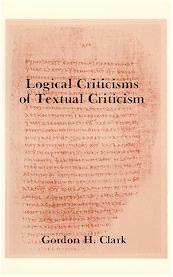
Logical Criticism of Textual Criticism

In my review of the book Logical Criticism of Textual Criticism, Dr. Gordon H. Clark has pointed out the mistranslation of two texts in the book of Hebrews in the NIV — namely Heb. 1:5 and 11:11. I had then decided to check out the bible versions themselves electronically on the Biblegateway website. What I saw confirmed the claims of Dr. Gordon Clark and places serious doubts on the fidelity of the NIV and TNIV (which claims to be an improvement over the NIV) at least at those two verses.

Here are the verses in the different versions:

For to which of the angels did God ever say, “You are my Son, today I have begotten you”? (Heb. 1:5a — ESV)

For to which of the angels did God ever say, "You are my Son; today I have become your Father"? (Heb. 1:5a — NIV)

For to which of the angels did God ever say, "You are my Son; today I have become your Father"? (Heb. 1:5a — TNIV)

and

By faith Sarah herself received power to conceive, even when she was past the age, since she considered him faithful who had promised. (Heb. 11:11 — ESV)

By faith Abraham, even though he was past age—and Sarah herself was barren—was enabled to become a father because he considered him faithful who had made the promise (Heb. 11:11 — NIV)

And by faith even Sarah, who was past childbearing age, was enabled to bear children because she considered him faithful who had made the promise. (Heb. 11:11 — TNIV)

As I have said in my review:

As it can be seen, the NIV and TNIV in Heb. 1:5a changed the traditional phrase "begotten you" to "have become your Father", which alters the meaning of the text rather significantly. There is a footnote there giving the rendering of "begotten", but the question then is why is the phrase "have become" used here, since there is no textual variant that can be translated "have become" here? Furthermore, this footnote is found only in the NIV not in the later TNIV, so why is that the case?

With regards to Heb. 11:11, the distortion of the text in the NIV and the TNIV is simply amazing. The NIV comes up with a complete novel proposition and places the correct rendering in a footnote, all done without any textual rationale for doing so. The TNIV which is later and supposed to be better reverts back to the correct rendering of the passage (which is good), but inexplicably it places the false rendering of the passage in a footnote for the text! So much for improvement of the NIV! Oh well, I guess swapping the text and footnote text is an improvement after all, but still in error.

So what do the NIV and TNIV supporters have to say about this?

Book reviews

I have just finished reviews of two interesting books that I have read recently. The first is a review of the book The Market Driven Church by Udo W. Middelmann, which can be found here.

The second review is of the book Logical Criticism of Textual Criticism by Gordon H. Clark, which can be found here.

Logical Criticism of Textual Criticism

As it can be seen from this book, anyone with even a bit of knowledge on textual issues can see that there is a difference between the textual critical methodology as utilized by Westcort, Hort, Metzger, Aland etc, and the text-types (Byzantine, Alexandrian, Western etc) contributing to the variant readings of the texts.

[Btw, if anybody discovers any link whatsoever that I have missed out to the blog of that irrational, cowardly and reprobate anonymous idiot who calls himself Antithesis (fulfilling Jude 1:10 and 2 Peter 2:12), please inform me so I can delete those links.

But these people blaspheme all that they do not understand, and they are destroyed by all that they, like unreasoning animals, understand instinctively. (Jude 1:10)

But these, like irrational animals, creatures of instinct, born to be caught and destroyed, blaspheming about matters of which they are ignorant, will also be destroyed in their destruction, (2 Peter 2:12)]

Wednesday, August 20, 2008

A few more reasons why we should disavow the Dynamic Equivalence versions

Here is an excellent article by Tim Challies on the problems with the NLT, CEV, Message and basically with all dynamic equivalence (hereafter short formed D-E) versions of the Bible. It is truly amazing that there are people who are so blind as to say that there is nothing wrong with tampering with God's Word.

Let's just take one example — Rom. 13:4. The presence of Rom. 13:4 allows the reader/ preacher to make a case for capital punishment since the sword is meant for killing. Yet, as Tim has succinctly put it, such D-E versions have made it such that "there is nothing to discuss", and no case for capital punishment can be made from them. Furthermore, this is NOT because the underlying Greek text do not teach it (because if that was the case, then we must accept it since we should not add to God's Word), but because some "translator(s)" decides that the sword imagery is too literal and thus interpret it in various ways without any reference to capital punishment. This shows the error of the D-E versions which subtract from God's Word on this matter as their interpretation causes an unwarranted narrowing of the exegetical possibilities due to the removal of the word "sword".

Our critic seems to have problems comprehending what it means to be accurate in terms of translations. In his article, he states that the "goal of any translation is to render accurately the meaning of the original language in its receptor language". But exactly WHO decides what is the "accurate meaning of the original language in its receptor language"? For example, the DE translators translates Rom. 13:4 as omitting all mention whatsoever of the possibility of capital punishment in these verses, while I contend that the accurate meaning of the original language does include the teaching of capital punishment. So, IF it is indeed true that Rom. 13:4 through the use of the word "sword" is intended to convey the idea of capital punishment, then all the D-E versions shown as examples (NLT, CEV, Msg) do not convey the "accurate meaning of the original language in its receptor language".

In a journal article by Professor Robert L. Thomas by the Master's Seminary pointed out to me by my brother-in-Christ Vincent Chia, the issue and fallacies of the translational philosophy of D-E have been addressed as follows:

The traditional method of translation adopted the source message as its control and sought to bring the contemporary reader back to that point. Most recent preferences in translation [D-E] express the opposite goal, that of bringing the source message into the twentieth century to the contemporary reader. The new aim is to relate the text to the receptor and his modes of behavior relevant within the context of his own culture, a controlling factor called "the principle of equivalent effect." The traditional method of taking the receptor to the text seeks to help the reader identify himself with a person in the source-language context as fully as possible, teaching him the customs, manner of thought, and means of expression of the earlier time. With D-E, comprehension of the patterns of the source-language culture is unnecessary

...

Such a release from restraints of the original text coincides with varying degrees of subjectivism that characterize contemporary hermeneutical systems. These recent schemes dismiss the traditional system of letting the author be the determining factor in interpretation. In so doing, of necessity they force a judgment of the Bible's meaning through the eyes of something or someone contemporary. Hirsch notes that the text has to represent someone's meaning; if it is not the author's, then it must be the modern critic's meaning that is drawn from the text. Hirsch's terminology distinguishes the author's meaning from the critic's by calling what the author intended "meaning" and by using the term "significance" to refer to a relationship between that meaning and a person, concept, situation, or anything else. (Bold added)

As for the serious questions created by the D-E philosophy:

A Linguistic Question

Nida and other linguistic authorities are quite specific in telling translators to abide by the referential meanings of words, meanings they identify with those found in standard dictionaries. In Webster's Ninth New Collegiate Dictionary the relevant definition of the word "translation" is, "an act, process, or instance of translating: as a: a rendering from one language into another; also the product of such a rendering." There is little doubt that, in the minds of most people who use the English language, the term "translation" used in a cross-cultural connection suggests the simple idea of changing from one language into another. Yet this is only one-third of the process of dynamic equivalence, the step that is called "transfer." The question is then, "Is it proper linguistic practice to use the word `translation' to describe the product of a D-E exercise?"

More recently, de Waard and Nida use "associative meaning" in lieu of "referential meaning" to describe lexical definitions. They point out, for example, the hesitancy of most translations to use "Yahweh" because in the minds of many Christians, it has become associated with a modernistic attitude toward the Bible and God.

Should not the same precision be shown in use of the word "translation"? The use of "translation" to include implementation of all the principles of hermeneutics and exegesis reflects an insensitivity to the associative meaning of that word in the minds of most English-speaking people. Perhaps "commentary" is too strong a word to describe a D-E product, but it seems that something such as "cultural translation" or "interpretive translation" would be more in keeping with principles espoused by linguistic authorities.

An Ethical Question

A closely related ethical question may also be raised: Is it honest to give people what purports to be the closest representation of the inspired text in their own language, something that intentionally maximizes rather than minimizes the personal interpretations of the translator or translators?

Graves has observed that every translation is a lie in the sense that there are no identical equivalents between languages. This problem is alleviated by an understanding in the minds of most that translation is done by means of near equivalents rather than exact equivalents. But if a translator goes one step further and intentionally incorporates his personal interpretations when he could have left many passages with the same ambiguity as the original, has he done right by those who will use his translation?

It is not our purpose to pursue this ethical question further, but simply to raise it as a matter for possible discussion.

A Practical Question

A last question for consideration relates to the use of a D-E product in ministry: How shall I deal with the problem that the high degree of interpretation in a D-E work makes it unsuitable for close study by those who do not know the original languages? The answer to this question will depend on the type of preaching and teaching one does. If his approach is general, dealing only with broad subjects, he perhaps will not be too bothered by this characteristic.

But if he at times treats specific doctrinal issues and wants to stress this or that detail of the text, the presence of a large interpretive element in his basic text will pose problems. He will inevitably encounter renderings that differ from the view he wants to represent in his message`a problem that is largely precluded in using a formal-equivalence translation. If a preacher has to correct his translation too often, people will soon look upon it as unreliable and reflect doubts about either the translation itself or the larger issue of biblical inspiration.

These are only three questions that emerge because of an intentional incorporation of hermeneutics into the translation process. Others could be proposed. It seems that precision in discussing English versions of the Bible has been largely lost. If more exact terminology is not adopted, the church may some day incur the besetting ailment of a confusion of tongues that is self-inflicted.

(Bold added)

Amen.

To round off this discussion, it is simply amazing to see a pro-TNIV-er attacks those who are against D-E as "ESV-only" folks, while all the while using KJVO style argumentation to attack the ESV. It seems that certain people simply cannot comprehend the issues at stake in this TNIV controversy. [Hint: the fundamental issue is not just the TNIV, but the entire issue of D-E. The TNIV is only the flashpoint]. Not to mention that I have no problems with people using the NKJV, NASB, HCSB, and minor problems with the KJV and NIV.

Oh well, judging by the devolution of culture, I would be waiting NOT for the D-E philosophy to run its logical end into creating the "Soft Porn Sex Outreach version", featuring a graphically and vocabulary-enhanced Songs of Songs version which properly give us the "accurate meaning of the original language in its receptor language", and thus shows forth the sexual overtones in Solomon's love song to his lover.

Or how about the Hokkien Beng version. Maybe we can translate Mt. 23:13 this way:

F--- you, scribes and Pharisees, wayang-kings! You b-----ds stop people from going to heaven. You m-----f---ers dun wan go in still stop others from coming in.

I apologize for those who are offended, but this is the type of logical end of the D-E methodology of "render[ing] accurately the meaning of the original language in its receptor language". So if the receptor language is the degenerate street language peppered with at least one vulgarity per sentence, then the "bible version" should be made so that we can "render accurately the meaning of the original language" in THAT particular receptor language as well. A "bible" peppered with vulgarities? Probably not that far off if the visible Church continues to degenerate.

Monday, August 18, 2008

My response to the Dynamic Equivalence translational methodology

After having a discussion on Bible versions and the TNIV, it soon became obvious that the fundamental issues at hand has nothing whatsoever to do with the TNIV or gender-neutrality/ inclusive language. Rather, it seems that there are many more fundamental problems with those who attempt such a defence, which are as follows:

1) Their practice of Dynamic Equivalence Methodology practically denies the doctrine of Verbal Inspiration of Scripture.

The whole idea of translating the "sense" of the verse and passage causes one to interpret them and tailor them to the audience or culture. While there is always an element of interpretation in translation, such interpretation should be minimized in order to preserve as much as possible the exact words in the original. This is not to translate it as some sort of wooden literalism, but the governing principle should be: Minimize interpretation unless absolutely necessary, NOT Use as much interpretation as you think necessary!

2) Committing the error of lexicography.

For example, the attempt to defend the translation of anthropos (ανθρωπος) to 'people' in Mk. 2:27 is based on the possible meaning of anthropos to mean both men and women in the lexicon (whether BDAG or Liddell-Scots). However, this ignores the fact that the phrase huios tou anthropou (υίος του ανθρωπου) in the consecutive verse Mk. 2:28 is translated as 'Son of Man'. The traditional rendering of anthropos as 'man' in Mk. 2:27 can thus flow with Mk. 2:28 with the rendering of 'Son of Man' in Mk. 2:28 , whereas such an analogy cannot be seen in inclusive versions like the TNIV which translates anthropos in Mk. 2:27 as 'people' yet retain the traditional translation of anthropou in Mk 2:28 as 'man'. Somehow the defence always comes down to a defence based upon lexicography independent of the entire context of the passage the verse is found, thinking that somehow since a broader semantic range of the word anthropos is included in Mk. 2:27, therefore the TNIV in Mk. 2:27 is "more literal" and has higher fidelity to the original.

3) The move towards a Protestant magisterium, and Neo-Gnostic tendencies

The suggested move towards the usage of many different versions sounds innocent enough, until one probes deeper beneath the surface. While it is indeed correct that not one version can give the total sense of the Scriptures, and thus it may (not must) indeed by helpful to utilize various translations, over-emphasis on the plurality of translations in a manner that shows total disregard whether any single translation is truly a legitimate translation would cause confusion to the flock. And who is to say which translation is better than the other, since there are no real guidelines in place? The only option is to study the Greek/ Hebrew/ Aramaic, which is good. However, if one insists on this as to truly know the sense of the verse and passage of Scripture, without which it cannot truly be known, then it must be asked if such a position smacks of Neo-Gnosticism reminiscent of the position of the Roman church seen at the time of the Reformation. Will there come a time when only those who are educated in the original languages will constitute an unofficial Magisterium on what the true senses of the texts are?

4) The refusal to set strict guidelines for translations and the primacy of the Essentially Literal style of translation, and instead depend on multiple translations, is a decadent and sinful luxury of the English-speaking Church

Let's face the fact: the English-speaking world has many many Bible versions to choose from. In effect, we are spoilt rotten with choices! We have the KJV, NKJV, NASB, RSV, NRSV, HCSB, ESV, NLT, NIV, NIVI, TNIV, GNB, TEV, CEV, Ph, Msg, LB , and possibly others I miss out. We have tons of Bible commentaries in English and a similarly large number of study Bibles. Yet in many other languages, having more than 3 translations would probably be a luxury, not to mention commentaries and study Bibles! In fact, there are still people groups without even a Bible in their native language. In such scenarios, surly the priority would be to have a good Bible which preserves as much as possible the text of Scripture so that they can use that one version (which may be the only one they have) for all purposes starting from evangelism to basic discipleship to even theological training? The "check out many versions" excuse so that poor versions are acceptable is surely a sign of the decadent indulgence of the English-speaking world especially in America.

5) The laziness in wanting a commentary-Bible version hybrid

The argument over having a Bible version that fits with the culture is legitimate to a certain extent only, in that the language must not be alien to the culture (ie 'thees' and 'thous' are not exactly commonly used words). However, when one goes further than that and desires a Bible version that expands upon a particular point or word that is perfectly understandable, then one has confounded the purpose of a commentary or study Bible with the text of Scripture. The entire gender-neutral/ inclusive language debate boils down to the fact that certain phrases which are perfectly understandable using modern English are stated to be not clear enough because it for example did not mention the opposite sex. Such clarifications should however be placed in a commentary if the problem is really that serious, because the problem is not with the language but with the worldview of such people. It is an attitude of laziness indeed in wanting to have a commentary in the text of Scripture itself (not just in the Bible as in study Bibles), as opposed to separate from it.


So, in application, the exact same reasoning of lexicography would result in certain translation decisions being unassailable. As long as the variant rendering you are proposing is a legitimate alternative based upon the variants of a lexicon, there is no legitimate reason whatsoever to reject it. With that, let us look at a good example of this principle at work.

It may be remembered by some that when the RSV came out, there was a huge uproar over the change in Is. 7:14 (a Messianic prophetic verse) of the word "virgin" with "young woman". Yet, the word there almah according to the lexicon is legitimately translated "young woman". Worse still is the fact that the word "young woman" is indeed the preferred meaning in other areas where the term is used in Scripture, and there is another term betulah which could be used if "virgin" is indeed to be made more explicit.

The question, and my challenge to all TNIV supporters who utilize such defence of lexicography, is for them to attempt to prove that the term almah in Is. 7:14 should be rendered "virgin" instead of "young woman" according to their own principles of translations. I doubt they can though.

So with that, I conclude this response to the Dynamic Equivalence methodology which seems so prevalent among the supporters of the TNIV. I am eagerly awaiting their attempted defence of the traditional rendering of Is. 7:14, but I am not holding my breath for their success.