Showing posts with label Philosophy. Show all posts

Wednesday, December 06, 2023

John Damascene on energies

For activity is the natural power and movement of each essence. (St John of Damascus, On the Orthodox Faith, 147)

ἐνέργεια γάρ ἐστιν ἡ φυσικὴ ἑκάστης οὐσίας δύναμίς τε καὶ κίνησις (pp. 147-8)

And again: Natural activity is the innate movement of every essence. It is therefore clear that those things that have the same essence have the same activity, and those things that have different natures also have different activity. For it impossible for an essence to be without a natural activity. (p. 148)

Natural activity, again, is the power that makes each essence manifest. And again: Natural and primary activity is the ever-moving power of the intellectual soul, that is to say, its every-moving reason flowing out naturally from it. Natural activity is the power and movement of each essence; only non-being is without it. (p. 148)

One should know that the second way embraces both potentiality and actuality, for on the one hand, the latter is in potentiality, on the other, the former is in actuality. (p. 148)

Χρὴ οὖν γινώσκειν, ὁτι ὁ δεύτερος τρόπος κοινός ἐστι τοῦ δυνάμει καὶ τοῦ ἐνεργείᾳ, δεύτερος μὲν τοῦ δυνάμει, πρῶτος δὲ τοῦ ἐνεργείᾳ (p. 148)

Far from the static view of the classical God, the Eastern tradition has preserved a more dynamic view of God through its preservation of the difference between "essence," "energies," and "acts." In John of Damascus' work, all essences must have energies, and part of these energies includes the actions being do. However, the main focus of "energies" is to manifest the essence, not the actions themselves. Actions are part of the energies, but are not all of the energies. That is why actions are discussed later, after discussions of the "natural and primary activity" of the intellectual soul. We note here that discussions of "actuality" and "potentiality," where the same term is used for "actualities," should be taken to mean that "actualities" is a subset of "energies," rather than the two being the same.

God is thus not the "unmoved Mover," but rather He constantly "moves" yet never changes. The Father loves the Son, yet neither change despite the dynamism of the relationship. God has His own movement, and it is we who are blessed because of it.

John Damascene's view on the will

One needs to know that here is a faculty naturally implanted in the soul that is appetitive of what is in accordance with nature and embraces everything that is essentially characteristic of nature. This is called the capacity for willing (θέλησις, thelēsis). For the essence of being and living and moving, both mentally and sensibly, has an appetency directed towards its own natural and full realization. For that reason, this natural will (θέλημα, thelēma) is also defined as follows: Will is a rational and vital appetency that depends solely on what belongs to nature. (St John of Damascus, On the Orthodox Faith, 144)

Θέλημά ἐστιν ὄρεξις λογική τε καὶ ζωτικὴ μόνων ἠρτημένη τῶν φυσικῶν (Ibid., 143)

Actual willing or wishing (βούλησις, boulēsis) is a natural capacity for willing of a particular kind, that is to say, a natural and rational appetency in relation to some specific thing. For there lies within the human soul a faculty of reaching out in a rational manner. Therefore when this rational appetency in relation to some specific thing is set in motion in a natural manner, it is called wishing. For wishing is an appetency and yearning for some rational specific thing. (p. 144)

One needs to know that the capacity for willing (θέλησις, thelēsis) is one thing and actual willing (βούλησις, boulēsis) is another, and that what is willed (τὸ θελητόν, to thelēton) is one thing, the faculty of volition (τὸ θελητικόν, to thelētikon) is another, and the agent of willing (ὁ θέλων, ho thelōn) is another. For the capacity for willing is the simple power itself of willing. Actual willing is the direction of the capacity of willing towards something. What is willed is the matter that is subject to the will, namely, that which we will. (For example, appetency is oriented towards food. Appetency on its own is a rational capacity for willing but when appetency is directed towards food it is actual willing, and the food itself is what is willed.) The faculty of willing is that which possesses the power to will, such as a human being, and the agent of willing is the one who exercises the capacity for willing. (p. 147)

Much has been made over whether God has one will or three wills. When one look at the Church Fathers on the issue, one of course know that they insisted that God has one will and that will is tied to nature not to the persons. But why is that the case?

When one reads carefully what they are saying, it is clear the Father are definining "will" in a very specific way. They are defining it not as how most of us today think of as a will. No. According to them, "will" (το θέλημα) is the "rational and vital appetency that depends solely on what belongs to nature." Put it another way, "will" is capacity. One does not "will" (θέλω) to do anything, but rather one chooses (βουλομαι), thus a distinction is made between "actual willling" (βούλησις) and "the will" (θέλησις).

The distinction works in its own way of course, and if one holds to these definitions, then most certainly God has one will, the Father and the Son do not have different wills but merely different βούλησις. If one wants to holds to Patristic terminology, then one should be able to say of the Trinity that there is one θέλησις, three βούλησεις. The problem of course is that the new classical theists do not go there even though that seems to what John of Damascus is moving towards.

That said, I would gladly hold to the technical difference between θέλησις and βούλησις, but not to calling θέλησις "will" as belonging to the nature. That is because that is not how the Enlish language works. "Will" is a dynammic term in modern parlance, not a static term in later patristics/ early medieval thought. Rather, it stands to reason in the modern context that we should translate θέλησις as "disposition" and βούλησις as "will," so as to better appreciate their use in the texts.

Wednesday, May 10, 2023

God and Time: The aeon and the pre-aeonial state

Before the formation of the world, when there was no sun dividing day from night; there was only the aeon that is coextensive with the things that are eternal like some temporal movement or interval. In this sense there is a single aeon, in according with which God is said to be aoenial, but also pre-aeonial, for he himself also made this aeon. (John of Damascus, On the Orthodox Faith, 97-98)

What is before creation? It seems that, in the history of Christian thought, the idea of "time" before creation was explored in the concept of the "aeon" (αἰων), a Greek term normally translated as "age." John of Damascus explored this concept of the "aoen" as God's first "creation" (in Section 15) before the actual creation of the universe in Section 16, which were followed by discussions of the "invisible world" (Sections 17 and 18), the visible creation (Section 19), then the various frames and elements of the material world as understood at that time (Sections 20 to 24b). Therefore, the idea of "time" before creation, even an eternal "time" before creation, was held at least by John of Damascus. The "aeon" is made by God, yet it has a derivative "eternity" not linked to the essence of the eternal God.

It is this manner of talking that is interesting for our modern times, if only for the fact that much of the polemics coming from modern classical theists imply that anything that is eternal must be linked with God's essence. Yet, as we can see, this does not seem to be the view held to by John of Damascus, who is considered one of the later church fathers. We can speak of an "eternity" that is "aeonic" in nature, and this is not a heretical or heterodox position but a perfectly orthodox one.

Apophaticism and the limits of human reason

The divine, being incomprehensible, is also necessarily nameless. [St John of Damascus, On the Orthodox Faith: A New Translation of An Exact Exposition of the Orthodox Faith (Popular Patristics Series 62; trans. Norman Russell; Yonkers, NY: St Vladimir’s Seminary Press, 2022, 88]

… [God's essence - DHC] it is superessential and beyond beings, beyond the divine, beyond the good, beyond fullness, and is set apart from all principles and classes as a whole, and is superior to every principle and class, since it is more than essence, life, word, and concepts; it is light itself, goodness itself, life itself, essence itself, since it does not have its being, or anything in the category of existents, from another, being the source itself of the being of that which exists, of the life of that which lives, of the rationality of that which participates in reason, .... (Ibid., 71)

… ὡς ὑπερούσιον καὶ ὑπὲρ τὰ ὄντα οὖσαν, ὑπέρθεον, ὑπεράγαθον, ὑπερπλήρη, τὰς ὅλας ἀρχὰς καὶ τάξεις ἀφορίζουσαν καὶ πάσης ἀρχῆς και τάξεως ὑπεριδρυμένην ὑπερ οὐσίαν καὶ λόγον καὶ ἔννοιαν, αὐτοφῶς, αὐτοαγαθότητα, αὐτοζωήν, αὐτοουσίαν ὡς μὴ παρ' ἑτέρου τὸ εἶναι τοῖς οὖσι, τοῖς ζῶσι τῆς ζωῆς, τοῖς λόγου μετέχουσι τοῦ λογου , … (Ibid., 71)

Apophatism is the manner of deriving truths about God through negation. God is stated as being "not X." Apophatism comes about through influence from Neo-Platonic philosophy as it meditates upon the one "beyond (or above) being" (ὑπερούσιον). Simply stated, Neoplatonic philosophy finds the inadequacy its philosophy to comprehend the One, which is appropriated by Christians as the one God.

There can be many things that a Christian can find problematic about apophaticism, since it seems to make God unknowable. Absolute apophaticism seems to imply agnosticism on the one side (we cannot know anything about God since "we cannot say anything true about God") and mysticism on the other (we cannot know anything about God so we must bypass the mind and approach God through mystical encounter). Or we can go the "classical theist" route and use apophaticism to reject any ideas or implications of cataphatic ("positive") theology that we do not like. Thus, in the case of much of "classical theism," certain dogmas of what they deem to be orthodoxy is maintained to be true. But if pressed and if any contradictions are shown, they retreat to "mystery" and apophatic language, claiming that the objector is being a "rationalist" and embracing "univocity," thus evading any examination of their system by attacking the opposition.

There is therefore a prima facie reason to reject apophaticism. But if one thinks about the issues, there is another way to embrace apophaticism despite its questionable legacy, and despite its origin in Neo-Platonism. If one sees apophaticism as the realization of the finitude of human reason and human philosophy to truly grasp the nature of God, thus needing the revelation of God to truly reveal who He is, then we can embrace this form of apophaticism. We can say that God is "beyond being," meaning by that He is beyond all philosophical discussions of ontology. God is thus sui generis in this sense: Any discussion of God and His being must be from Scripture, and Scripture alone. All objections based upon Man's philosophy are necessarily corrupted, including those found in "classical theism," a system which is very much Aristotelian in its philosophy. This is not to deny that we can "spoil the Egyptians" of their philosophical riches, both Platonism and Aristotelianism, but to deny that any one philosophy should be considered definitive for the Christian doctrine of God, and that includes both Plato and Aristotle.

Saturday, May 06, 2023

The London Lyceum Symposium on "Christian Platonism"

Back in 2022, the London Lyceum did a symposium of sorts on the issue of "Christian Platonism" as promoted by Craig Carter - what it is and is it a helpful term. The posts are as follows:

  1. Paul M. Gould, “On Classical Christian Platonism: A Philosopher’s Reply to Carter,” (August 1 2022), here
  2. Willemien Otten, “Christian Platonism: Some Comments on Its Past and the Need for Its Future,” (August 3 2022), here
  3. R.T. Mullins, “Craig Carter’s Christian Platonism,” (August 5 2022), here
  4. Grant Sutherland, “Is Arius a Christian Platonist?,” (August 8 2022), here
  5. Hunter Hindsman, “Plato is not the point: A Critical Defense of Craig Carter’s Proposal,” (August 10 2022), here
  6. Jordan Steffaniak, “Whose Plato? Whose Platonism? Summarizing the Christian Platonism Symposium,” (September 2 2022), here

After reflecting on the issues and reviewing Carter's book promoting "Christian Platonism," I can more clearly understand the issues, and agree with the main thrust of the articles. That said, I still find it illuminating how people like Steffaniak continue to think there is one metaphysic at Nicaea, or that Classical Theism is necessitated by Nicaea or even Chalcedon.

Fanciful history and Dubious Hermeneutics: A review of Craig Carter's Interpreting Scripture with the Great Tradition

Craig Carter is one of the foremost proponents of the ressourcement happening in current Reformed and Evangelical circles. His books on the subject have been promoted as showing us the way forward towards embracing Classical Theism and 'Great Tradition' exegesis. I have finally gotten around to review his book on exegesis, and it has been a real doozy. Here is my review of Craig Carter's book Interpreting Scripture with the Great Tradition: Recovering the Genius of Premodern Exegesis, laid out in three main sections interacting with his narrative of church history, his idea of "Christian Platonism" or "Ur-Platonism," and his hermeneutics or embrace of the medieval Quadriga. An excerpt:

How does one interpret the Scriptures? In Craig Carter’s view, the correct way to interpret the Scriptures is to read them the “premodern” way. Taking us on a tour through the history of exegesis, as retold by Carter, we are told a history of the rise and fall of good exegesis. There was a ‘golden age’ of premodern exegesis based upon ‘Christian Platonism,’ which at the advent of the Enlightenment caused the downfall of this glorious age of exegesis into the broken shards of unbelieving scholarship. The way back is to recover the ‘Great Tradition’ based upon ‘Christian Platonism,’ and in so doing we learn how to interpret Scripture alright. In Carter’s words, “academic theory needs to be reformed according to church practice when it comes to biblical interpretation.”

[continue]

Monday, September 12, 2022

Side B theology, "nature" and "will"

Over in the degenerate country that was once a long time ago a godly nation, Christianity Astray Today back in December 3 2021 had published a opinion piece promoting the ideas of "Side B Christianity." "Side B Christianity" teaches that one can legitimately be or identify as homosexual, LGBTQ+, as an expression of one's struggle with these sexual sins, and at the same time call oneself a Christian. As opposed to "Side A" which celebrates the goodness of homosexual acts and LGBTQ+ sex acts, up to and including "marriage," "Side B" claims they agree with the Bible that these sex acts are sins. Therefore, as Christians, they would not engage in these acts, yet they continue to assert their identity as LGBTQ+ and assert they are in those "communities."

As LGBTQ+ acts are gross sexual perversions, Side B followers are most definitely to be lauded for treating these as sins and refusing to engage in these sins. At the same time, their continual identification with gross sin as an identity marker goes against everything Christ died for in purchasing us to be holy in His sight, which excludes identifying with our sins. One argument that a Side B advocate might advance though is a favorite of the LGBTQ+ lobby, that they are just "born this way." In other words, by nature, they were created with this LGBTQ+ orientation. Therefore, just as one born a man identifies as a man, one borns Hispanic identifies as Hispanic, so likewise one born LGBTQ+ should identify as LGBTQ+.

Now, there are various ways to adddess Side B theology and show how it is contrary to Scripture. I however would like to approach it alongside the issue of "will" and "nature." When we tell someone that LGBTQ+ is wrong, we are asking them to "will" to not engage in it, to "will" to not identify as that. In classical metaphysics however, "will" is a property of "nature." But if "will" truly is a property of "nature," then what does this imply for the issue of Side B theology? If by nature they are LGBTQ+, then they would be unable to will to be something else. In other words, under classical metaphysics, Side B proponents would be justified in claiming LGBTQ+ as their identity, even while they do not engage in the sex acts themselves.

Christians of course would point out that in Christ, we are a new creation (2 Cor. 5:17). Therefore, as new creation, our identity is now in Christ and not in our past sins. They are correct in their response. However, that is an insufficient response when one understandings how classical metaphysics interact with Side B theology. If in classical metaphysics, the "will" is a property of "nature," then having a new nature in Christ means having a new "will." However, as Reformed Christians, we hold that grace does not destroy nature but rather renews it. In other words, the new nature we have in Christ does not nullify the created nature. The old, sinful nature most certainly would slowly pass away. However, the old, sinful nature is not necessarily the same as the created nature. Side B proponents could claim that LGBTQ+ identity is just like being male or being Hispanic, and therefore is not part of the old, sinful nature. If that is the case, then being a new creation does not remove the LGBTQ+ aspect anymore than being a new creation makes a Hispanic man not a man and not a Hispanic. Of course, there are a couple of spectacular claims made here, all of which I do not believe are defensible. The point here is that if such a claim is made, then classical metaphysics has been used in the service of Side B theology. Since "will" is a property of "nature," then it is wrong to attempt to make a LGBTQ+ "Christian" change his "will" on this matter, as he can no more change that than a human become a cat.

The good thing about rejecting classical metaphysics is that we do not have to worry about what one's nature is. The fact is that God commands us to be such, therefore everything else is wrong. Side B theology is wrong because it matters not what their natures may or may not be; whether they are "born this way" or not is irrelevant. All have sinned and fall short of the glory of God (Rom. 3:23) and all are to repent of what God calls sin regardless of their "nature" or feelings about the matter. It matters not whether your nature allows you to reject LGBTQ+, because God has commanded therefore it must be done.

Thursday, September 01, 2022

Musings on actualism and possibilism in modality

Actualism, with respect to possible worlds, is the view that if there are any true statements in which there are said to be nonactual possible worlds, they must be reducible to statements in which the only things there are said to be are things which there are in the actual world and which are not identical with nonactual possibles. The actualist will not agree that there are nonactual possible worlds, if the notion of possible worlds is to be regarded as primitive. Possibilism, with respect to possible worlds, is the view that there are nonactual possible worlds and that the notion of a possible world is not to be analyzed in terms of actual things. … As we shall see, it may involve the difference between an absolute and a world-relative concept of truth. [Robert Merrihew Adams, "Theories of Actuality," in Michael J. Loux, ed., The possible and the Actual: Readings in the Metaphysics of Modality, 202-3]

(20) It is possible that there exists an object distinct from every actually existent object. [Michael J. Loux, "Introduction" in Loux, ed., 45]

What do the term "actualism" and "possiblism" mean when discussing the issue of modality? One might guess it is somehow related to realism and anti-realism as it comes to the nature of things, and that would be close. However, it is possible to be an actualist and an anti-realist concerning possible worlds (probably Plantinga?), and possible to be a possibilism and an extreme realist (e.g. David Lewis). So actualism does not mean realism, and possibilism does not mean anti-realism. What are they then?

As defined by Robert Adams, the difference between actualism and possibilism concerns the type (and the quantity) of things in any possible world, and that entire possible world as well. An actualist believes that all possible worlds can only be construed out of what is in the actual world. In other words, they deny statement 20 as stated by Michael Loux above. An actualist must also deny the extensionist sense of the statement:

It is possible for there to exist more things than actually exist.

In my understanding, actualism therefore thinks that all possible things, worlds, etc, must in some way exist in the actual world. The "furniture" to work on are only things that we can see in the actual world. For possibilism on the other thing, the sky's the limit. For both, it is of course possible to claim nonactual things. In actualism however, nonactual things can be taken to be mere words, and it is impossible to evaluate truth conditions for them, since nonactual things do not, well, exist.

It is more in line with commonsense to hold to the existence of possibilia, although actualists have many objections to possibilism. Thus, without taking a firm position on the issue, I hold to possiblism for now, noting that we can talk about truth values in possible worlds of fiction, as for example evaluating a scene from the Star Wards universe according to interal world coherence.

Tuesday, August 23, 2022

How to evaluate truth values in possible worlds under possibilism

Part of the allure of modal actualism is that it makes it easier to state what we mean by truth values in possible worlds. Truth values in an actualist world is evaluated by whether it corresponds with any or some possible world, be they considered as "states of affairs," "sets of properties," "propositions" etc. Since these are actual things that any statement can be compared, one is able to evaluate the truth of falsity of modal statements. Whereas in a possibilist system, how exactly are the truth values of modal statements to be evaluated? Possibilia are non-existent things, so how does one evaluate any modal statement under possiblism?

To answer this question, we must ask ourselves how possible worlds come about. Possible worlds are thought of by someone. Someone wonders what might happen if aliens invaded the earth, and we end up with tons of alien invasions storylines. Some others wondered what a mythology for England would look like, and we arrived at Tolkien's Middle Earth. George Lucas conceived of a possible world with New Age concepts in a sci-fi fantasy setting, and we have Star Wars. The list goes on and on. All of these are possible worlds, conceived by one or more humans using the power of their imaginations. Despite being fiction, they fit any qualification for inclusion as possible worlds, as a giant catalogue of "What If" scenarios play out in the minds of imaginative minds.

What allows some possible worlds to actually seem like a possible universe, while others are absolute trash? Plausible possible worlds are internally coherent. If the world holds that the laws of physics are similar to our own, then the laws of physics will operate just like ours. If the world is a sci-fi setting that holds that there is a miracle ubotainium metal that provides energy and gravitational manipulation, that unobtainium will not suddenly become a human being without powers. In a fantasy setting with magic that is governed by quantity of mana, it is always the case that someone with more mana has access to more magical power. The point here is simple: Any real possible world must be self-consistent. In other words, there is a coherence to any possible world which cannot be violated without undermining that world.

After Disney Star Wars took the liberty of "innovating" Star Wars, Episode VIII The Last Jedi was an absolute mess (I did not even bother paying to watch it; just watch the train wreck later on either Netflix or Disney Plus). One scene in that stinking mess illustrates why coherence in world-building is so important. That scene is the so-called "Lightspeed ramming" by woke feminist 'Admiral' Holdo. In that scene, Holdo sacrificed herself to take out the pursuing Imperial Dreadnought. Her method to do so is to accelerate to "lightspeed," which normally means entering hyperspace. However, by doing so so close to the dreadnought, hyperspace was not entered before the startship hit the dreadnought, destroying them both together with many other surrounding imperial ships.

That scene was one of the things Star Wars fans were furious over, and with good reason. If "lightspeed ramming" were possible, then everyone should be using it and there would be no reason to build any capital ship. One can just program a droid to make the calculations to execute such suicide missions, and the enemy capital ships would be gone. In fact, the supposed existential threat posed by the two Death Stars make no sense. Just program twenty droid ships, make them do lightspeed ramming into the Death Star, and goodbye Death Star! In other words, "lightspeed ramming" violates the internal logic of the Star Wards mythology. JJ. Abrams' forced retcon that the "Holdo manoeuvre" is a "one in a million" thing is a total joke, because one can get around the odds by using droids who are suposed to be able to do the precise calculations faster than any human (including Holdo) ever could.

All of these show us how we can evaluate truth values in possible worlds, if we reject modal actualism. One evaluates truth values by its consistency with the mythos of the imagined world. From a consistency standpoint, "lightspeed ramming" is necessarily false in the Star Wars universe. That it is treated as "true" by Disney Star Wars makes the Disney Star Wars version of Star Wars an irrational world, where nothing in the world needs to cohere with each other. Is that a "possible world"? No, it is an irrational world where "truth values" corresponds merely to the ipse dixit of whoever happens to be the storyteller at the moment. Nothing needs to make sense anymore in such an irrational world, where nothing can work until the narrator decides how they ought to work, for who knows whether a giant Mickey Mouse will suddenly appear out of nowhere, pick up Darth Sidious and swallow him up before instituting a 1000 year of intergalatic peace under Wanda Maximoff?

Truth values are evaluated in possible worlds based upon the internal logic of each possible world in addition to the normal nonmodal predicates, and none of the entities need to exist ontologially for modal arguments to be evaluated. One does not need to think any of them are actually existing, and thus truth claims in possible worlds can be evaluated under possibilism, or in this case, conceptual possibilism.

Sunday, August 21, 2022

Alvin Plantinga, Modal Actualism, and the Modal Ontological Argument

Socrates is a contingent being; his essence, however, is not. Properties, like propositions and possible worlds, are necessary beings. If Socrates had not existed, his essence would have been unexemplified, but not nonexistent. ... so being exemplified by Socrates if at all is essential to Socrateity, while being exemplified by Socrates is accidental to it. [Alvin Plantinga, "Actualism and Possible Worlds," in Michael J. Loux, ed., The Possible and the Actual: Readings in the Metaphysics of Modality, 268]

The Christian philosopher Alvin Plantinga is well-known for his modal ontological argument for the existence of God, a modification of the original ontological argument first expressed by Anselm in the Proslogion. A version of the modal ontological argument can be expressed as follows:

  1. It is at least possible for God to exist.
  2. If God’s existence is possible, then necessarily, God does exist.
  3. Therefore, necessarily, God exists.

The argument is expanded as follows:

  1. It is possible for God to exist.
  2. Therefore, God exists in some possible world.
  3. Necessarily, God exists in some possible world.
  4. Necessarily, God exists.
  5. God exists.

Premise 1 seems true for certainly the existence of God is conceivable, thus it is possible for God to exist and therefore statement 2 is true. From statement 2, one arrives at statement 3 through the modal axiom S5. Since the definition of God is that He has necessary existence, therefore if God necessarily exists in some possible world, he exists necessarily (Statement 4). Therefore, God exists (Statement 5).

Another way to frame the modal ontological argument is taken from "Formulation 4" of the entry on "Ontological Argument" on the Stanford Encyclopedia of Philosphy (accessed Aug 20, 2022), and simplified and expanded as follows:

  1. For any being x, there is a possible world w where x exists.
  2. For any beings x and y, there are possible worlds w and v, such that x exists in w and v, while y exists in w and not v.
  3. Being x is superior to being y as it exists in both w and y.
  4. If being x exists in worlds w, y, z, while God exists in y and z, then being x is superior to God.
  5. God, being defined as maximally great, cannot have any being superior to Him. Therefore, God must exists in more possible worlds than other beings
  6. A being that exists in the actual world would exists in more worlds than a being that does not exist in the actual world.
  7. God in order to be maximally great must exists in the actual world and all possible worlds.
  8. God exists.

Premises 1 and 2 are statements about possible worlds. Statements 3 and 4 are normally taken to be true, based on the premise that existence is greater than non-existence. Statement 5-7 flow from statements 3 and 4 and the idea that God is defined as a maximally great being, which is defined as such for the purpose of this argument.

So here we have two slightly different versions of the modal ontological argument. Unlike Anselm's original ontological argument, these arguments have more meat in them, and does not seem to require us to hold to some idea that God is defined as "greater than that can be conceived," with all its attendant problems. Are these arguments sound then? Have Christian philosophers like Alvin Plantinga stumble upon a viable form of the ontological argument that does indeed, as Natural Theology, prove the existence of God without appeal to special revelation?

Analyzing the arguments

The first argument form looks sound. However, note here that the argument depends on how one interprets premise 1. What does it mean for God to "exist in some possible world"? Most certainly, if one means that God ontologically exist in some possible world, then certainly the argument is sound, but is that what one means by premise 1?

The second argument form looks a bit more problematic. This form is closer to the traditional ontological argument, but it deals with maximal greatness through linking it with existence in possible worlds. The possible issues with this argument are the hidden premises correlating greatness with existence, and the idea that the actual world is a possible world that we see of as actual.

Existence is certainly better than non-existence, but this this only applies for creatures who can differentiate between the two states. For non-creatures, non-existence could mean imaginery existence, as in the case of imaginery numbers in Mathematics or virtual particles in quantum physics. Therefore, the idea that existence is always better than non-existence does not apply to everything. While in the case of God (and all creatures) it is true that existence is better than non-existence, to assert that is to assume God (or at least creaturely existence as superior to non-creaturely existence) from the start and therefore cannot truly function as an axiom to prove God's existence.

The key problem: Actualist modal ontology

Both argument forms when analyzed seem sound, until one digs deeper. For the first argument form, premise 1 states that God exists in some possible world. But does this possible world truly and actually exist? For the second argument form, the hidden premise is that the actual world is a possible world that we see as actual to us. Presumably, individuals in some possible world w would see theirs as an actual world and ours as a possible world.

Underlying this is a commitment to an actualist modal ontology. What is an actualist modal ontology? An actualist modal ontology states that all modal entities truly and actually exist. How that is so divides the actualists. Plantinga's form of actualist modal ontology borrows from Platonism and differentiates existence from examplification. As seen in the quote above, for Plantinga, all modal entities exist as "things" or haecceities, which are analogous to the Platonic forms. In any possible world, these forms all exist but the actual thing exist only if the form is "exemplified" in any particular world. Therefore, the existence of Socrates in world w is due to the "exemplification" of "Socrateity" in that possible world. In possible world v however where Socrates does not exist, "Socrateity" still exists in that possible world v but "Socrateity" was not "exemplified" in possible world v.

According to Plantinga's modal ontological argument therefore, that God exists in some possible world can start as something as simple as the Platonic form of "God" being present in that possible world. Likewise, there is nothing essentially different between the actual world and possible worlds except in the perspectives of the ones in that world. The actual world in this case is a possible world that we are in. With this actualist modal ontology, things possible are more than mental conceptions but are possible existing objects.

Plantinga's modal ontological argument therefore seem to depend on an actualist modal ontology. It is a question if the argument can survive without actualism. For many of us, possible worlds are taken as hypothetical worlds, creations of the mind to explore alternate forms of the world. We are possibilists, and believe in one actual world where things ontologically exist.

Conclusion

The modal ontological argument is indeed a stronger argument that seems to point to the success of Natural Theology to prove God's existence. However, at least one variation of that argument by Alvin Plantinga seems to demand an actualist modal ontology which I do not hold to. Therefore, it stands to reason that the modal ontological argument has not been proven to be sound, and the goal of Natural Theology seems unrealized.

Thursday, June 23, 2022

Ontology and science

On the classical Aristotelian metaphysics inherited by the medieval scholastics, every primary substance ... has a secondary substance-kind ... that pertains to it and without which it could not exist. ... (Thomas H. McCall, An Invitation to Analytic Christian Theology, 104)

Metaphysics is the branch of philosophy that seeks to deal with the nature of reality. Part of that is the nature of all reality, thus they deal with questions involving whether reality is actually real in a material sense or not. That level of metaphysics goes beyond scientific examination because it deals with the ultimate reality of things beyond that of science. However, there is another level of metaphysics which in the modern world has mostly gone obsolete, that of Aristotelian substances and accidents, where that level of metaphysics seek to discover the nature of things as they are present in real life. In the modern world, science in the fields of physics, chemistry, and biology have supplanted this level of metaphysics, and have provided answers to these questions that are far more practical and much better approximations to the truth. Nevertheless, a new level of interest in Aristotelianism has arisen recently. Perhaps such is due to the failure of modern philosophy to provide a unitary vision of the truth. Perhaps it is due to an interest in virtue ethics of which Aristotle has much to contribute. Or perhaps it is due to influence from certain fields of theology where Aristotelianism has laid dormant and are now uncritically accepted due to a unbiblical view of what theological retreival should mean for a Reformed Christian. Needless to say, this resurrection of Aristotelian metaphysics is deeply troubling. Part of that of course is that the notion of Aristotelian substance and accidents are just plain wrong; science has shown that to be the case. The same people who are resurrecting Aristotle, either Aristotle himself or Aristotle as mediated through Aquinas, are the same people who are benefitting from the applications of modern science, science that would not be possible if scientists stuck with Aristotelian metaphysics!

Reality can be described and explained in many ways. There is therefore nothing wrong with using Aristotelian categories if one understands them to be mere descriptions. However, the claim that these are true of reality is an ontic claim, and that is a problem because such claims are demonstrably false. For example, a dog as substance would possess the "substance-kind" dogness or caninity. But there is no such ontological thing as "dogness." A dog is an emergent substance formed by the expression of instructions found in the canine DNA of dog cells. "Dogness" is at best information encoded by DNA. That information in turn does not produce an ontological substance called "dog" but rather a bunch of phenotypes that we collectively called "dog." Platonism with its view of forms is more amenable to modern science here, since dog phenotypes can be called its "form." Even then, there is no "dog substance" that is combined with a "dog form," since the substance of DNA, proteins, and carbohydrates are common to all animals.

The substance of living things are the molecules that form the thing, or the particular permutation of molecules in various cellular structures. The substance of all living things are therefore the same, since all living things have DNA, proteins, carbohydrates and so on. There is no "dog substance," no "human substance" and so on. Dog cells and human cells, the fundamental living unit of dogs and humans respectively, are emergent substances that form as the "form" from the instructions on the DNA imprints unto the cells to form these different dog and human cells. Dogs are made of dog cells, tertiary substances that can only emerge from the imprint of dog DNA information unto them. There is no primary substance called "dog"‐ never has been and never will be.

With the resurrection of Aristotle, we can expect to see bad philosophy, bad science and bad theology. In philosophy, one can obviously find alternatives to Aristotelianism. That cannot be said to be true of much of classical Christian theology, which needs a good round of de-Aristotelianism to bring it out of captivity to this false philosophy.

Monday, April 11, 2022

A journal article on the issue of modal collapse, and a brief comment

An interesting journal article has just come out on the issue of modal collapse as it relates to the doctrine of God, in the Journal of Reformed Theology which is currently open access here. Modal collapse is an argument, promoted by those like Ryan Mullins, that a strong version of divine simplicity (DDS) implies a collapse of all contingencies into absolute necessities in God. The article is an attempt to argue that such ideas of modal collapse depend on premises that are at best contested, and therefore the modal collapse argument is not the knockdown argument against the doctrine of divine simplicity as it has been stated to be.

There are a lot of interesting things in this article, and I am sure Mullins will respond to this article in due time. I would just like to make a brief comment here on the article's explanation of necessity. According to the authors, the difference between hypothetical and absolute necessity "rests solely on the source, or ground, of a thing’s necessity in relation to its essence or concept." The authors cite Boethius, Aquinas and Leibniz to support this distinction. The authors then argue that therefore, asserting that something will necessarily happen does not imply that it is absolutely necessary, since the ground of why it happens is external to its being, and therefore still considered hypothetically necessary. In other words, whether something is necessary in any and all possible worlds is totally irrelevant to the discussion about the nature of necessity, since the only thing that matters is the intrinsicity or extrinsicity of the act to its being.

While it is certainly understandable why the ancients think like that, that manner of thinking is something I reject. Intrinsicity or extrinsicity certainly informs one understanding of necessity, in the sense that nothing can go against its nature. Therefore, it is intrinsically necessary that a triangle has three sides. However, it is one thing to claim that intrinsic necessity is associated with absolute necessity. It is another to claim that intrinsic necessity IS absolute necessity, and extrinsic necessity IS hypothetical necessity. The authors in this article have cleverly asserted that even an appearance of absolute necessity does not imply that necessity is absolute if the ground is extrinsic, so any proof that an extrinsic necessity seems absolute will be rejected by this criterion. However, what if an intrinsic necessity can be shown to be not absolute? Such should certainly blow their argument apart.

What is a thing? Sometimes, defining what a thing is, and what is necessary for the thing to be what it is (intrinsically) is not that easy. So, what is a photon with a wavelength of 700nm? We call it a light particle transmitting red light. But what is intrinsically necessary in such a light particle? Well, traditional philosophers would probably say that "redness" is an essential property of such a light particle. However, we know from science that "redness" is perceived subjectively to the human person, therefore "redness" as a secondary property is not intrinsic to "photon with wavelength of 700nm." So "wavelength of 700nm" seems to be intrinsically necessary for such a proton. Except, it is not absolutely necessary for that photon to have a wavelength of 700nm. That photon is blue or red shifted to an observer moving at relativistic speed, thus it has a different wavelength despite the photon not undergoing any change. True, the different wavelength is due to perception from relativistic viewpoints, but the point remains that this intrinsic necessity is not absolutely necessary.

What is the intrinsic necessity of "infinity"? It seems clear that infinity is a number beyond all numbers. Therefore, an intrinsic necessity of infinity is transcendence. Yet, from the work of Georg Cantor, we know this intrinsic necessity is not an absolute necessity, since it is possible to have different infinities and therefore, despite the intrinsic necessity of infinity to transcend numbers, under specific mathematical manipulation, infinities can be managed, qualified, and even transcended despite their inherent transcendence. Here, we see another case in which intrinsic necessity is not absolute necessary.

These two counter-examples, one from physics and the other from math, show that intrinsic necessity does not necessarily mean absolute necessity. The point is not to separate the two, but to show that the assertion that hypothetical necessities are always hypothetical even when they look absolute, is based upon an association of the types of necessities that are not necessarily the case. If there can be even one intrinsic necessity that is not absolute, then one should not assert that the only thing that matters is the ground of necessity and not the overall manner in which any necessity plays out not just due to being but due to place and circumstance.

On the older distinction between hypothetical and absolute necessity, just because in many cases something is absolute or necessary due to whether it is intrinsic or extrinsic to the thing does not entitle one to ground necessity in being alone. In the case of light for example, "being" is very much linked with act, because light is in act. Therefore, it is much better to ground necessity in possible world scenarios rather than talk about essence. Speaking of essence, it is clear from looking at things like shadows that just because something is a thing does not imply it has a essence, so grounding necessity in essence is strange if it is possible that a thing does not have an essence. How does one talk about the necessity or otherwise of shadows since shadows have no essence?

Now, most certainly, this paper is an interesting paper. However, as I do not hold to the same metaphysics as the classical theists but that amenable to modern science, I do not find the arguments in the paper convincing. After all, why should I find arguments based on ontology persuasive when we all know that the ancients, while smart and perceptive and who build the foundation with which we can attain to modern science, are ignorant of actual ontology? We can respect their insight, respect their contribution, without uncritically accepting anything they have to say on any topic.

Monday, March 28, 2022

David Bradshaw: The Transformation of energeia into esse in the West

… how energeia as it is found in Plotinus and Porphyry was transformed into the medieval (and especially Thomistic) concept of esse, the ”act of being.” Tracing this history will reveal a major and relatively little noticed source of medieval thought. At the same time it will be important to notice what the developments we are tracing leave behind. At each stage there is a king of sloughing off of unwanted metaphysics. This is usually done silently, so that a reader not familiar with the earlier texts will be unaware of how key concepts have been removed from their original setting and radically simplified. [David Bradshaw, Aristotle East and West: Metaphysics and the Division of Christendom, 97]

In effect we find in [Marius - DHC] Victorinus a further specification of the energein katharon of the Anonymous Commentary [on Pamenides -DHC]. This energein now turns out to be esse, the unlimited and uncircumscribed being of the Father, from which is derived all the limited and circumscribed being (ὄν) found in the Son. Such esse is anything but “being” conceived as a static condition of existence; it is a kind of inwardly directed activity, containing implicitly life and intelligence as well as existence. In thinking itself it manifests itself as what it is, giving rise to the triad of ese, vivere, and intellegere – Father, Son and Holy Spirit. Oddly enough, then, despite all the accretions of Neoplatonism, we are not too far from the self-thinking thought of Aristotle’s Prime Mover. The divine self-intellection remains the activity par excellence, the one that precedes all others, giving rise by virtue of its necessary intrinsic structure to the intelligible order and plurality of the world. (Ibid., 115)

According to David Bradshaw's resarch, it seems that there is a shift in the West (after Plotinus) to turn activity into being, energeia into esse. This is troubling for many reasons, but it would answer the question of how pure act is interpreted in Classical Theism to be a rejection of divine choices and activity outside the being of God.

Sunday, March 27, 2022

On ontology and realism

I have been busy with work and other stuff in real life, so unfortunately I cannot read and write as much as I would like to. I still get involved in Twitter discussions though, so this recent exchange has been helpful in illustrating one main issue of contention I have with classical theism.

Classical Theism, being formed in the Middle Ages and mostly complete by the high Middle Ages in the time of Thomas Aquinas, assumes a realist ontology. Everything that exist has real existence. A thing is made up of a substance and its accidents. Aristotelians focus on the fourfold causation that underlie each thing, and all things are explained by Aristotelian causation. As long as something exists, it must have a cause—material, formal, efficient and/or final.

Such an embrace of Aristotelian ontology commits the Classical Theist to assume that everything that is a thing must have real existence and be explanable by the four causes. But the problem arises as to whether all things have real existence at all. Just because something is a "thing," a noun, does not necessarrily mean that it has real existence. Now, here we are not talking about things like unicorns, which do not exist in this world but can be conceived to exist in a possible world. Rather, we are talking about things that exist in this world, but I would assert they do not have real existence at all.

In my interaction with Joshua Sommer, I had listed three things: Light, Gravity, and Color. But for the purpose of this post, I would like to look at a slightly more expanded list of Shadow, Light, Color and Gravity. It is my assertion that these things are examples of things that exist and yet do not have real (or ontological) existence. They are actual phenomena, but not things that have real ontological existence. These function as counter-examples to the idea that all things can be explained by Aristotelian causation, and each must have essences of their own.

What is a shadow? In physics, a "shadow" is an artifact formed when light to an object is blocked by another object. A "shadow" is not a thing as it has no mass or substance, energy or form. A "shadow" is an area where there is absence of light where the obstruction has cut off the light. During a solar eclipse, the moon moved across the day sky casting a shadow upon the surface of the earth, which we perceive as a solar eclipse when the day dimmed to twilight for a few moments during a full solar eclipse.

An interesting fact about shadows is that they can "move" faster than the speed of light. In a thought experiment, a huge screen with a height of a few light years is placed about 10 AU away from the earth. A cosmic laser flashlight is put in the place of the sun and shone upon the earth. The flashlight oscillates vertically 1 AU up and 1 AU down, with an average move speed of a quarter of the speed of light (c), as follows:
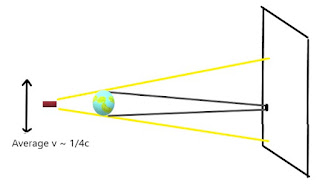
In this figure, the shadow of the earth will oscillate down and up as the torchlight oscillates up and down. This shadow will be moving up and down the screen faster than the speed of light, since the earth is closer to the rapidly moving torchlight than the screen. But we know that nothing can go faster than the speed of light, so how is that possible? It is possible because shadows are not real things. Shadows emerge from the relation of light source to obstruction of light. They are "real" in the sense that they exist, but they are not real in the sense that they have no essence or form. When a shadow moves "faster than light," what is physically moving is not the shadow but the light from the cosmic flashlight, which travels at the speed of light.

It can be argued that shadows are artifacts, so of course they have no essence. Well, let us look at the case of light. Light is a thing that everyone who is not blind can perceive. But what exactly is light? For some time, light was considered a wave, which was easily to understand until we discovered that light does not need a medium to propagate, which poses a problem for a traditonal understanding of waves. The wave-particle duality of light, with the discovery of the photon through the photo-electric effect, complicates matters even more. While hard to understand, scientists however have the relative luxury of ignoring how their findings affect our understanding of ontology. Philosphers and theologians do not have that luxury. So how do Aristotelians deal with the issue of light? That is a very good question.

The main problem with light and photons is that light is not matter; photons have no mass (effective mass through using Einstein's famous equation is not the same as actual mass). Photons are also transient particles, since they are present only when light is shining, unlike protons and neutrons that are always present as matter. How can something that has no matter has an essence? Light has no form either, and one does not even directly measure light. Light is measured by the amount of illumination (or energy) it gives, which is to say the amount of light is a measurement of its effect not the thing itself. Measuring luminosity involves taking in light, and the amount of light taken cannot be measured and then put back into the system, but rather the light is "used up" as its effect is measured.

Color is another interesting phenomenon. In modern physics, we understand that color is what our minds perceive through receiving light waves into our eyes that have the wavelengths of the visible light spectrum. In other words, color is subjective, as it requires a subject to perceive it. Color is still universally recognized in the sense that all men will see grass under the light of the sun to be greeen. However, it is universal not because it is an objective truth but because all human eyes work that way. Since it is perceived by the brain, it is always possible that an animal with a differently wired brain and eye will perceive different colors differently. Red might be invisible, blue might be greenish, and Ultra-Violet seen as blue to such an animal. Our actual perception of color will be different from that animal's perception, and who gets to determine which color is the "true" color of the grass under the light of the Sun?

Color as such is an emergent property at best. Unlike shadow or light, it also subjective. Therefore, it has no form and no essence, for there is no such thing as an objective property of "whiteness," "greenness" or that of any other color, for "whitenesss" for one creature may be "orangeness" for another creature. Yet, we have an objective idea of what these colors are, even though they are not objective, which shows that one does not have to have form or substance to conceptually exist.

Lastly, we look at gravity. Ever since Isaac Newton discovered his laws on gravity, we knew that gravity is proportional to mass but not why that is the case. With Einstein's contribution, we now know that gravity is merely the curvature of curved space-time, and the curvature is caused by the mass of the object. This new understanding of gravity however puts gravity in the same category as "Shadow," as something that is an artifact of something else. In the case of gravity, gravity is an artifact of curved space time. Since space time is curved, an object in order to preserve its space-time trajectory must curve towards the object distorting space time.

Recently, there has been an interesting discovery of something matching the hypothetical gravity waves by LIGO. However, such a discovery has no bearing on our perceptions of gravity since the gravity waves could very likely be a shock wave transmitted through the space-time fabric of the universe. From all these, we can clearly state that gravity has no essence and no form. As with "shadow," they exist as real physical phenomenon, but they don't have the essence and form Aristotelian essences require.

In conclusion, I believe I have shown four physical phenomena that actually occur, yet have no form and no essence. The fact is that actual occurence makes no difference as to whether something exists ontologically, which is to say it would have a real essence. Modern physics have shattered the naive ontological realism of Aristotle, and as it fails, so too should we be critical of classical theism with its many unspoken philosophical assumptions.
Thursday, March 03, 2022

James White on "Reformed Thomists"

Dr. James White has done a one hour episode on the issue on "Reformed Thomists" as follows:

While it is true that many Reformed Scholastics are Aristotelians, that does not make them Thomists. In fact, Aristotelianism was used more as a tool than as the philosophy in which to interpret everything. That is why Witsius can talk about the will of the Father and the will of the Son, without worrying about whether that runs afoul of the idea that God has only one will.

Thursday, November 25, 2021

Why defining immutability according to Aristotelian categories is problematic

In Aristotelian (meta)physics, "motion" is a change of state. A moving ball has motion, just as a piece of burning wood which is in motion from being wood to becoming ash. Basically, anything is motion is changing in some form or another. This use of the word "motion" is alien and confusing to those of us trained in the sciences, which presumably should include most educated people in this modern 21st century world. Nevertheless, one must conceptually split the word "motion" into is older, Aristotelian meaning, and the modern (and what I would think correct) meaning. I will use motion(A) for the Aristotelian sense of "motion" and motion(M) for the modern sense of motion. A moving ball has motion(A) because moving implies change. A moving ball has motion(M) because its displacement is changing over time. However, a moving ball according to Aristotelian metaphysics is constantly changing because it is moving (A). Whereas, a moving ball in the modern sense is not changing because it is in constant motion (M).

This concept of "motion" is important because much of classical theism draws upon Aristotelian philosophy and Aristotelian categories, even centuries after the modern world has consigned them to the realm of archaic history. It is therefore hard for the modern man to understand classical theism, seeing as how they have to learn not just a different philosophy but also to experience cognitive dissonance in the different definitions and concepts of terms. Grasping the Aristotelian notion of "motion" is like a gestalt switch—seeing things differently from how most people normally think. And for those who continue to want to live in the modern world and especially treasuring the sciences, even teaching the sciences, one has to learn how to hold two almost incommensurable concepts simultaneously, switching from one to the other when the situation demands it.

In classical theism, immutability is the doctrine that God does not change, and change is defined in terms of motion in the Aristotelian sense of the term. Thus, immutability is not the same as immotility (no movement (M)), since immotibility is built upon motion (M). That said, by sticking to the Aristotelian sense of the term, motion cannot do justice to the Scriptures, as I will show now.

We note in the beginning that for a moving ball, the ball is moving in both the Aristotelian and modern sense. However, the moving ball is changing according to motion (A), while not changing according to motion (M). The reason why the ball is not changing according to motion (M) is because there is no resultant unbalanced external force acting on the ball (assuming a ball moving at constant velocity). In other words, the ball continues to move because it does not change. For the ball to stop moving, it experiences a change. Since modern physics is a much better approximation of how the world works, we know that motion (M) is the correct notion of motion, and motion (A) is intesting conceptually but it does not reflect anything in the real world.

In the doctrine of God, the doctrine of immutability focuses on the fact that God does not change. But is Aristotelian physics, inadequate for the real world, adequate for one's doctrine of God? Since it is not applicable to the real world, we should be skeptical that it would be applicable here. But let's look further into the matter. Let us look at how immutability works in the Bible concerning God. Now, we say that God is love. Immutability as it is applied to God teaches us that God is always love. He does not change to be less loving, or more loving. That applies to all the attributes of God. But note one thing: "love" is an action attribute. "Love" is always to be expressed from the lover to the beloved. In other words, "love" is like a moving ball. As we remember, in Aristotelian physics, a moving ball has motion because it is moving. For a ball to not have motion, it must be stationary. But if love is like a moving ball, in that both are actions, then surely to asseert that there is no motion (A) in God is for God's love to cease? But if God's love does not change to be more or less loving, then there is no change in God's love according to motion (M). So which idea of "motion" is suitable when we deal with immutability and the love of God, if not the modern notion of motion, not the Aristotelian notion of motion?

Thus, we see here that definiting immutability according to Aristotelian categories is indeed problematic. While I will not claim that the immutability of classical theism is immotility, I will assert that the Aristotelian notion of "motion" is incompatible with the immutability of God's active atttributes. Aristotelian metaphysics, when applied to God's love, must say that God is immutable only when he has not love ad intra. Since that is not true, Aristotelian metaphysics about motion must be false, at least when applied to God's love.

Should we therefore change to the modern notion of motion and change? That is an interesting proposition to explore, but I will not claim that this is the path we should necessarily take. Rather, define immutability as God not changing, let the Bible informs us what change would be like if applied to God, and hold one's philosophy about what constitues "change" or "motion" at arm's length.

[Note: I know many classical theists believe God is love. This article is asserting that it is inconsistent to hold to Aristotelian metaphysics of motion and still believe God is love. So one has to decide whether to follow Scripture, or follow Aristotle. Thankfully, classical theists follow Scripture where it counts, however inconsistent that is with their Aristotelianism.]

Saturday, October 09, 2021

In response to Perl's call for a return to Neoplatonism

The alternative to the principle that to be is to be intelligible, therefore is the nihilism which afflicts so much of contemporary thought and culture. For if being is not what is apprehended by thought, then thought does not apprehend being. This in effect means that there is no being, since whatever we call “being” is not being but a projection, interpretation, illusion—in short, nothing. If reality is not as thought must apprehend it, then there is no such thing as reality. Conversely, if thought is not the apprehension of being, then all thought, in that it never apprehends being, is illusory. Nihilism may indeed be said to consist most fundamentally in the denial of the intelligibility of being. (Eric D. Perl, Theophany: The Neoplatonic Philosophy of Dionysius the Areopagite, p. 111-2)

In his conclusion of his book on Dionysius, Eric Perl puts forth his promotion of Neoplatonism. Neoplatonism is treated as superior as opposed to what he sees as the nihilism that infects the modern world. While certainly nihilism is present in much modern thought, I do not agree that Neoplatonism is a better alternative.

Perl's argument against much of modern philosophy can be stated as follows: (1) If thought does not apprehend being, being is an illusion. (2) If thought is not the apprehension of being, then thought is illusory. (3) Therefore, if Neoplatonism is false, being and thought are illusory. (4) (Implied) Being and thought are not illusory. (5) Therefore, Neoplatonism is true. The problem comes with statements 1 and 2. Is it really true that apprehending being is necessary for the reality of thought and being?

Reality and thought are linked in Plato due to the idea of forms, in which apprehension comes about when one apprehends the form of things. One knows what fire is when one sees "fire-ness" in the object. Implicit in this view of knowledge is that the mind has access to the forms in order to apprehend an object. But is that truly how cognition works?

Let us think through a few questions: Can the mind apprehend a pink unicorn? How about a pegasus? Surely we can say that the mind can apprehend these things, but then these things are not real. But suppose it is said that their forms are derived from real forms, and thus even though the mythical creatures do not exist, the reason why we apprehend them is because the original forms exist and we can apprehend them. So let's try something different, something real. How about the wave-particle duality of photons? Can our minds apprehend the concept? I would think so. Pointing out that we can apprehend "wave" and "particle" does not help because "wave-particle" is not wave and not particle. Or from Math, can we apprehend the idea of transfinites, where again transfinites are not truly infinite and yet they compose infinite sets?

The thing is: Ever since the Scientific Revolution, the link between being and intelligibility has been strained to the breaking point. Our knowledge is not limited to what there is, as we are able to conceptualize new theories and new things. Our thought is virtually limited to what we can conceptualize. Reality of course remains the same. The world in Plato's time is more or less the same world in modern times. Photons existed as wave-particles in Plato's time just as it does in ours, except Plato did not know or understand modern physics. Thus, we see a separation between the world of being and the world of ideas. Reality remains the same, yet thought and cognition does not.

Since such is the case, I would propose that we need a separation of reality from the world of ideas. There is nothing necessarily wrong with the Platonic forms, and that objects have forms which impress themselves on the mind (Whether that is the best way to understand cognition I would not comment here). The separation however needs to happen between reality and thought. We must understand that conceptualization is a mental process that can operate apart from the world, and that has happened as we come to grips with the strangeness and counter-intuitive nature of the inner workings of reality. Reality or being is one thing; the world of ideas does have relation to reality but is able to transcend it altogether.

From a Christian perspective, we must hold to some version of that separation, since we believe in a God who is in many ways unlike us. To assert that God is a se (when nothing in reality is a se), and we are expected to understand what we mean when we say that God is a se, is already a conceptual leap from reality. We also say that there are the "secret things of God" (c.f. Deut. 29:29), which are certainly real and yet not known by us, thus we must create an extra category of real but not intelligible. Christianity therefore cuts against the identification of being and intelligibility, and those who hold to such an identification would come to face problems in their philosophies. Those holding to Platonism tend towards rationalism, while those rejecting rationalism tend towards mysticism, precisely because they continue to run with Plato's link between being and intelligibility.

If we separate being and intelligibility, we can have 3 categories: (1) Things real but not intelligible (secret things of God), (2) Things real and intelligible (most things), and (3) Things intelligible but without being (e.g. knowledge of God, Scientific paradigms). There is no need to reduce everything to intelligibility and thus become a rationalist (rejecting 1), or focus on being and thus treading the path of Dionysius (rejecting 1 and 3). If we take this paradigm, then we can reject statements 1 and 2 of Perl's argument, and therefore his case for Neoplatonism. What I suspect is happening in much of philosophy is a failure of imagination, and a stubborn clinging to the idea that unity of thought and being can be found in this world by Man.

Neoplatonism, symbols, and the issue of icons

All expressions of God, the lowly and sensible no less than the exalted and intelligible, participate in him and are thus “similar.” (Eric D. Perl, Theophany: The Neoplatonic Philosophy of Dionysius the Areopagite, p. 103)

All things, then, are in effect symbols of God and are so used in the scriptures, and this is simply a restatement of the doctrine that being is theophany. (p. 103)

The Platonic doctrine of participation, which Dionysius invokes in justifying the suitability of all things as symbols of God, makes it clear that the symbol is a genuine presentation of the symbolized. (p. 104)

A symbol, then, in being finite, available, in not being God and thus in leaving him behind, in concealing him, reveals him as beyond being and thought. … Only by being concealed in symbols can God be revealed (p. 104)

Hence, as Dionysius here indicates, there can be non-symbolic knowledge of God, no knowledge of God without the concealment of symbolism. (p. 105)

The Second Council of Nicea of 787 AD, known in Eastern Orthodoxy as the "Seventh Ecumenical Council," mandated the virtue of holy icons (two-dimensional images) and anathemized those who reject icons (the iconoclasts). For Protestants who see idols of any kind as a violation of the Second Commandment, Nicea II contradicts Scripture and is thus an illegitimate council. Therefore, we would not call it the "Seventh Ecumenical Council" except improperly. Nevertheless, Eastern Orthodox promotion of icons and treating the issue as of the essence of faith stems from this council.

For a Reformed person like myself, I had found it puzzling why Eastern Orthodoxy is so adamant on the issue of icons. Reading Eric Perl on Dionysius however has shown me the likely backdrop for this fascination with icons. This is not to argue that any Eastern Orthodox is a neoplatonist or that any of them hold to full-blown neoplatonism, but rather that the philosophical underpinnings of the Eastern theology of icons is found in the neoplatonism of Dionysius.

In Dionysius' neoplatonic ontology, symbols mediate the divine. Since God is not "being" neither is he "not-being," being the unity of all as the necessary condition for being, being as such is a "theophany," an appearance of the divine (Ibid., p. 32). All things are symbols mediating the divine. To use Christian terminology, all matter is "sacramental." Since God is "beyond being" and "unknowable," to get to the "hidden God" is to go through the symbols mediating the divine. As Perl said, "Only by being concealed in symbols can God be revealed." In other words, Dionysius asserts that there is no way to reach the divine if the symbols are gone.

Once we see this, it becomes clear that a main reason why icons are so important in Eastern Orthodoxy is due to its fear of losing the connection to God. If symbols are necessary to reveal the hidden God, then removing the symbols would be akin to removing God. Seen this way, Nicea II is understandable, albeit it shows us the tragic consequences of adopting an unbiblical ontology which leads to gross idolatry.

Friday, October 08, 2021

Neoplatonic ontology: Being as Intelligibility and God as unknowable

Plato’s understanding of being as form or idea (εἶδος, ἰδέα) is a direct consequence of this identification of being and intelligibility. [Eric D. Perl, Theophany: The Neoplatonic Philosophy of Dionysius the Areopagite (New York NY: State University of New York Press, 2007), p. 6]

Intellect, therefore, is perfect consciousness in that it is the knowledge of being as its own content and therefore as itself. (Ibid., p. 85)

Dionysius adopts his doctrine of God as “nameless,” “unknowable,” and “beyond being” from the Neoplatonic tradition established by Plotinus, and his thought can be understood only in that context. His “negative theology” is not fundamentally a theory of theological language but a philosophical position taken over directly from Neoplatonism, although, as in Plotinus, it has implications for language in that words are discursive expressions of intellection and hence cannot apply to God. (Ibid., p. 13)

Similarly, Dionysius is not content to say simply that God is ineffable, unknowable, or incomprehensible. To say “God is ineffable” is to describe him, to ascribe the attribute of ineffability to him, and thus to contradict oneself. (Ibid., p. 14)

… God is not some being other than all things (the very formula is an absurdity) but is rather the entire content of reality, i.e. all things, without differentiation, without the distinctions from one another by which they are all things. (Ibid., p. 31)

The knowledge of God, then, is given to sense no less than to intellect. Conversely, since God is the object of all cognition and of none rather than merely the object of the highest cognition, the cognitive ascent does not end with intellect. It extends beyond intellect to culminate in “the darkness of unknowing” … (Ibid., p. 93)

Platonism and neoplatonism are important philosophies at the base of the Western philosophical enterprise. For the purpose of church history, Neoplatonism plays an important role in the formation of certain philosophies and theologies in the church. Specifically, as I read more into Eastern Orthodoxy, the writings of Pseudo-Dionysius played an important role in the formation of Eastern Orthodoxy theology, as mediated by Eastern fathers such as Gregoras Palamas in his Triads. Dionysius is not actually written by the real Dionysius the Aeropagite (thus a "false writing" - pseudepigrapha), but it was thought to be so for a long time. The writer of these false writings was a Neoplatonist, and through him Neoplatonism influenced the theology of Eastern Orthodoxy.

But what does Neoplatonism believe in, besides the usual things we associate with Plato? In his book, Eric Perl brought forth certain aspects of Neoplatonism that can be seen in the writing of Psuedo-Dionysius. Concerning ontology, one thing that struck out was the absolute identity between being and thought. Whether Plato taught that to be the case I am unsure, but certainly this strong identification of one to the other was surprising. Note that Perl is not merely stating that Neoplatonism teaches that being and intelligibility are associated or linked, but that they are to be identified. Thus, it is not the case that things exist are intelligible, but rather that to begin to exist is to be intelligible, and to not begin to exist is to be unintelligible. In set theory, all elements of the set "having being" map exhaustively onto all elements of the set "being intelligible." This strict identification implies a collapse of epistemology into ontology, and I suppose that is why the issue of "being" is so prominent in many philosophical discussions.

In Perl's analysis of Dionysius as read alongside Plotinus and Proclus, this identification of being with intelligibility is the reason why Dionysius calls God (the philosophical "the One") "beyond being." To call God a "being" is to imply that he is derivative and not ultimate. To say that one can speak about what God is, is to likewise make God knowable and thus derivative, since being is intelligibility. Thus, in Dionysius, God is "beyond being" and we can describe him only using "negative theology" or apophatic theology. But unlike today's classical theists who use the term, apophatic theology in the Dionysian sense implies a total rejection of any description of God, such that even "ineffable" cannot be predicated of God, for to predicate something of God (even "ineffable") is to reduce him from cause to derivation. Dionysian apophatism is thorough and cannot be squared with any Western theology save mysticism.

Not surprisingly, Dionysian apophatism logically leads to a form of naturalism. The One is not separate from the world, but rather is the supreme unity of the world, in a descriptive manner of speaking (since it technically *is* not anything). While Neoplatonism would baulk at any determination of the One, both Proclus and Dionysius would reject the view that God can exist apart from the world (aseity), and thus no matter how apophatic they want to be, "the One" is certainly not a se therefore Neoplatonism would be considered a form of naturalism. Since Dionysius influenced Eastern Orthodoxy, it would be interesting to see to what extent Gregory Palamas and Eastern Orthodoxy in general utilized those ideas from Dionysius, but that is for another time.

Friday, April 10, 2020

Book review: Aristotle's Revenge: The Metaphysical Foundations of Physical and Biological Science

With the reflections done on various passages in the book, I have compiled and rewrote some of the reflections and joined them together in a review of the book. Here is my review of Edward Feser's book Aristotle's Revenge: The Metaphysical Foundations of Physical and Biological Science. An excerpt:

How should we understand the world and how it works? What is the nature of reality itself? In the modern era, the natural sciences are taken to be the study of reality. The success of the natural sciences is due to the correspondence their theories have to how reality seems to function, and the ability to apply the knowledge gained from the natural sciences for the betterment of humanity. While the natural sciences are always developing, their explanatory power and technological advancement has gained our trust that they do in fact teach us what reality is and how reality functions.

The philosopher Edward Feser however demurs from this depiction of reality. Rather, he asserts that Aristotelian philosophy is properly basic and that the operation of science presupposes Aristotelian categories and terms. ... [more]