Showing posts with label Discernment. Show all posts

Monday, February 27, 2017

Revisiting the issue of discernment and discernment ministries

Back around the time when I first started this blog (2006), Christian blogs were proliferating and the notion of Discernment ministries was just forming. For good or for ill, I became involved with the discernment movement, which, as all movements are, are a mixed bag. The proliferation of discernment ministries, good as it may seem to be, ignores the fact that sin pervades all our thoughts, our actions, and even ministries. The Christian blogosphere became like the Wild West, totally unregulated, where everything goes. In the highly decentralized, naturally anti-authoritarian, radical egalitarian Western (especially American) societies, who has the right to tell another that he or she is not called or not qualified for discerning truth from error?

Thus, what was to be a good thing did not turn out as well as it should. There was almost zero QC (Quality Control), and, as we sinners are tempted to do, personal emotions get into the mix and tempers flare. It is not uncommon especially in the anti-ODM (Online Discernment Ministries) blogs to see flame wars happening non-stop. As much as there was light, there also seem to be much heat.

Many of the original Discernment bloggers however take the high road. My friend Mike Ratliff has recently posted an article Discernment and Slander". I do not know the exact reason why he posts this, but it shows the high road that those of us who are or were involved in the Discernment movement in the beginning aspire to.

So why have I did a short reflection on something that, in Internet time, is centuries ago? I did it not because "discernment" has (unjustly) gained a bad rep, although that is true. But I see the same dynamic continue to be in play when certain second or third generation "discernment bloggers" are, to put it nicely, sloppy in their research. Others react by attacking "discernment" and "discernment bloggers." The whole sordid affair that is seen in the episode of Tim Challies' article against discernment, which he published in 2009, just repeats itself, again! It's almost like nobody learns from the past! What is to be gained from making blanket generalizations and demonizing an entire group, just because perhaps your opponents are currently the most "prominent" among that group? Is that helpful? What do such blanket condemnations hope to achieve, besides slandering those in the group who are innocent?

If, just because certain Reformed Baptists sinned against me, it is right for me to attack ALL Reformed Baptists as wicked people? If an Arminian were to meet five self-declared "Calvinists" who taught Hyper-Calvinism, would it be justified for that Arminian to assert that ALL Calvinists were Hyper-Calvinists? But if we do not like broad generalizations when we ourselves become implicated because of the sins of others, why do we think it fit to inflict such a travesty on others?

Some of the Online Discernment Ministries continue, but the movement has mostly passed. What was good in it did benefit the Church, and what was bad was ugly, to be repented of. Yet one should not make broad generalizations against it all, especially when one was formerly a contributor to the team blog that one has now become so bitterly opposed.

Thursday, October 06, 2011

Revisiting the Challies/ ODM issue 2 years on

Back in 2009, specifically April 6th 2009, Tim Challies wrote an article entitled Evil as Entertainment, in which he attacked watchbloggers for treating evil as entertainment, and that those who do so find sick, strange delight in all that is evil and ugly. This article precipitated a fuller response in an article from me on the problems of the New Evangelical Calvinism.

Fast forward to 2011 today. The same attacks on "ODMs" (Online Discernment Ministries) in 2009 are now employed against all those who object to the invitation of Sabellian heretic TD Jakes to the Elephant Room. This time however, Tim Challies is on the side of orthodoxy.

What has happened? The fact of the matter is that Challies' blanket attack on "watchbloggers" undermined the entire enterprise of discernment, whether wittingly or unwittingly. I have foreseen this already and that was why I have opposed Challies and that article of his from the beginning at that time. There are of course "watchbloggers" who may fit Challies' portrayal, but that does not mean that we should throw a blanket condemnation on "watchbloggers" in general. The same weapon that Challies utilized is now utilized against him and everyone else on an even more fundamental issue of the Faith — the doctrine of the Trinity.

As I have said then, the way to deal with errant people who treat evil as entertainment is to deal with them specifically, NOT attack all "watchbloggers." The chicken that Challies nurtured has now come home to roost. As back then, so now, those who object to the compromise of the faith are attacked as "discernmentalists" or "discernment bloggers" who "sits in their underwear at home in their mother's basement." The attack on all forms of negativity threw out the baby with the bathwater, and now any form of negativity including the biblical mandate to separate from first order heretics like TD Jakes, who deny a doctrine that even the Roman Catholics and Eastern Orthodox do not, is ridiculed.

The New Calvinist movement carries within itself the seed of its own destruction. If they will not reverse their course, soon they will be no different from the World Council of Churches.

Monday, March 22, 2010

Scripture and the epistemic priority of logic

Log-ic (noun):

  • 1) the science that investigates the principles governing correct or reliable inference
  • 3) the system or principles of reasoning applicable to any branch of knowledge or study

(Dictionary.com)

In my defence of the doctrine of the Covenant of Works (certainly a controversial topic among people today), a certain minister disagreed with my position. One interesting tidbit of our interaction was his denigration of logic. (I was looking forward to a discussion of the interpretation of Rom. 2:6-10 but was sorely disappointed in this regard.) In this post therefore, we would look at the topic of logic and its relation to Scripture. How exactly does logic relate to Scripture?

As it can be seen, logic is defined as "the science that investigates the principles governing correct or reliable inference" or "the system or principles of reasoning applicable to any field of knowledge or study". The first definition looks at logic as an academic discipline of its own, while the second is the description of logic in its outworking in cognitive fields.

To put it as simple as possible, logic is the way we normally think. Everytime we do so much as think, read, write, daydream whatever, some form of reasoning takes place, and most of it logical. Logic as an academic discipline is simply the formalization of our thinking processes into laws which we all generally observe and rules which we all generally follow even if tacitly. Logical deduction is the process by which we reason out a conclusion based upon other propositions which we have accepted already as true, such that the information in the conclusion is found in the premises. Logical inferences are the processes by which we make conclusions based upon normalizing the information of the premises such that the conclusion is possibly true depending on the legitimacy of our normalization.

During my undergraduate days, I was privileged to take a module in Logic in which the lecturer spent about 1/4 of the course on the foundation. Instead of jumping immediately to truth tables and logical notations or even Venn diagrams (Aristotelian logic), the lecturer insisted on starting with nearly 3 lectures and 3 tutorials on the topic of Informal logic, thus forcing us to think for ourselves without mere rote memory of truth tables and mathematical formulae. I did all the homework provided, which helped me tremendously honed my skill in breaking down complex sentences into propositions and seek out implicit premises. In fact, in order to make us evaluate the arguments found in the examples given in our worksheets, we were forced to write down every single implied premises found in the arguments, even those as obvious as "Socrates is a man" or "All women are humans" or "3 is greater than 1" and some even more obvious than that!

Such a focus on informal logic would aid me to see logical reasoning everywhere. In fact, any (non-poetic) sentence can be converted to propositions, and every argument meant to persuade someone can be broken down into its logical form.

For most people, logic is often used without much thought about it. Who for example does not apply logic to their bank accounts, and ensure that their balances tally? (Maths is a special form of logic). Besides those who have difficulty understanding/counting, those who can understand mathematical logic are not illogical with their money. Nobody for example thinks it is right for them to have for example $1000 left in their bank account after they have withdrawn $500 from their balance of $2000.

Similarly, logical reasoning is almost always used without question in normal discourse and interaction. On the road in traffic, nobody in their right mind when seeing a "No speeding" sign thinks that the sign does not apply to him, or that the "No speeding" sign actually means "Please speed". The reasoning process that takes the indefinite imperative of "No speeding" and applies it to himself that "I am told not to speed" is itself a logical argument.

Logical reasoning extends even to Scripture and the application of biblical truth. As an example, we can look at a simple proposition in 1 Jn. 1:9

If we confess our sins, he is faithful and just to forgive us our sins and to cleanse us from all unrighteousness.

This verse is a conditional (If... then) statement. Most Christians do not bat an eyelid when they apply it to themselves in the following manner (even though Scripture never once mentioned that it applies to them — whoever wants to disagree please go and find your name in 1 Jn. 1:9):

P1: If we confess our sins, ...

P2: I confess my sin

C: God is faithful and just and has forgiven my sin and cleanse me from all unrighteousness

Logic therefore is the method or way in which we reason, and the way in which all communication can occur. Without logic, there can be no such thing as verbal or written communication at all. Even now, this paragraph of mine is an argument based upon the rules of logic, and this entire article too.

To be illogical therefore is to be irrational and thus unable to communicate and be communicated with. Since logic is the rules of thinking and discourse, discarding them makes thinking and discourse impossible. Irrationality in philosophy (i.e. Postmodernism) needs to utilize logic in order to argue against logic — a self-defeating notion as it is. Even the Kantian metaphysical category of das Ding an Sich (the thing in itself - the noumenal), while supposedly totally non describable and unknowable, has to be described and known as such (non describable and unknowable) using logic and reasoning. Truly, there are irrationalist philosophies, but no philosopher (that I know) has ever endeavored to write their books illogically and irrationally. Well, I guess it is possible if you put a monkey on your keyboard...

So how does Logic relate to Scripture? They don't with regards to authority, except in the fact that logic is epistemologically prior to anything. That minister in one of his comments states that we should "submit our "method" (logic) to Scripture". The problem with such pious nonsense is that it is precisely that: nonsense. How, may I ask, do you submit logic to Scripture? In order to do so, you need to outline a process by which such can be done and you cannot outline the process without using logic. It must be noted that I have not even yet mentioned the most fundamental law in logic: the Law of non-contradiction. If we have to submit logic to Scripture, then this law cannot even be assumed to be true and must be "submitted to Scripture". But if this law cannot be assumed to be true, then perhaps the phrase "submitted to Scripture" actually means "submitted to the Devil" or "Obama is a socialist". Who knows?

Logic by virtue of its definition thus assumes epistemic priority even over Scripture, for there is simply no way to begin talking about Scripture or anything in Scripture (and anything else) without an a priori acceptance of logic. Without logic, the demand to "submit logic to Scripture" cannot even be understood cognitively, much less acted upon. It is no wonder that the Apostle John used the Greek word logos to describe God

In the beginning was the Logic (logos), and the Logic was with God, and GOD, the Logic was (Jn. 1:1 - alternate translation)

Sunday, February 07, 2010

Phil Johnson on the Neo-Liberal Stealth Offensive

Beloved, although I was very eager to write to you about our common salvation, I found it necessary to write appealing to you to contend for the faith that was once for all delivered to the saints. For certain people have crept in unnoticed who long ago were designated for this condemnation, ungodly people, who pervert the grace of our God into sensuality and deny our only Master and Lord, Jesus Christ. (Jude 1:3-4)

I know that after my departure fierce wolves will come in among you, not sparing the flock; and from among your own selves will arise men speaking twisted things, to draw away the disciples after them. (Acts 20:29-30)

In the e-Journal by 9Marks ministry (Jan/Feb 2010, 7:1), Phil Johnson, who is the Executive Director of Grace to You, has written an excellent and extremely pertinent article on the attack of the enemy against the churches. He begins:

The gospel’s most dangerous earthly adversaries are not raving atheists who stand outside the door shouting threats and insults. They are church leaders who cultivate a gentle, friendly, pious demeanor but hack away at the foundations of faith under the guise of keeping in step with a changing world.

No Christian should imagine that heresy is always conspicuous or that every purveyor of theological mischief will lay out his agenda in plain and honest terms. The enemy prefers to sow tares secretly, for obvious reasons. Thus Scripture expressly warns us to be on guard against false teachers who creep into the church unnoticed (Jude 4), wolves who sneak into the flock wearing sheep’s clothing (Matt 7:15), and servants of Satan who disguise themselves as angels of light (2 Cor. 11:13-15).

In light of the disaster of the New Evangelical experiment, especially as epitomized in the Seeker sensitive movement, causing biblical illiteracy to rise to shockingly new levels, evangelical churches are ripe for the infiltration and taking over by liberals of all stripes, from the capital "L" Liberals on the left to the Neo-Orthodox on the right.

In his article, Johnson details the 4 trends that is leaving evangelicals vulnerable to subversion:

1. They recklessly follow the zeitgeist.

...

Beware of church leaders who are more worried about being contemporary than they are about being doctrinally sound, more concerned with their methodology than they are with their message, and more captivated by political correctness than they are by the truth. The church is not called to ape the world or make Christianity seem cool and likable, but to proclaim the gospel faithfully—including the parts the world usually scoffs at: sin, righteousness, and judgment (cf. Jn. 16:8). Jesus expressly taught that if we are faithful in that task, the Holy Spirit will convict hearts and draw believers to Christ.

...

2. They want the world’s admiration at all costs.

... When we need to shave corners off the truth or compromise righteousness in order to gain the world’s friendship, bearing the reproach of Christ is an infinitely better option. No true friend of God deliberately seeks the world's camaraderie (Jas. 4:4).

But one of the common characteristics of liberalism is an obsession with gaining the world’s approval and admiration no matter the cost.

...

When churches give in to that craving for worldly approval, they inevitably subjugate the gospel to a more popular message. At first, they won’t necessarily deny (or even challenge) core gospel truths such as the historical facts outlined in 1 Corinthians 15:3-4. But they will abbreviate, modify, or add to the message. The embellishments usually echo whatever happens to be politically correct at the moment — climate change, world hunger, the AIDS crisis, or whatever. Those things will be stressed and talked about repeatedly while the historic facts of Christ’s death and resurrection, the great themes of gospel doctrine, and the actual text of Scripture itself will be largely ignored or treated as something to be taken for granted.

Feed any church a steady diet of that for a few years and they will have no means of defense when someone attacks the faith more directly. That’s precisely what is happening today with various attacks on substitutionary atonement, the exclusivity of Christ, the authority and inerrancy of Scripture, and other essential Christian truths. All of those things were first downplayed in order to make the church’s message sound more “positive.” Now they are being subjected to a full-scale assault.

...

3. Their “faith” comes with an air of intellectual superiority.

Liberals treat faith itself as an academic matter. Their whole system is essentially a wholesale rejection of simple, childlike belief. Their worldview foments an air of academic arrogance, setting human reason in the place of highest authority, treating the Bible with haughty condescension, and showing utter contempt for the kind of faith Christ blessed.

Consequently, liberals are and always have been obsessed with academic respectability. They want the world’s esteem as scholars and intellectuals—no matter what they have to compromise to get it. They sometimes defend that motive by arguing that the secular academy’s acceptance is essential to the Christian testimony.

Of course that is a quixotic quest. It is also a denial of the Bible’s plain teaching. Believers cannot be faithful to Scripture and win general accolades from the wise men, scribes, and debaters of this age. The world hated Jesus, and he made it clear that his faithful disciples mustn’t expect — or seek — the world’s honor (Jn. 15:18; Luke 6:22; cf. Jas. 4:4). Paul, himself a true scholar in every sense, wrote this world’s wisdom off as sheer foolishness: “Let no one deceive himself. If anyone among you thinks that he is wise in this age, let him become a fool that he may become wise. For the wisdom of this world is folly with God” (1 Cor. 3:18-19).

True Christian scholarship is about integrity, not accolades. Liberalism covets the latter, and that explains why liberals are always drawn to ideas that are stylish and politically correct, yet they are resistant to virtually all the hard truths of Christianity, starting with the authority Scripture claims for itself. Be on guard against that tendency.

4. They despise doctrinal and biblical precision.

This may sound like an oxymoron, but while treating faith as an academic matter, liberals prefer an almost anti-intellectual, agnostic approach to dealing with the specific truth-claims of Scripture. They like their doctrine hazy and indistinct.

...

Heavy doses of that flavor of postmodern, neo-liberal evasion have conditioned multitudes of church members to regard carefulness and precision in handling doctrine as both unimportant and potentially divisive. These days the person who shows evidence of doctrinal scruples is much more likely to be held in suspicion or disdain among evangelicals than the neo-liberals who have deliberately made the study of biblical doctrine seem so cloudy, confusing, and contentious.

...

Do read the complete article by Phil Johnson, as it shows us the deadly compromises made by New Evangelicalism, who sold out their evangelical birthright for a bowl of academic respectability soup. When you sow to the wind, you reap the whirlwind. May we learn from their mistakes and turn from them.

Monday, November 30, 2009

Wednesday, November 18, 2009

Misquoted verse: Acts 5:38-39

So in the present case I tell you, keep away from these men and let them alone, for if this plan or this undertaking is of man, it will fail; but if it is of God, you will not be able to overthrow them. You might even be found opposing God!” So they took his advice, (Acts 5:38-39)

In context:

But a Pharisee in the council named Gamaliel, a teacher of the law held in honor by all the people, stood up and gave orders to put the men outside for a little while. And he said to them, “Men of Israel, take care what you are about to do with these men. For before these days Theudas rose up, claiming to be somebody, and a number of men, about four hundred, joined him. He was killed, and all who followed him were dispersed and came to nothing. After him Judas the Galilean rose up in the days of the census and drew away some of the people after him. He too perished, and all who followed him were scattered. So in the present case I tell you, keep away from these men and let them alone, for if this plan or this undertaking is of man, it will fail; but if it is of God, you will not be able to overthrow them. You might even be found opposing God!” So they took his advice, and when they had called in the apostles, they beat them and charged them not to speak in the name of Jesus, and let them go. Then they left the presence of the council, rejoicing that they were counted worthy to suffer dishonor for the name. And every day, in the temple and from house to house, they did not cease teaching and preaching Jesus as the Christ. (Acts 5:34-42)

Acts 5:38-39 is often used as a prooftext for Neo-Evangelicals and others like them to "counsel" people against refuting error. Following the advice of Gamaliel, they call on such "hotheads" to cool down and let things run its course. After all, shouldn't we trust in the sovereignty of God? As Gamaliel states so clearly, if the movement, plan or undertaking is of man, it will fail, but if it is of God it will thrive. Worse still, we would have been found to be going against God Himself! However, does this verse actually give us this advice?

In context, it can be seen that the Apostles were arrested for preaching the Gospel in public by the High Priest and the Sadducees, and brought to trial before the religious council, the Sanhedrin. When commanded not to preach the Gospel (v. 28), Peter and the apostles openly defied them and say that they will in fact do so, thus making the Sanhedrin furious and murderous.

It is in this light that the counsel from Gamaliel was given, which defuses for a time the anger of the Jewish leaders against the apostles' manifest defiance of their commands. Through an appeal to the sovereignty of God, Gamaliel persuaded the Counsel not to go ahead with their intentions to murder the apostles there but to release them, letting God do the judging instead.

Now, it is a sure fact that in God's providence, Gamaliel's advice did in fact save the apostles at that time. It is also true that God is sovereign and that He is in control, thus nothing can happen without His permission. In all this, Gamaliel was in fact quite right. However, do all these facts therefore make Gamaliel's advice right?

An understanding of God's revealed will (His precepts) and God's sovereign will would be of great help here. God commands various things in line with what would be pleasing in His sight, yet we all know that not all and in fact most of them do not come to pass. God is against sins of any kind, yet we all know that men sin everyday. Thus, it can be seen that God's will of command is often frustrated, and thus not come to pass.

If God is indeed sovereign however, then all that He desires to come to pass will be indeed accomplished (cf Dan. 4:35 etc). In this we speak of God's sovereign will or His will of desire. Nothing can ever thwart God's desires, for such is the very essence of what it means to be totally sovereign.

Knowing this, we can see that Gamaliel's advice alludes merely to the sovereignty of God or God's sovereign will. However, are we to follow the commands of God or the sovereign decrees of God? God summons us to obey His commands (for that is the very definition of the concept of 'command'), while His sovereign will is not our domain to discern and attempt to accomplish (cf Deut. 29:29). God calls us to obey His Word and we are to do them. In the case of exposing errors, that is the command of Scripture especially in Jude 1:3. Therefore, we are to follow God's commands in this respect instead of attempting to discern God's will based upon the successes or failures of any person/ ministry.

One other error in misquoting such a verse to teach fatalism is that it assumes that God will in fact do such and such. In the biblical context, is it always the case that a plan of God will succeed while a plan of men will fail? If such is the case, then isn't Islam the true religion, after all having conquered the heartlands of ancient Christianity (by the sword) and now being well on its way to overrun Europe in the near future? Who or what determines failure and success? Biblically, without the full revelation of Scripture, did the plan of God fail when Jerusalem fell to the Babylonian Empire? Was the Davidic Covenant made void when the last king of Judah was executed with his sons? It would certainly seem that way for the people living at that time.

God sovereignly allows things to pass that may not be what seems good to us, for example the captivity of Judah. Therefore, Gamaliel's advice, while it may be generally correct, is flawed. Further proof can be obtained if we were to think what is actually involved if such a fatalistic attitude were to be implemented in all of life and not just ministry: Vaccines are not necessary because if you are destined to fall sick, you will regardless of whether you have the vaccine or not and vice versa; Medicine do not need to be taken too to cure an illness, since the disease may be from God and vice versa; etc. Gamaliel's advice is therefore absurd when applied to "practical" life issues, so what more spiritual issues that are more real than the present world?

In our actions, we are to obey God's commands in everything (not just in the area of discernment), and not to attempt to "follow God" through deciphering God's intention through providence or any other ways. Even if God had actually decreed a certain evil end, it is right and proper for us to follow God's commands in Scripture to work against that evil end. For how do we know God's intentions — that He may use us as an instrument to halt that evil? Our actions are to be guided by the precepts of Scripture, not garnered through sinful enquiry into what God is actually going to do or not to do!

In conclusion, these two verses are merely descriptive of Gamaliel's advice which was useful providentially, but they are not prescriptive for God's people. Gamaliel's advice is therefore not biblical, and we should therefore treat it as the narrative it actually is rather than grounding our conduct on it.

Tuesday, November 10, 2009

Mike Ratliff: Rebuking Repentance and Restoration

My friend Mike Ratliff has written an excellent post here regarding discernment. Mike makes the excellent points that we are not to be hasty in judgment but to ensure that what we know is indeed true before we make a judgment on the facts of the case. Also, we are to be loving and not fight the enemy with the same carnal weapons they use against us (fight fire with fire).

IMO, Mike has successfully navigated between the two extremes in this regard: the ecumenical response of "no-judging" or, closer, Tim Challies' method of stating that all judging must be done in a "positive manner" and thus he castigates all "discernment ministries". The opposite extreme can be seen in some discernment sites but mainly in the so-called "watcher of watchmen" anti-Christian discernment sites that litter the Internet like so many sewer pipes choked full with libel, all initially started mainly to defend some false teaching(s) or teacher(s) but which degenerates into the stinks they now are. Thanks Mike for your excellent article.

Saturday, October 31, 2009

Reformation Day musing

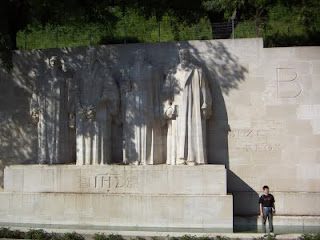
Reformation Monument

Today is Reformation Day. On this day 492 years ago, on Oct 31st 1517, a non-discreet German monk by the name of Martin Luther nailed his 95 theses on the door of the Castle Church (Schlosskirche) in Wittenberg, Germany, in protest especially of the Roman church's sanction of the selling of indulgences by the infamous marketeer Johann Tetzel. This act was the flash point which started the great Protestant Reformation, and forced the professing Church to take a stand on whether it desired Reformation according to the Word of God, or whether it desired power and the philosophy of Man more than the things of God. As it is in the time of the Pharisees, it is the unlearned "Northerners" who embraced the Scriptures, while the learned scholars and humanists in the "South" [Europe] rejected the Gospel for their own profits and philosophies.

492 years later, and the Church is in a worse shape than ever before. All manner of heresies which Tridentine Catholicism did not even descend to flourish within the walls of the professing churches, reformed, evangelical or otherwise. Ancient heresies denounced by various church councils, like for example the Christological heresy of Sabellianism, flourishes in so-called Evangelical circles (ie T.D. Jakes). Although Tridentine Catholicism by its denial of the Gospel of Justification by Faith Alone is heresy, even its proponents would be horrified by what is being promoted in what calls itself the Roman Catholic Church today. Inclusivism, Embrace of Evolutionary theory, not to mention ecumenical endaevors with the "Protestant heretics" and worse still, the Eastern [Orthodox] schismatics and Muslims, would make the Tridentine delegates spin in their grave.

The need to reform the church is getting more and more desperate by the day. The issues to speak out against and the supplantation of error by the truth of Scripture are too many to be counted. The harvest is plentiful, but the workers are few (Mt. 9:37-38). Far from being near to completing the Great Commission (Mt. 28:18-20), we are nowhere near it, and moving further from it by the moment.

Yet despite this, we can take heart in the fact that God is sovereign and in control. We are not to despair of the situation, but to do all we can because God has already gone on ahead of us. While reflecting on the needs of the Church, the following lyrics from a hymn came to mind.

Tho’ with a scornful wonder men see her sore oppressed
By schisms rent asunder, by heresies distressed,
Yet saints their watch are keeping, their cry goes up – “How long?”
But soon the night of weeping, shall be the morn of song

or in Chinese:

教会历尽了苦难,世人讥笑毁谤,
内争分裂她身体,异端叛道中伤,
圣徒儆醒争相问,黑夜到底多长?
哭泣将变为歌唱,转眼即见晨光

As it is stated in Scripture,

And Isaiah cries out concerning Israel: “Though the number of the sons of Israel be as the sand of the sea, only a remnant of them will be saved, for the Lord will carry out his sentence upon the earth fully and without delay.” And as Isaiah predicted,

“If the Lord of hosts had not left us offspring, we would have been like Sodom and become like Gomorrah.”

(Rom. 9:27-29)

The Church exists and perseveres in this world only by the power of God. It is God alone who substains her such that we are not destroyed like Sodom and Gomorrah. In context, the whole of Romans 9 is on the doctrine of election — God's sovereign election of those who would be saved and those who would be passed-over and damned. The Church being made up of the elect are therefore also preserved and substained by the power of God alone. Without God, the Church would be similar to the case of National Israel, rejected by God and as void of life as Sodom and Gomorrah.

It is this understanding of the electing and preserving power of God that gives us hope for the Church, because God is the one who saves His people, who keeps them (Jn. 6:39) and who promises that the Church will never fall (Mt. 16:18b). When we look at the devastation in the churches therefore, let us look with the eyes of faith to see how God is at work even in the midst of great apostasy. As in the days of Elijah, there are 'yet 7000 people who have not bowed the knee to Baal' (1 Ki. 19:18; Rom. 11:4). As it is written:

I ask, then, has God rejected his people? By no means! For I myself am an Israelite, a descendant of Abraham, a member of the tribe of Benjamin. God has not rejected his people whom he foreknew. Do you not know what the Scripture says of Elijah, how he appeals to God against Israel? “Lord, they have killed your prophets, they have demolished your altars, and I alone am left, and they seek my life.” But what is God's reply to him? “I have kept for myself seven thousand men who have not bowed the knee to Baal.” So too at the present time there is a remnant, chosen by grace. (Rom. 11:1-5)

God has not rejected His people, and neither has He abandoned His Church. The true Church of God is the remnant chosen by grace, and as such we can hope. God will always have His people even in the darkest times and places.

Let us therefore look with the eyes of faith and thus not be disheartened at the circumstances around us. Continue to press on in faith, knowing that in the end God will triumph through us. And "soon the night of weeping, shall be the morn of song"

Monday, August 31, 2009

Sunday, April 26, 2009

A belated response to Tim Challies' article attacking watchblogs

I have been writing for quite some time and am now polishing up my article on New Evangelical Calvinism or the "New Calvinism", after receiving constructive feedback from my friend Stephen Macasil.

Anyway, I thought I would post my belated response to Tim Challies' horrible posts attacking watchblogs. For those who have no clue as to what has happened, the "world's most famous Christian blogger" Tim Challies has decided to post an attack article attacking watchblogs as presenting Evil as Entertainment (presumably he is exempted from his own charge?). Both Steve Camp in his post Blogging, Watchblogging and Ministry, and Phil R. Johnson in his post Turning a Blind Eye to Evil is Evil Too have responded to the outrageous attack launched by Challies against fellow Christians. Challies responded to the outrage with a follow-up article Fighting Fire with Fire, in which he made some cosmetic changes but maintained his fundamental stance with regards to the issue.

Previously, I have decided to respond to Challies in the context of my larger article on New Evangelical Calvinism, for otherwise it may be harder to substantiate my refutations since they deal with an issue not normaly seen as errant, New Evangelicalism with its infatuation with positivity. However, it seems that such may not be a good idea after all, so I would be presenting my full rebuttal here first.


The idea of being positive or seen as positive was one aspect of the New Evangelical movement [1] which is however not as easily recognized as demarcating New Evangelicalism per se. The New Evangelical/ Fundamentalist divide is remembered more for the divide over the doctrine of separation, if it is remembered at all. The apostatizing mainstream "evangelicals" in our day have long since jettisoned treasuring and proclaiming the truth, and therefore the New Calvinists do not seem to be New Evangelical in the aspect of truth as compared to the "Evangelicals" nowadays. However, this has not been the case. The early New Evangelicals like Harold Ockenga and Edward Carnell treasure the truth [2] and desire that biblical Christianity experience a revival in the land. Trying to have their cake and eat it however, the New Evangelical strategy of infiltration backfired and it was the world that turned the church upside down instead of the other way round. But it must be remembered that the early New Evangelicals do treasure the truth and were appalled by the fruit of their compromise [3].

The desire to be loving and positive, both New Evangelical traits, have never been repudiated by the New Calvinist movement, a successor of the conservative wing of New Evangelicalism. In fact, these twin related traits manifests themselves in the blogosphere in New Calvinist Tim Challies' blog post attacking so-called watchbloggers [4]. In his highly inflammatory post, Challies utilizes zero Scripture to support his case and through analogy with the secular world accuses watchblogs or discernment blogs as utilizing evil as entertainment, merely because such watchblogs act as watchmen in portraying the errors within the professing visible Church. The irony that Challies is, in this one post of his, doing exactly what he accuses the watchblogs as doing (portraying the errors within the professing visible Church) is seemingly lost on him, as it has been written:

Take note of the irony here: what we just read was a blogger concerned about watchbloggers watchblogging, issuing a very pointed criticism against watchbloggers in general, but in point of fact was watchblogging about other watchbloggers on his own blog. [5]

Phillip R. Johnson [6] and Steven J. Camp [7] have both responded to Challies' article rather well, and it is not our desire to repeat their good arguments against Challies. What is more of concern here is to note that Challies' article betrays his New Evangelical tendency, in his desire to be loving and positive. In his initial attack piece, Challies labeled all Discernment ministries without any distinction and attacked all of them. Being taken to task especially by Phil Johnson, Challies in his follow-up article Fighting Fire with Fire [8] softens his absolutist stance and says that there is "a time and place to expose sin and even to expose sin publicly", but this as we shall see is mere cosmetic change.

The first warning sign that Challies has not in fact changed his view on positivity, on having an infatuation with being positive, comes from the title of the blog post itself "Fighting fire with fire". Taking the example of a forest fire, Challies likened doctrinal error to a forest fire, and the actions of watchbloggers as smaller fires started with the intention of preventing the creation of larger fires. While this may seem to convey his stated point that "negative watchblogging" is sin and cause destruction probably on par with the spreading of doctrinal error, what it also conveys is that both are destructive in the exact same way and degree. That such a bold claim is made is nothing short of astonishing. Does Challies know even one bit of Church history? The most "negative watchblogging", which focus on persons, can do is destroy individuals, which is highly unlikely in the first place. Heresy however attacks the truth and thus permanently destroys individual souls, churches, and denominations, and that destruction continues through time. The former deals with people, the latter with the Truth! It is a symptom indeed of Challies' view on positivity and his myopic view of reality that both are to be regarded as equally bad.

Having sullied the idea of discernment by his inappropriate analogy, Challies continued by poisoning the well. Challies opined on the type of feedback he has received and phrased it in such a way that the impression is given that he has received a lot of hatemail confirming the correctness of his first post, through the use of the phrase "learned more about those watchblogs than I have wanted". Challies is a good writer, and he skillfully uses his words to give the impression that the hatemail he received confirmed that many "watchbloggers" are indeed people who regard evil as entertainment. Even if the majority of emails rebuking Challies are harsh, it is logically fallacious to infer that therefore these same people are treating evil as entertainment. There is simply no causative relationships between the two, unless of course one believe in the principle of positivity as an axiom.

To support his so-far non-existent argument, Challies placed up a couple of links. The first one links to an article by James McDonald [9] about the idea of the gift of discernment used in the flesh. The whole argument is suspect however, for the very issue at hand is taking criticism from other Christians. Are we to suppose that any and ALL criticism equates to the use of discernment? Is McDonald, and Challies by extension, saying that criticism from others equals the use of the gift of discernment albeit in the flesh? It seems that one does not have to be a Christian in order to have this gift! Whether rightly or wrongly, criticism comes to all of us, and to attack the act of discernment and discernment ministries themselves because criticism occurs is utterly fallacious. In fact, since Challies is discerning the watchblogs here, why isn't this act of his done in the flesh?

The second links to New Evangelical Frank Turk's article [10] that discernment is to be exercised within the local church. Since discernment ministries are meant to inform people of error and in so doing contributing to the Great Commission by warning the flock of possible soul-destroying error, Turk's peculiar ecclesia localis centrism logically leads to the conclusion that evangelism is to be done only within the Local Church! This is simply untenable, and therefore Turk's view of the Local Church is in error. The early church came together for worship, prayer, fellowship and sacraments, and went out to reach the world for Christ. The focus always was outward. No doubt we should treasure the Local Church, but ministry is not limited to the Local Church: Evangelism for example should be always done without to reach lost souls for Christ. The early church in Acts also did not know of Turk's peculiar emphasis on the Local Church, and there never was a situation whereby Christians refuse to minister together or to accept each other's ministry because they were not of the same Local Church! Last of all, it will suffice that Turk is violating his own advice since this article of his is not posted within the context of the Local Church anyway, not to mention Turk is not a pastor or elder so he has disqualified himself on his own principles!

Challies finished by basically repeating the essence of his initial post. In his own words:

But a blog that has as its bread and butter exposing error in the church, and especially error that is completely decontextualized and irrelevant to any of its readers, is a blog I think we ought to avoid [11]. A Christian’s thoughts ought to be dominated by “whatever is true, whatever is honorable, whatever is just, whatever is pure, whatever is lovely, whatever is commendable, if there is any excellence, if there is anything worthy of praise, think about these things” (Philippians 4:8). As I said last Monday, “Do I really need to read and to know about the seedy underbelly of the church, when such things happen thousands of miles away, among people I will never meet and in places I will never be? Such news is plenty entertaining, but it is useless to me. It does nothing to further my faith or to cause me to grow in godliness.” [12]

The problem with Challies which can be seen here is that he has attacked the idea of discernment ministries in general, in his bid to be positive. This has nothing to do whatsoever with the responsibility of the readership, an issue which must be kept totally separate.

Now of course, is there nothing to Challies' complaint? Of course there is! There are so-called "discernment" blogs that I personally do not exactly want to be associated with. But to attack "watchblogs" in general and state that the problem is that they are "doing discernment in the flesh", or are using "evil as entertainment" attacks the very actions of discernment itself and is a judgmental statement on the state of people's souls. How does Challies know whether a person is operating a watchblog because he is concerned over others, or because he wants to destroy others or entertain others with evil? He doesn't! Also, we shouldn't confuse the motives of the writers with the motives of the readers. If people read it because they want to be entertained by evil, the blame should be placed on the reader not the sharer of information, unless it can be proven that that was the motive of the sharer in posting it also.

The proper biblical response to inappropriate "discernment" ministries is to lovingly reach them and call upon them to be loving as well as discerning. Most of these people are doing such because they are concerned over what is happening in the churches, not because they delight in entertaining people with evil. Instead of attacking them, they should be given loving guidance. In the case of inappropriate judgments, we should correct them in love and if they reject it, to stand firm in the truth. If rebukes are required, the offending parties are to be named, their errors shown biblically and specifically, and they are to be called to repent. Such people are wrong because they have no love or they make a wrong judgment, not because of their action of discernment.

Challies with his view of being loving and positivity has manifests his New Evangelical convictions and has done damage to the cause of Christ, with legitimate discernment ministries de-legitimized and the enemies of the Truth emboldened [13]. Just like New Evangelicalism historically, such an infatuation with positivity will slowly but surely destroy the Church. Will we reject this infatuation with positivity? Of course, this does not mean that we extol negativity; we should not strive to be either positivist or negativist, but to be biblical and embrace both in antithetical living. As it is written:

I charge you in the presence of God and of Christ Jesus, who is to judge the living and the dead, and by his appearing and his kingdom:preach the word; be ready in season and out of season; reprove, rebuke, and exhort, with complete patience and teaching. For the time is coming when people will not endure sound teaching, but having itching ears they will accumulate for themselves teachers to suit their own passions, and will turn away from listening to the truth and wander off into myths. As for you, always be sober-minded, endure suffering, do the work of an evangelist, fulfill your ministry (2 Tim. 4:1-5)

Note the pattern here: Verse 1-2 are "positive" verses, which is followed by a "negative" verses in verses 3-4, and capped with a "positive" statement in verse 5. Such patterns are in fact found throughout the Scripture, and this antithetical teaching and lifestyle should characterize the lives of Christians. We are to be positive and negative; positive towards godliness and truth and negative towards ungodliness and error. New Evangelicalism threw out the need to be negative, while Fundamentalism in general tend to throw out the need to be positive. Biblical Christianity is both, and may we therefore embrace both.

REFERENCES:

[1] Earnest D. Pickering, The Tragedy of Compromise: The Origin and Impact of the New Evangelicalism (Greenville, SC, USA: Bob Jones University Press, 1994), p. 8

Early New Evangelical leaders took great pains to emphasize the fact that fundamentalists were too much "again" and not enough "for". Their plea was "Let's be positive and not negative". While this statement has an emotional appeal to many, it is not a biblical philosophy. Scripture is both positive and negative — it is for some things and against others. We must strive for that same balance.

[2] Iain H. Murray, Evangelicalism Divided: A Record of Crucial Change in the Years 1950 to 2000 (Carlisle, Pennsylvania, USA: Banner of Truth Trust, 2000), p. 20

[3] Pickering, pp. 78, 96-97

[4] Tim Challies, Evil as Entertainment, Blog post dated April 6, 2009 (http://www.challies.com/archives/articles/evil-as-entertainment.php)

[5] Steven J. Camp, Blogging, Watchblogging and Ministry, Blog post dated April 8th, 2009 (http://stevenjcamp.blogspot.com/2009/04/blogging-watchblogging-meta-and.html)

[6] Phil. R Johnson, Turning a Blind Eye to Evil is Evil Too, Blog post dated April 9th, 2009 (http://teampyro.blogspot.com/2009/04/turning-blind-eye-to-evil-is-evil-too.html)

[7] Steven J. Camp, Blogging, Watchblogging and Ministry.

[8] Tim Challies, Fighting Fire with Fire, Blog post dated April 13, 2009 (http://www.challies.com/archives/articles/fighting-fire-with-fire.php)

[9] James McDonald, Great Damage: The Use of the Gift of Discernment Used in the Flesh, Blog post dated March 2, 2009 (http://blog.harvestbiblefellowship.org/?p=1527 )

[10] Frank Turk, Establish Elders (3), Blog post dated April 8, 2009 (http://teampyro.blogspot.com/2009/04/establish-elders-3.html)

[11] Note that Challies' positivity criteria would function to throw a watchblog like Chris Rosebrough's Museum of Idolatry (http://www.alittleleaven.com/) under the bus, a blog site which Phil Johnson defended as serving a valid function.

[12] Challies, Fighting Fire with Fire

[13] One just need to glance at the meta of Challies' two posts to see Warren apologist Richard Abanes and Chris Lyons of the anti-Christian watchblog CRN.info praising Challies and attacking the watchblogs, to see the damage Challies has done.

Sunday, April 05, 2009

Quote: The heresy of heresy-hunting

Here is an interesting quote taken from a book by Dr. Peter Jones:

It is Satan's sincerest wish that we should never make a negative judgment about those who set out to destroy the Church and its foundations, or who spread deadly heresy and false doctrine. Correspondingly, the real reason that human non-judgmentalism in any form is becoming so fashionable in this age is that it makes the concept of a judging, avenging God seem ridiculous, anachronistic and implausible.

- Alan Morrison, The Serpent, p.200. As cited in Peter Jones, Spirit Wars: Pagan Revival in Christian America (Mukilteo, WA, USA: WinePress Publishing, 1997), p. 74

Sounds familiar? This comes from a section in the book under the heading The Modern Heresy: Heresy-hunting.

Wednesday, December 10, 2008

Some book reviews

Here are some book reviews that I have done on the books I have recently finished.

Called to the Ministry by Edmund P. Clowney (Review here)

Redemption Accomplished and Applied by John Murray (Review here)

The Discipline of Spiritual Discernment by Tim Challies (Review here)

All of these books are highly recommended. Although I have bones of contention with John Murray with regards to the promotion of Neo-Amyraldism, this particular book — Redemption Accomplished and Applied is excellent in its biblical presentation and defense of Reformed soteriology.

Monday, September 15, 2008

Interesting quotes that are a sad indictment on "evangelical" Christianity

David Servant has posted the article Three Lessons from Lakeland in which he has extracted three lessons to learn from that fiasco. Going off on a tangent however, here are two quotes which are a sad indictment of the contemporary "Evangelical" scene (not just limited to the Charismatics by the way)

One lesson we can all learn from Lakeland is that you can toss out the gospel found in the Bible, kick and punch people who are seeking healing, regularly chat with angels with names like “Winds of Change” and “Emma,” act like a drunken fool, transfer your anointing so that others can spread these blessings around the globe, repeatedly exaggerate and lie, gain riches in the process, and be a successful minister in the U.S. But whatever you do, don’t divorce your wife. That could ruin you (at least temporarily).

It is very very sad that Christians behave exactly like the world in this regard. Heresies of all kinds are allowed to be taught, but anytime you commit one of the "big" moral sins (in this case divorce), you are done for. This is not to say that divorce is a small thing; the moral outrage at Bentley's unfaithfulness is justifiable But why, oh why, is it that we have our pet sins, the new "sins against the Holy Spirit", which when committed ruin a minister, but the much more pernicious and damnable sins of heresy are allowed to be committed with impunity from the pulpit, and God's people are not outraged!!??! Not even a fraction of outrage will you get from promoting heresy as compared to any type of moral failing?

And

What is the motive of those whom God has not called to be apostles or prophets yet who claim to be apostles and prophets? It can only be pride and self-exaltation. For this reason, thousands of ministers in North America and elsewhere are seeking titles and joining organizations like the International Coalition of Apostles (where membership dues are $650 per year). They want recognition, and so they play a more subtle version of the child's game King of the Hill. It wasn't too long ago that these self-promoters were vying only for the title of "bishop."

Nothing much to add here, except to note the latest advertisement from "apostle" Chuck Pierce for a product which was used in Bentley's "anointing" service.


Be Revived Anointing Oil and Candle Set

Revival is in the Earth’s atmosphere! Because the anointing breaks the yoke, we have sought the Lord on the ingredients needed for a revival fire anointing oil and candle. The first aspect of Be Revived is “awakening”. We use costmary, an original herb used by the colonists to stay alert and awake. The second ingredient we incorporate is pomegranate, representing healing, overcoming and prosperity. The third ingredient is “harvest”. This is a mixture of botanicals which represent the fullness of unlocking the harvest fields. There is a boldness that God is bringing on His people to pray over others. We must come alive and be bold witnesses in this hour. Be revived and use these resources to “break the yoke” as you minister to others.Candle with 1 oz. Anointing Oil Roll-on is $20 (regularly $22)


I guess such blasphemy speaks for itself. Sometimes I guess it hurts so much to see such blasphemy that the only sane response left is satire.

[HT: End Times Prophetic]

Sunday, August 31, 2008

Slicecast: A Word to Christians Online

Very good interview with Pastor Dustin Segers in the latest slicecast here, especially with regards to the potential pitfalls for those of us who take Jude 3 seriously.

When we as Christians interact online, how do we keep from becoming distracted by the mockery, scorn and sin that dominates in much of the blog world? Does it matter if we neglect our families in pursuit of “sound doctrine?” How do we keep our focus on Christ when we face constant attacks from those who are enemies of the cross? Pastor Dustin Segers of Shepherd’s Fellowship in Greensboro, North Carolina minces no words on this podcast today. Christians have to be on guard against those who would draw us into foolish debates and arguments, gossip and time wasting pursuits. Psalm 1 provides the guideline: don’t waste time with the scorners. We are to be like Nehemiah, refusing to leave God’s work for fruitless debate and argument with those who will not acknowledge the truth. In this Slicecast, there is something for everyone who spends time online. We need to examine ourselves regularly to make sure our conduct is Christ-honoring and focused on the tasks God has given us. We’re not wrestling against people. This is a spiritual battle, and that is easy to forget.

Click here to download this episode.

See also Loving the Lord while avoiding Distractions

Tuesday, July 22, 2008

Devouring one another

But if you bite and devour one another, watch out that you are not consumed by one another. (Gal. 5:15)

Following from my previous post on the differentiation between being watchmen and just being a gossip, there seems to be some people involved in pointing out what they perceive as errors and heresies who either align themselves with the ODM (Online Discernment Ministries) or the ODAODM (Online Discerning Anti-ODM). Previously, I had ignored the dynamics between the two and even some of their antics. However, since having being harshly attacked recently, and slandered and libeled by these "discerning people" (or "anti-watchmen" people), I have began to ponder about the situation.

As the previous post states, our attitude when showing forth the error of others is to be one out of love and not in glee when another falls. Yet it seems that are quite a few people who delight in attacking others personally. Not only that, they post outrageous lies about others, even setting up blogs with the sole purpose just to attack another brethren in Christ (It happened to me once by OldSchoolCalvinist before it was deleted). All of this is done of course apart from the teachings of Scripture. Rather, there is a certain spirit of bitterness in their actions; in using the public space afforded them via the Internet to blissfully slander others while sanctimoniously disavowing that they are doing this (attacks) as watchmen or teachers.

The spirit of devouring each other is alive and well on the Internet, unfortunately. Under the guise of "discernment" or "exposing the heresy hunters", representatives from both sides and especially all of the AODM turn against those doing the work of Christ and hinder their work. Recently, the Goforth conference on missions, which was held in Singapore, ended. I wasn't keen because of various reasons which I shall not be posting about now, though it surely is a mixed blessing to the churches involved, and my friend Huaizhi has blogged a bit about it here. What I wanted to focus on however, is an example of some who deemed it alright to criticize the conference without even understanding what it is about, plus the fact that the person does not even comprehend that the particular talk was about the priesthood of believers, who are all empowered for ministry. Strawmen, non sequiturs, various forms of misrepresentations and even outright lying and slander abound in such circles who, although they do not claim to teach, sure put forth their opinions on certain issues very forcefully.

But avoid irreverent babble, for it will lead people into more and more ungodliness, and their talk will spread like gangrene. (2 Tim. 2:16-17a)

As Paul exhorted Timothy, so we should do likewise in avoiding such people and the nonsense they sprout. For example, it would be very well for all of us to avoid the waste of webspace called CRN.(mis)info, who act as the watering hole by which all manner of false accusations against true discernment and watchmen ministries are thrown, debated and refined. Ignore such people and their irreverent babble, for interaction will pull us down to their level and lead to more and more ungodliness in our conduct. Let them slander all they want, in the end God will take care of them. After all,

A man that is an heretick after the first and second admonition reject; Knowing that he that is such is subverted, and sinneth, being condemned of himself. (Titus 3:10-11 — KJV)

As for a person who stirs up division, after warning him once and then twice, have nothing more to do with him, knowing that such a person is warped and sinful; he is self-condemned. (Titus 3:10-11 — ESV)

Such divisive people are self-condemned, and as such we do not even need to bother with their nonsense.

One thing which has happened which will shift my future focus on this blog also is the realization that not all who call themselves conservatives are truly for the Lord. My previous experience with Charismania drove me to Conservatism, yet it seems that I am forced to the reality that the lines of good and evil run through every movement. I was previously almost totally trusting of Conservatism and of the entire Fundamentalist movement; that they are right in doctrine though probably are over-reacting to the errors of the New Evangelicals in their praxis. The recent attack on my character by people affiliated with 'OldSchool' Fundamentalist separatists slowly change all this. Looking through rose-tinted glasses, it was my view that if only we were to show them that we embrace orthodox doctrines and center our lives on the teachings of Scripture, and show that to them through Scripture, the traditionalist separatists could be won over back to doing the task which Christ has given to the Church — to fulfil the Great Commission. Yet such was a mirage, a chasing after the wind in presupposing that all that separates ultra-conservatives from true Christianity is their siege mentality founded on fear. I was really a fool to think that way. Of course, this is not to say that there are conservatives who are not ostriches and are looking outward and desiring to fulfil the Great Commission, but my former impression that they are one monolithic group with regards to this issue has been shattered.

And Paul and Barnabas spoke out boldly, saying, “It was necessary that the word of God be spoken first to you. Since you thrust it aside and judge yourselves unworthy of eternal life, behold, we are turning to the Gentiles." ... And when the Gentiles heard this, they began rejoicing and glorifying the word of the Lord, and as many as were appointed to eternal life believed. (Acts 13: 46, 48)

Whereas as before, my mindset was on winning the traditionalists for the work of the Church. Yet now, seeing how some at least prefer their own holy huddle rather than to work towards the fulfilling of the Great Commission, and constantly attack and deride those who are trying to do the work of God, the focus will shift and move on. From now on, as for me, I will see how I can contribute in building the churches (including New Evangelical ones as long as they have not apostatized) and bring them to biblical soundness, and the people therein. These 'OldSchool' Fundamentalist Separatists can take care of themselves and stay in their holy huddle for all I care, for they have to answer to God for their own conduct anyway. In point of fact, if such people are representative of the Fundamentalist movement during the early 1950s/60s (hopefully not), I will really symphatize with the early New Evangelicals and support them over against the Fundamentalists then.

Monday, July 21, 2008

Watchman or Gossip - A corrective to the pitfall of a critical spirit

The duty of a watchmen in warning Christians of the enemy and the tactics of the enemy (Ez. 3:17-21) is surely much needed in this time of great deception in the visible churches. Yet, focusing too much attention on errors is surely unhealthy for the soul and creates the potential to fall into the sin of having a critical and judgmental spirit. This post from Herescope (a discernment ministry blog) written by Anton Bosch clearly show us the right attitude we should have as we earnestly contend for the faith which was once for all delivered to the saints (Jude 1:3).

How do we react to the news of the fall of Christians, or to the rumor of the latest heresy that comes out of the camp of the false teachers? Do we take delight in pouncing on the latest tidbit of scandal and spreading it as wide as possible? Or do we react like David and Samuel did?

Will we delight in reporting the latest heresy or the fall of a Christian leader, or do we grieve even as we report it, lamenting the destruction caused by heresies and sins?

[HT: Christian Research Net]

Note: This has nothing whatsoever to do with the necessity for discernment, so the vultures of the AODMs are not welcomed here.

Saturday, May 31, 2008

On the fire-storm going on over Chris R and Bob DeWaay's visit

I have been informed of the growing fire-strom primarily on Chris Rosebrough's blog after he publicly thanked Rick Warren for hosting him and Pastor Bob DeWaay at Saddleback and listen to their concerns over the PD paradigm. It seems that Warren invited many of his critics (not me however), and offered to pay for and host them at his conference at Saddleback Church, and afterwards hearing their concerns. Ingrid Schlueter declines the invitation along with a couple of others, but Chris Rosebrough and Bob DeWaay attended it.

The fire-storm was generated when, because of Chris' somewhat glowing thanks for Warren's hospitality, a couple of people decided to warn him because they knew of Warren's deceitfulness; of his playing the game of the Hegelian dialetics. Richard Abanes decided to pour oil onto the volatile situation, plus the ever-so-helpful destructive CRN.(mis)info added rocket fuel to the mix. The result is one big explosion, no thanks to these foxes who ruined the Vineyard (SoS 2:15), leaving a mess for us to pick up.

Anyway, first of all, it must be admitted that there is nothing wrong with going to Saddleback and calling upon Rick Warren to repent. That some may have decided not to do it like Ingrid is perfectly fine. But that others choose to do so is perfectly fine too. And there is nothing wrong wih thanking Rick Warren for being hospitable for that matter either.

The problem comes about when others would prefer a hardline approach to Rick Warren, and because they know of Warren's methods, are very wary of his kindness. That of course is a legitimate fear, for it is very easy to be disarmed by people's kindness into deception, myself included. After all, none of us like conflict. (And if you do, please do us a favor and go see a psychiatrist, or better still repent of such an attitude). The issue of being charitable then is conflated with the issue of diabolical dialetical deception, and therein lies the knotty situation we find ourselves in.

To untangle this mess, we should first of all remember some principles:

1) There is nothing wrong with praising someone (anyone) for something he did do which was good or right

Rick Warren may be many things, but he is not the devil. Ditto Richard Abanes. We must always not be too over-sensitive, as if anything praising Rick Warren does is de facto wrong, or Richard Abanes for that matter.

2) That said, we must be careful of our speech and mindful of the sheep

In this, I think Chris Rosebrough was not sensitive of the situation nor mindful of what may happen. As Rom. 14:21 says, we are not to do anything which causes our brethren to stumble. Knowing that many Christians are hurt and scarred by the PD paradigm, and knowing that the process by which the PD paradigm is introduced into churches is through the unbiblical and highly subversive change-management Transitioning techniques, it is my opinion that Chris should have taken all of these into account when he posted that post of his. Yes, it is wrong to wrongly infer that praise for Rick Warren on anything means that one is mesmorizeed by Rick Warren, but knowing the presence of such sensitization, shouldn't we not take that into account instead of just posting whatever we feel like posting?

Now, of course, this does not mean that we should all just gag ourselves out of fear of offending weaker brethren, but we can post disclaimers and put a damper onto what seems otherwise to be just exuberant praise. For example, you can make a short note that you still think Rick Warren has severely compromised the Gospel, even denying it, or something along those lines. Although that may not satisfy everybody, it would do much to alleviate much of the storm that is going on, and would not stumble our weaker brethren who are still hurt and wounded by the PD paradigm.

Another thing which Chris fails to do is to rebuke Richard Abanes. It was obvious that Abanes was instigating much of the heated exchange and bringing out the worst in others. And that is one reason why my blog has rules, and I do enforce then and moderate the comments. Our goal should be to edify the flock and not to contribute to confusion and an increase in animosity, and most definitely contribute to stumbling the flock. It is my opinion that Chris contributed to the mess by not commenting as he should and instead let the whole discussion take on a life of its own.

3) We should not second-guess others' intentions or motives, unless they are made explicit

Chris has been under-fire for not planning to publicly release the interactive session he and Pastor Bob DeWaay have with Rick Warren. This is regrettable. While it is good to release it publicly, it is not a sign of compromise if Chris decides NOT to release it. To think just because of that that Chris has drank the PD kool-aid is to second-guess his intentions, which is wrong. Of course, Chris is not above blame also, for reasons which are stated in section 2. Instead of just giving reasons which are probably valid, it is always good to assure people that you are still against the PD paradigm (as I am sure he still is), instead of just giving a "Trust me" answer, or worse still, invoke Mt. 18! And frankly speaking, those who have been hurt by the betrayal of the church leadership due to the PD paradigm are most definitely not assured by such an approach. Does Chris not know this to be the case? Does he not know that such an action ("Trust me" approach) will stumble the sheep who have probably witnessed the same tactic used by their leaders who betrayed them? Ditto the Mt. 18 verses which are distorted by these very same folks, and of which the mere mention of them wil set up alarms in anyone who faces the gag command found not only in the PD paradigm, but also in a lot of movements like the New Apostolic Deformation Reformation for example.

So this is the concern over the fire-storm over at Chris's site, and hopefully this should help us to untangle the mess and move on. We should remember also that Rick Warren, and Richard Abanes is not our main enemy but the pawns of the enemy; Satan is. We are to love them and desire their repentance and salvation, not to condemn them to hell.

Another thing which was quite interesting was Pastor Bob DeWaay's comments on his meeting made on his May 25th Sunday School Discussion, in which Pastor Bob said that he found that Rick and him shared essentially the same beliefs. Having looked at the PD paradigm, it is rather more accurate to say that Pastor Bob DeWaay shares the same beliefs as Rick Warren's professed beliefs. For orthodoxy (correct belief) should lead one to orthopraxy (correct living), and therefore for Rick Warren to continue his waywardness while professing Christian beliefs shows that his profession is not actually what he believes, otherwise he wouldn't do what he has indeed done. I'm sure even I can find myself professing many of the same beliefs that Rick Warren professes, but what use is it to merely profess the faith, rather than truly believing it? This then should be our concern and thus I think it would be better for Pastor Bob DeWaay to make this clear also.

So therefore, it is my hope that this would contribute to peace-making within the Christian community over this issue. May we continue to stand firm in the faith, and tak care not to stumble each other needlessly, for the glory of God alone. Amen.

Sunday, January 27, 2008

Biblical Dialetics? An expose of the abomination that calls itself 'Progressive Christianity' **Update**

**Update**: It seems that Pastor Rayburn is actually pastor of Faith Tacoma Church (PCA), and that he was giving a series of sermons in Harvest OPC then. Thanks to John for the feedback regarding the error, which is corrected now.

*Update*: I probably have erred on the identity of "Rabbi" Duncan, so I'lll withdraw that part. Thanks to those who feedbacked to me the information.

I have on the Net recently came across a former friend, Jonathan Koh, a former Reformed Charismatic turned visibly apostate, and who mentioned that he is now attending the Word-faith New Creation "Church", though presumably not a member. As he is adamant in promoting his heresies and false ecumenism online, I think it would be instructive to look at one aspect of his heresy for now; that of the embrace of the philosophy of dialectics. Unlike his Emergent friends, Jonathan is not so slippery and thus it is easier to hold him on the statements that he has made.

Just some background so it would be seen where I am coming from. Jonathan was a person seemingly passionate for the cause of Christ and the Reformed truth when he joined my former church, Covenant Presbyterian Church, when I was still rather young (~ 16-18 years old I think) and didn't know much about anything, though newly converted then. He taught my younger brother in their cell group and was a friend of ours. One thing I remembered was when he tried to taught my brother's cell about the topic of predestination, of which I didn't have a view (If pressed, I would answer like an Arminian) then. Needless to say, from the responses, I garner that almost nothing went through to them, due to the topic being 'very profound'. He also organized all night prayer meetings and for some time, it seemed that the youth ministry would be progressing towards greater growth in biblical spirituality.

However, his idealism created a dissonance within him as he was naive enough to think that doing such would create revival, and the resistance of the higher leadership to change was not helping matters, leading to disillusionment. And the flaws within himself began to show, as his foundation on the truths of the Reformation began to show itself as being shallow (Mt. 7: 26-27). He was then also interested in sociology and political science, of which he read some of their works then also. His epistemological shallowness began to show as the lies spun by the Liberals and their allies in the media on topics such as Israel and the so-called "Palestinian occupation" began to be imbibed by him without discernment. And of course, those causes are very safe, costing little in terms of personal sacrifice and pain compared to the cross and discouragement of ministry, and the people ARE indeed passionate about what they do. Not to mention that Satan will not be actively working against you if you take up such causes. Anyway, he left the church when he went to study overseas and we lost contact with him soon after.

This is just a brief summary of Jonathan's life as I came to know him then. Since then, he has changed a lot especially in his embrace of postmodern epistemology, or rather called 'Modernism part II'.

Let it be said that I do this not out of anything but love, although Jonathan in our recent exchange was very judgmental in libeling my motives, as if he is God and knows them. I hope this warning and expose would have a three-fold effect. First of all, it is sincerely hoped that the Holy Spirit would convict Jonathan of his heresy and that he would repent of this. Or if he doesn't, then the truth would harden his heart in preparation for future wrath (Rom. 2:5). Secondly, for those who look on, by his example, it is hoped that we be warned of the particular heresy that Jonathan has fallen into, and that we can learn to exercise discernment and learn from his mistakes. Being enthusiastic about the Christian faith, and of the Reformed truths even, means nothing, for in Jonathan's case it could be the case of the seed which sprung up on rocky ground, and were destroyed when the sun of trials come (Mt. 13:5-6). Thus, it pains me to do this, but where the truth of God is concerned, God is above all others, and I will not allow such heresy to remain unchallenged.

With such a long introduction, let us look at the piece written by Jonathan Koh his website/blog here.

In this article, Jonathan promotes the philosophy of dialectics. From his piece, it can be seen that the strain of dialectics he is promoting is a form of the Hegelian dialectic of thesis/antithesis-synthesis in keeping contradictions together as part of the truth. The dialectical method he is promoting is that seen here, in an attempt to "overcome formal dualism" in positing transcendence of the truths of so-called contradictions found within the Bible. This is made very explicit in the various quotes Jonathan placed there in which the very idea of holding contradictions in tension and resolving none of them but instead celebrating both is put forth. As examples, Jonathan quotes:

I would run after nothing and shun nothing… the truth is not in the middle, and not in one extreme, but in both extremes. (Charles Simeon)

Preach the antinomies of truth, and carry each out a far as it is possible to carry it. But don’t attempt to reconcile them. These two lines [/ \] will meet if produced far enough. But if I try to make them meet, I give one or other of them a twist, and so reduce it from being a straight line. ... (Rabbi Duncan)

Christianity got over the difficulty of combining furious opposites by keeping them both, and keeping them both furious. (Chesterton)

There is revelation only as the contradictions are held together. (Jacques Ellul, The subversion of Christianity)

We would look at some of his supposed contradictions later, but suffice it is to say that one such contradiction that he puts forward is the 'contradiction' between faith and works. Does Federal Vision ring a bell here?

First of all, I couldn't care less about the 'reputations' of these people, as Scripture alone is my authority. That does not mean that their reputation does not mean anything, but God's Word reigns supreme. The person that Jonathan mentions upon hearing his sermon is one Pastor Robert Rayburn, a PCA pastor preaching then in an OPC church. I do not know Pastor Rayburn, but I would be charitable to Pastor Rayburn, and until evidence is found, assume that Jonathan misunderstood him. With regards to the other authors, I have no idea since when a Roman Catholic could be termed as an authority in epistemology, especially with regards to the truths of Scripture. That again shows Jonathan's embrace of anybody who seems intellectual, even if the person is teaching heresy; the worship of the Academy.

And with that, let us look into the issue proper. Does Scripture promote the Hegelian dialectic? Of course, examples could be given and will be analyzed later as to whether they truly are contradictory, but for now, let us analyze the issue epistemologically.

It can be easily seen that the Bible does not promote such irrationalism. First of all, the entire thought pattern of the Bible is dualistic, from Genesis to Revelation, without any mixing of the thesis/antithesis pair. God is set in opposition to Satan, good vs evil, obedience vs disobedience, election vs reprobation, love vs hate, saved vs lost, light vs darkness and we could go on and on. Those who truly read the Bible for all its worth will develop a sharply antithecal mindset and see things in thesis/antithesis pairings. An example of such antithecal wording can be found in phrases like 'for the one who is not against you is for you' (Lk. 9:50ff) and 'And if anyone's name was not found written in the book of life, he was thrown into the lake of fire' (Rev. 20:15). To make it very apparent, to be a Christian is the opposite of being a non-Christian. One cannot be a Christian and a non-Christian at the same time.

This brings us to the fundamental issue — the law of non-contradiction. Jonathan probably did not study logic, but to deny this law is just plainly absurd, for the denial of the law of non-contradiction is definitely not the affirmation of such a law (Reductio ad absurdum). Yet, this is what dialectics seeks to have. We must remember that dialetics does not just deal with seeming contradictions or paradox, since these are solvable. Rather, they deal with flat-out contradictions which are irreconcilable or antinomies. Therefore, to embrace the Hegelian dialectics epistemologically is to commit epistmological suicide, which Jonathan has done. In Jonathan's view therefore, one can deny Christ and yet be a Christian and go to heaven (ie Brian McLaren), since there is no need to be logically coherent. In other words, the only authority for Jonathan's words are himself or the Academy (when his views happen to be the same as theirs), all being totally irrational, unbiblical and unlivable. Debating therefore with Jonathan, like probably with any of the Emergents, is useless, for they are not committed to being rational. They can say anything they want, and affirm and deny the faith in the same breath. And of course those who criticize them would be deemed to be 'Modernistic', which show their either ignorance or denial of what Modernism actually is.

After dispensing of the heresy of the dialectic, let us look at the various examples which are so-called antinomies or logical contradictions. Jonathan listed the doctrine of people being at the same time sinners and yet saints (justified), how the Kingdom of God is here and not yet, how Jesus is wholly Man and wholly God, the doctrine of the Trinity, and how the Bible teaches justification by faith yet judgment about works. It is the biblical position that none of these are antinomies, since if they contradict each other, then the Christian faith is in error, since God is not God and not-not God at the same time, and God states that He is truth (Jn. 14:6) and is logical (Jn. 1:1), not both truth and error, and both logical and illogical at the same time in the same sense

Take the first example given. Christians are sinner yet saints. However, this is not a contradiction because we are not sinners and saints in the same manner. We are sinners by nature, and saints by legal declaration and through adoption, and not both sinners and saints in the same manner. In the same way, an adopted child is not the child biologically but is the child by adoption, thus he/she can be said to be both the child and not the child of a couple. Ditto for the Kingdom of God. The Kingdom of God has come in the spiritual sense secretly. It is in this sense that the Kingdom of God has come. Yet the Kingdom of God has not come in the sense of Christ coming visibly to all and bringing the entire creation into judgment, and fulfilling all history, and thus it is not yet come. Failure to differentiate between the senses creates a false contradiction where none actually existed.

With regards to the others, that Jonathan mentioned them shows how far from orthodoxy he has strayed. The hypostatic union of Christ (100% human and 100% God) is not illogical. It is a mystery in that we cannot comprehend totally what this means, but it is not a contradiction, unless you add the premise that the class of humans and God is mutually exclusive. But upon what can we maintain that? Just because no human is God does not mean that there can never be one person who is both God and Man. The contradictions will only exist if a faulty premise is maintained about the mutual exclusivity of the natures of God and Man. Such a position is counter-intuitive to be sure, but it is not illogical. With regards to the Trinity, the orthodox position has always been that God is three persons in one essence/nature. A contradiction would only arise if God is three persons in one person, or three nature in one nature., because 3 ≠ 1. But just as there is no contradiction in saying 3x = 1y, but contradiction in saying that 3x = 1x, from whence the contradiction? Jonathan by using such examples only show he does not even understand, or is purposefully ignoring, the formulation of these historic Christian doctrines.

The mention of faith and works is at the core of the Reformation, and if the undermining of the hypostatic union and the Trinity ring hollow in the ears of modern Evanjellifishes, then perhaps they might want to consider the more practical mess you will get when you add works in order to gain salvation. The Bible is explicit that faith and works are mutually incompatible (Rom. 3:28, Rom. 4:4-5, Gal. 2:16). What then about Jonathan's statement? If what is in mind here is the fact that believers will be rewarded for their labors, then there is no contradictions, for such works count after salvation by faith. In other words, works still play no part in salvation. However, Jonathan actually have in mind something deeper. What he has in mind is the Scriptural commands of obedience, which would thus cut directly into the whole Lordship controversy issue. However, that is only a contradiction if one refuses to follow the plain teachings of Scripture. The commands of obedience can only be obeyed by Christians, since they received a new regenerate heart (2 Cor. 5:17) and thus have a new nature that can obey God. To place obedience as a prerequisite for salvation implies that unregenerate unbelievers can somehow strive towards obedience, which the Bible explicitly denies, as no one seeks for God. (Rom. 3:11). I am surprised that Jonathan does not seem to realize this as he claimed to be a Calvinist earlier in his life, and thus should know about the doctrine of Total Depravity.

It is a sad day when a person apostatize from the faith, and especially someone who held a lot of truth and had great passion before. Yet, such people have been prophesied before in Scripture and we are to avoid them like the plaque they really are.

They went out from us, but they were not of us; for if they had been of us, they would have continued with us. But they went out, that it might become plain that they all are not of us. (1 Jn. 2:19)

For it is impossible, in the case of those who have once been enlightened, who have tasted the heavenly gift, and have shared in the Holy Spirit, and have tasted the goodness of the word of God and the powers of the age to come, and then have fallen away, to restore them again to repentance, since they are crucifying once again the Son of God to their own harm and holding him up to contempt. For land that has drunk the rain that often falls on it, and produces a crop useful to those for whose sake it is cultivated, receives a blessing from God. But if it bears thorns and thistles, it is worthless and near to being cursed, and its end is to be burned. (Heb. 6:4-8)

For if we go on sinning deliberately after receiving the knowledge of the truth, there no longer remains a sacrifice for sins, but a fearful expectation of judgment, and a fury of fire that will consume the adversaries. Anyone who has set aside the law of Moses dies without mercy on the evidence of two or three witnesses. How much worse punishment, do you think, will be deserved by the one who has spurned the Son of God, and has profaned the blood of the covenant by which he was sanctified, and has outraged the Spirit of grace? For we know him who said, “Vengeance is mine; I will repay.” And again, “The Lord will judge his people.” It is a fearful thing to fall into the hands of the living God. (Heb. 10:26-31)

And with regards to the comment that Scripture is obscure, this is what Scripture says:

The natural person does not accept the things of the Spirit of God, for they are folly to him, and he is not able to understand them because they are spiritually discerned. The spiritual person judges all things, but is himself to be judged by no one. “For who has understood the mind of the Lord so as to instruct him?” But we have the mind of Christ. (1 Cor. 2:14-16. Bold added)