Tuesday, November 10, 2009

The implosion of global Anglicanism and a falling away from the Faith

With the break-up of global Anglicanism due to the crisis in the ECUSA caused by the embrace and celebration of deviant sexuality by her leaders, the newly formed ACNA (Anglican Church in North America) and the Global South coalition are still trying to resolve the mess formed in the aftermath of the schism and total apostasy of the ECUSA (although it has already apostatized much earlier, but this it seems is the straw that broke the camel's neck for a lot of Anglicans — Says a lot about the importance they place on orthodoxy as compared to orthopraxy). The Roman Church, seeing an opportunity, has seen fit to poach some sheep as Anglicanism continues to fracture with the release of the document Apostolic Constitution ANGLICANORUM COETIBUS.

In response, the 'Global South Primates Steering Committee' has issued a statement as follows:

1. We, under-shepherds of the one, holy, catholic and apostolic church of Jesus Christ, bring greetings to the faithful in the Anglican Communion. Grace to you and peace from God our Father and the Lord Jesus Christ. For in his great love for us, we are no longer foreigners and aliens, but fellow citizens with God’s people and members of God’s household, built on the foundation of the apostles and prophets, with Christ Jesus himself as the chief cornerstone. In him the whole building is joined together and rises to become a holy temple in the Lord. And in him you too are being built together to become a dwelling in which God lives by his Spirit (Ephesians 2: 19-22).

2. The Vatican announcement on Apostolic Constitution gives us an occasion in making the following pastoral exhortation.

3. We welcome Pope Benedict XVI’s stance on the common biblical teaching on human sexuality, and the commitment to continuing ecumenical dialogue.

4. At the same time we believe that the proposed Anglican Covenant sets the necessary parameters in safeguarding the catholic and apostolic faith and order of the Communion. It gives Anglican churches worldwide a clear and principled way forward in pursuing God’s divine purposes together in the one, holy, catholic and apostolic church of Jesus Christ. We urge churches in the Communion to actively work together towards a speedy adoption of the Covenant.

5. In God’s gracious purposes the Anglican Communion has moved beyond the historical beginnings and expressions of English Christianity into a worldwide Communion, of which the Church of England is a constitutive part. In view of the global nature of the Communion, matters of faith and order would inevitably have serious ramifications for the continuing well-being and coherence of the Communion as a whole, and not only for Provinces of the British Isles and The Episcopal Church in the USA. We urge the Archbishop of Canterbury to work in close collegial consultation with fellow Primates in the Communion, act decisively on already agreed measures in the Primates’ Meetings, and exercise effective leadership in nourishing the flock under our charge, so that none would be left wandering and bereft of spiritual oversight.

6. As Primates of the Communion and guardians of the catholic and apostolic faith and order, we stand in communion with our fellow bishops, clergy and laity who are steadfast in the biblical teaching against the ordination of openly homosexual clergy, the consecration of such to the episcopate, and the blessing of homosexual partnerships. We also urge them, as fellow Anglicans, to continue to stand firm with us in cherishing the Anglican heritage, in pursuing a common vocation, in expressing our unity and common life, and in maintaining our covenanted life together.

7. In the closing words of the Anglican Covenant: With joy and with firm resolve, we offer ourselves for fruitful service and binding ourselves more closely in the truth and love of Christ, to whom with the Father and the Holy Spirit be glory for ever. Amen.

“Now may the God of Peace, who brought again from the dead our Lord Jesus, the great shepherd of the sheep, by the blood of the eternal covenant, make you complete in everything good so that you may do his will, working among us that which is pleasing in his sight, through Jesus Christ, to whom be the glory forever and ever. Amen.” (Hebrews 13.20, 21)

25th October 2009

Global South Primates Steering Committee:

Chairman: The Most Revd Peter J. Akinola, Nigeria
Vice-Chairman: The Most Revd Emmanuel Kolini, Rwanda
General Secretary: The Most Revd John Chew, Southeast Asia
Treasurer: The Most Revd Mouneer Anis, Jerusalem and the Middle East.

Members:
The Most Revd Stephen Than Myint Oo, Myanmar
Bishop Albert Chama, Dean of Central Africa

Compare this statement with the Response from the Council of Church Society which can be accessed here.

Response from the Council of Church Society to the plans by the Church of Rome to receive disaffected Anglicans.

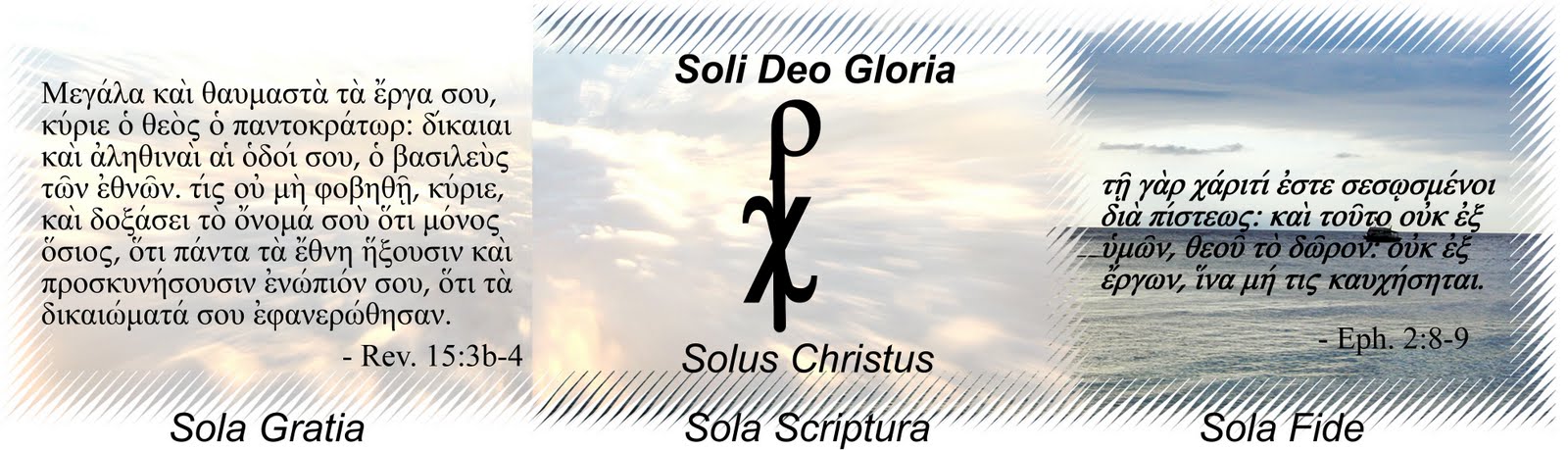
According to its own doctrinal standards and history, the Church of England's true nature is that of a Protestant, Reformed, Evangelical and catholic (in other words, universal) church. Orthodox Anglicanism is therefore defined by reference to these characteristics only, which are set out in the Thirty-nine Articles and the Church of England's submission to the over-arching authority of Scripture alone. Church Society seeks to defend and promote these defining characteristics, especially the Gospel of salvation by grace alone, through faith alone, in Christ alone which is at the heart of the message and mission of the Church of England.

While acknowledging the correct stand taken by Anglo-Catholics against theological liberalism (the features of which do not represent true, Biblical Anglicanism), it should also be noted that the true doctrine of the Church of England does not embrace any of the teachings or practices which characterise the Church of Rome. For instance, the Church of Rome is fundamentally flawed in its claims about its own nature and authority and in its teaching about the means of salvation.

A proper rejection of theological liberalism should therefore not be accompanied by a turning to the Church of Rome and its unbiblical teachings and practices. Rather, both theological liberalism and the unscriptural teachings and practices of the Church of Rome are contrary to the Bible and to the historic doctrines of the Church of England as a Protestant, Reformed, Evangelical and catholic church.

The longing of Church Society is that all Anglicans, whether in England or elsewhere, would see and understand both the destructive nature of theological liberalism and the false nature, teachings and practices of the Church of Rome.

We grieve that the Church of England, along with our nation, has fallen so low in its spiritual and moral condition. We pray that God would pour out His Spirit on both church and nation.

We rejoice that salvation is by grace alone, through faith alone, in Christ alone and we pray that the Church of England will return to full adherence to its doctrinal standards, acknowledging the supreme authority of the Bible as God's Word and seeking to shape its teaching and practices by what He has revealed.

The statement was agreed by the Council at its meeting on 4 November 2009.

No prizes for guessing correctly which statement is more in line with the teachings and tenor of Scripture.

[HT: Reformation Anglicanism, Reasonable Christian]

Mike Ratliff: Rebuking Repentance and Restoration

My friend Mike Ratliff has written an excellent post here regarding discernment. Mike makes the excellent points that we are not to be hasty in judgment but to ensure that what we know is indeed true before we make a judgment on the facts of the case. Also, we are to be loving and not fight the enemy with the same carnal weapons they use against us (fight fire with fire).

IMO, Mike has successfully navigated between the two extremes in this regard: the ecumenical response of "no-judging" or, closer, Tim Challies' method of stating that all judging must be done in a "positive manner" and thus he castigates all "discernment ministries". The opposite extreme can be seen in some discernment sites but mainly in the so-called "watcher of watchmen" anti-Christian discernment sites that litter the Internet like so many sewer pipes choked full with libel, all initially started mainly to defend some false teaching(s) or teacher(s) but which degenerates into the stinks they now are. Thanks Mike for your excellent article.

Monday, November 09, 2009

The biblical answer to Dominionism cum Book Review

What is Scripture's answer to the challenge of Dominionism? In my analysis of Dominionism, the answer has been split into 4 main headings:

  • The Concept of the Church and Apostles
  • The Concept of the Church in distinction from the State
  • The Cultural Mandate?
  • Being a pilgrim and a citizen
  • The Bible's teaching on wealth

The book review of C. Peter Wagner's book has been completed, and the answers can be found there. Also included are responses to Wagner's other errors, which can be seen in his [typical] teaching of the "new wine and new wineskins", and his shocking endorsement of the heresy of Open Theism.

What is Dominionism?

What is Dominionism? "Apostle" C. Peter Wagner has came out with a book on the topic last year on that topic. With this book, all of us can now know what exactly does the New Apostolic Reformation teaches in her understanding of the Cultural Mandate, which we shall examine below.


So what is Dominionism? Dominionism can be defined thus:

The application of the Cultural Mandate in working towards Social Transformation by the strategy of having workplace apostles taking control of the various spheres of society, facilitating the Great transfer of Wealth and so bringing God's Kingdom here on the earth.

Every phrase here reveals something about the theory of Dominionism, which we shall look at below.

Application of the Cultural Mandate ...

Wagner states his belief in the Cultural (or Creation) Mandate early in his book (p. 41), quoting personal correspondence with John D. Hunter that it is a "mandate to change the world" (p. 41). Wagner uses this term and sees his theory as the proper application of the Cultural Mandate. Of course, whether Wagner has correctly understood the cultural mandate or applied it properly may be of dispute, but what cannot be disputed is that Wagner himself sees his theory as an application of the Cultural Mandate, which in his view has to do with "tak[ing] dominion and transform[ing] society" (p. 46).

... in working towards Social Transformation ...

Wagner sincerely believes that the application of the Cultural Mandate is to work towards Social Transformation, which is defined as the transformation of society to one based upon God's original design for human life (p. 11). In promoting this theory, Wagner claims that the exclusive focus of churches on the Great Commission is based upon the "Greek mindset", which "tells us Christians should be concerned with saving souls and going to heaven rather than paying much attention to material things like transforming our societies." (p. 41). Instead of embracing this "dualistic" Greek mindset, we should embrace the holistic "Hebrew mindset" which posits that "God and accompanying spiritual principles permeate all of life on earth" (p. 40). Therefore, the Cultural Mandate of transforming society is to be kept central alongside the Great Commission. This transformation of society must refer to "sociologically verifiable transformation" (p. 55), in which "an independent, outside, qualified observer using standard tools of social science or investigative reporting concludes that the social unit is now as different from what it used to be as a butterfly is from a caterpillar" (p. 55).

... by the strategy of having workplace apostles ...

Wagner creates the category of workplace apostles by first creating the idea of the Nuclear and Extended Church. The "Nuclear Church", analogous to the nuclear family, refers to the people of God "meeting in their congregation". Playing on the word translated church in Greek ekklesia (εκκλησια), Wagner defines the meaning of church to refer to "the people of God scattered out wherever they might be" (p. 140). The "Extended Church", analogous to the extended family, thus refers to "the people of God in the workplace" (p. 141). From there, Wagner states that apostles and prophets "should be found not only in the nuclear Church, but in the extended Church as well" (p. 141). In Wagner's words,

... there must be such a thing as workplace (extended church) apostles. God has given them the spiritual gift of apostle, and He has called them to a ministry or activity in the extended Church of the workplace, over against ministry in the nuclear Church. (p. 141)

... taking control of the various spheres of society ...

Society according to Wagner consists of seven spheres or seven segments of society — the molders of culture. These seven spheres/ mountains are in random order "religion, family, government, arts and entertainment, media, business, and education" (p. 144). Wagner quotes Wallnau approvingly, who says "If the world is to be won, these are the mountains that mold the culture and the minds of men. Whoever controls these mountains controls the direction of the world and the harvest therein." (p. 144). Each of these seven mountains have their own distinct cultures, in which there exists significant difference in "crucial nuances" such that it would be difficult "for anyone attempting to go to the top and take dominion of one particular sphere" (p. 147). Even worse in Wagner's opinion, most "nuclear church" leaders are ignorant of the culture of the "extended church". In order to exercise dominion therefore, workplace apostles are needed. These workplace apostles would "have the God-given authority to influence and take charge of a certain segment of society on behalf of the Kingdom of God" (p. 148), thus taking control of it.

... facilitating the Great transfer of Wealth and so bringing God's Kingdom here on the earth

In the beginning of this book, C. Peter Wagner states that "without vast amounts of wealth in the hands of righteous people who line up with the principles of the Kingdom of God, we will not see the social transformation that we desire" (p. 19), further stating that "we must cast out the spirit of poverty and replace it with the godly spirit of prosperity if we expect to act as effective agents of social transformation" (p. 19). After outlining his strategy of workplace apostles and control of the various spheres of society, Wagner says that "an essential part of the process should be to transfer the control of wealth" (p 182), such that the Extended Church and the Workplace Apostles have the money to implement their plans for dominion.

Wagner has decided to attack what he calls the "spirit of poverty". In Wagner's own words:

One of the most effective tactics of the evil spirit of poverty has been to persuade Christian leaders that poverty is somehow noble. This mindset entered the Church when Greek philosophy gradually replaced the biblical Hebrew worldview among church leaders around the time when Constantine was the Roman empire. ... Issues of wealth were associated with the material world, and truly spiritual people were to avoid wealth as much as possible. That is why, in the monastic movement that began around that time, the monks were required to display their spirituality with vows of poverty, chastity and obedience. While chastity and obedience are not as prevalent today, poverty unfortunately persists as a spiritual ideal. (p. 185)

While espousing a type of prosperity preaching, Wagner comes down hard on the love of money. He does this by interpreting Mammon as a demon (p. 189) who causes people to love money through his subordinate spirits of greed, covetousness, parsimony (stingyness), and self-reliance (p. 190), and therefore states that believers should therefore not love money because that is to worship the demon Mammon.

Wagner continues on to describe the chain of wealth transfer to channel funds for Kingdom use, from providers to managers to distributors and field marshals. Providers provide the huge amount of funds required for "Kingdom work", managers manage the money, multiply it and channel it to the appropriate distributors, who will in turn pass it to the field marshals who do the actual work "making things happen for the extension of the Kingdom of God" (pp. 192-196)

So how does Dominionism fare in light of Scripture?

[to be continued]

Saturday, November 07, 2009

Song: Speak O Lord

I was asked to lead worship for cell yesterday, and have decided to use a couple of songs one of which was the contemporary hymn Speak O Lord by Keith Getty and Stuart Townend. The lyrics of the song are as follows:

Speak, O Lord
by Stuart Townend and Keith Getty © 2005 Thankyou Music

1:
Speak, O Lord, as we come to You
To receive the food of Your holy Word
Take Your truth plant it deep in us
Shape and fashion us in Your likeness
That the light of Christ might be seen today
In our acts of love and our deeds of faith
Speak O Lord and fulfill in us
All Your purposes for Your glory

2:
Teach us, Lord, full obedience
Holy reverence, true humility
Test our thoughts and our attitudes
In the radiance of Your purity
Cause our faith to rise,
Cause our eyes to see
Your majestic love and authority
Words of power that can never fail
Let their truth prevail over unbelief

3:
Speak, O Lord, and renew our minds;
Help us grasp the heights of Your plans for us.
Truths unchanged from the dawn of time
That will echo down through eternity.
And by grace we'll stand on Your promises,
And by faith we'll walk as You walk with us.
Speak, O Lord, till Your church is built
And the earth is filled with Your glory.

In this episode of New Song Cafe, Keith and Kristyn Getty together with Stuart Townend teach us how to play this contemporary hymn, a song which has meaningful lyrics and beautiful music.

The background of Paul Washer's shocking message

Paul Washer has recently done a video interview whereby he reveals to us the background behind his shocking sermon preached in 2002 to a conference of stunned youths, about 5000 strong.

An interesting quote from Pastor Washer here:

"We are living in a time when billions of people are dying without Christ. We are living in a time when millions of so-called Evangelicals do not even understand the Gospel. We are living in a time when some of the greatest "Evangelical" heroes, if they were simply critiqued in light of historic Christianity, they would be proven heretics. Shouldn't somebody be disturbed? Shouldn't someone be broken and shouldn't someone stand up and say: "This is wrong" This IS wrong" — Pastor, Evangelist and Missionary Paul Washer

Just in case it was missed, Pastor Washer's shocking youth sermon can be seen here.

[HT: Isaiah Chua]

Tuesday, November 03, 2009

Review of Michael Horton's book The Gospel-Driven Life

I have just finished a book review of Michael Horton's excellent book, which can be found at my website here. Let's hope it comes to Singapore soon, otherwise all orders can only be done online.

Monday, November 02, 2009

Michael Horton against "Practical Christianity"

The working assumption in much of contemporary Christianity seems to be that modern culture — whether sociology, psychology, anthropology, business and marketing, politics, education, and ethics — properly interprets human identity and the ideals of proper human flourishing. However, it lacks some crucial methods for attaining these goals. This is where we typically introduce the Bible as the "answer to life's questions." This is where the Bible becomes relevant to people "where they are" in their experience. Accordingly, it is often said that we must apply the Scripture to daily living. But this is to invoke the Bible too late, as if we already knew what "life" or "daily living" meant. The problem is not merely that we lack the right answers, but that we don't even have the right questions until God introduces us to his interpretation of reality. (Bold added)

- Micheal Horton, in The Gospel Driven Life, p. 111

Saturday, October 31, 2009

Reformation Day musing

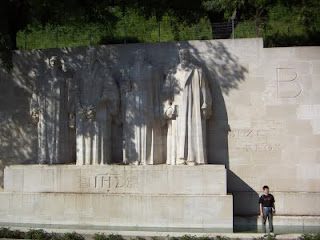
Reformation Monument

Today is Reformation Day. On this day 492 years ago, on Oct 31st 1517, a non-discreet German monk by the name of Martin Luther nailed his 95 theses on the door of the Castle Church (Schlosskirche) in Wittenberg, Germany, in protest especially of the Roman church's sanction of the selling of indulgences by the infamous marketeer Johann Tetzel. This act was the flash point which started the great Protestant Reformation, and forced the professing Church to take a stand on whether it desired Reformation according to the Word of God, or whether it desired power and the philosophy of Man more than the things of God. As it is in the time of the Pharisees, it is the unlearned "Northerners" who embraced the Scriptures, while the learned scholars and humanists in the "South" [Europe] rejected the Gospel for their own profits and philosophies.

492 years later, and the Church is in a worse shape than ever before. All manner of heresies which Tridentine Catholicism did not even descend to flourish within the walls of the professing churches, reformed, evangelical or otherwise. Ancient heresies denounced by various church councils, like for example the Christological heresy of Sabellianism, flourishes in so-called Evangelical circles (ie T.D. Jakes). Although Tridentine Catholicism by its denial of the Gospel of Justification by Faith Alone is heresy, even its proponents would be horrified by what is being promoted in what calls itself the Roman Catholic Church today. Inclusivism, Embrace of Evolutionary theory, not to mention ecumenical endaevors with the "Protestant heretics" and worse still, the Eastern [Orthodox] schismatics and Muslims, would make the Tridentine delegates spin in their grave.

The need to reform the church is getting more and more desperate by the day. The issues to speak out against and the supplantation of error by the truth of Scripture are too many to be counted. The harvest is plentiful, but the workers are few (Mt. 9:37-38). Far from being near to completing the Great Commission (Mt. 28:18-20), we are nowhere near it, and moving further from it by the moment.

Yet despite this, we can take heart in the fact that God is sovereign and in control. We are not to despair of the situation, but to do all we can because God has already gone on ahead of us. While reflecting on the needs of the Church, the following lyrics from a hymn came to mind.

Tho’ with a scornful wonder men see her sore oppressed
By schisms rent asunder, by heresies distressed,
Yet saints their watch are keeping, their cry goes up – “How long?”
But soon the night of weeping, shall be the morn of song

or in Chinese:

教会历尽了苦难,世人讥笑毁谤,
内争分裂她身体,异端叛道中伤,
圣徒儆醒争相问,黑夜到底多长?
哭泣将变为歌唱,转眼即见晨光

As it is stated in Scripture,

And Isaiah cries out concerning Israel: “Though the number of the sons of Israel be as the sand of the sea, only a remnant of them will be saved, for the Lord will carry out his sentence upon the earth fully and without delay.” And as Isaiah predicted,

“If the Lord of hosts had not left us offspring, we would have been like Sodom and become like Gomorrah.”

(Rom. 9:27-29)

The Church exists and perseveres in this world only by the power of God. It is God alone who substains her such that we are not destroyed like Sodom and Gomorrah. In context, the whole of Romans 9 is on the doctrine of election — God's sovereign election of those who would be saved and those who would be passed-over and damned. The Church being made up of the elect are therefore also preserved and substained by the power of God alone. Without God, the Church would be similar to the case of National Israel, rejected by God and as void of life as Sodom and Gomorrah.

It is this understanding of the electing and preserving power of God that gives us hope for the Church, because God is the one who saves His people, who keeps them (Jn. 6:39) and who promises that the Church will never fall (Mt. 16:18b). When we look at the devastation in the churches therefore, let us look with the eyes of faith to see how God is at work even in the midst of great apostasy. As in the days of Elijah, there are 'yet 7000 people who have not bowed the knee to Baal' (1 Ki. 19:18; Rom. 11:4). As it is written:

I ask, then, has God rejected his people? By no means! For I myself am an Israelite, a descendant of Abraham, a member of the tribe of Benjamin. God has not rejected his people whom he foreknew. Do you not know what the Scripture says of Elijah, how he appeals to God against Israel? “Lord, they have killed your prophets, they have demolished your altars, and I alone am left, and they seek my life.” But what is God's reply to him? “I have kept for myself seven thousand men who have not bowed the knee to Baal.” So too at the present time there is a remnant, chosen by grace. (Rom. 11:1-5)

God has not rejected His people, and neither has He abandoned His Church. The true Church of God is the remnant chosen by grace, and as such we can hope. God will always have His people even in the darkest times and places.

Let us therefore look with the eyes of faith and thus not be disheartened at the circumstances around us. Continue to press on in faith, knowing that in the end God will triumph through us. And "soon the night of weeping, shall be the morn of song"

Dealing with the enemy - In praise for AT

As for you, you meant evil against me, but God meant it for good ... (Gen. 50:20a)

Nope, I am not praising "Antithesis", and I am not out of my mind. However, I would like to take the opportunity to thank God for this thorn in the flesh.

In our struggle against the flesh and the world, nothing ever comes close to practically surfacing the sinful desires of the flesh than trials and tribulations, especially when others wrong us and slander us without cause and without truth. What shall we do then? We can attempt to fight fire with fire, and attack those who attack us even more harshly and vociferously. After all, don't we all have a right to protect ourselves and defend our reputations? Since the truth is on our side, victory is all but assured and we can thus steamroll all opposition, can't we?

To tackle this question, we must look at what the Scripture teaches about the topic. The problem with the above approach is that it is not biblical. Rather, it is written:

Bless those who persecute you; bless and do not curse them. Rejoice with those who rejoice, weep with those who weep. Live in harmony with one another. Do not be haughty, but associate with the lowly. Never be wise in your own sight. Repay no one evil for evil, but give thought to do what is honorable in the sight of all. If possible, so far as it depends on you, live peaceably with all. Beloved, never avenge yourselves, but leave it to the wrath of God, for it is written, “Vengeance is mine, I will repay, says the Lord.” To the contrary, “if your enemy is hungry, feed him; if he is thirsty, give him something to drink; for by so doing you will heap burning coals on his head.” Do not be overcome by evil, but overcome evil with good. (Rom. 1:14-21)

The biblical approach to dealing with our enemies is to bless them, and help them even. We are to overcome evil with good, and not be overcome by it.

Now, of course all of this can be easily seen, but how can we work this out in our own lives in *real* situations? Scriptures tell us that vengeance belongs to the Lord, and this should satisfy our desire for justice. Those who wrong us God will judge and pay back in time, for God as the supreme judge will ensure that justice will be done either now or in the judgment to come. Our role in this regard is rather to bless our enemies not merely because Scripture commands us to, or even as a sort of perverse way to get back at them (since it is promised that our good deeds will pour burning coals on their head) but rather to do it for Christ's sake. Christ died for the ungodly, so why can't we at least bless our enemies?

This is not to suggest that we must all be doormats who can be pushed around. Enemies who we are to bless and aid are still in the class of enemies. Nowhere is it suggested that we should treat them as friends or give them what they want. Rather, Scripture informs us of the attitude we should have towards them, while not eradicating the emnity that still exists.

It is in this regard that I strive to have a desire for AT's good. He as a Neo-Orthodox heretic is not saved. Yet, to desire for his good means to desire for his salvation from his vain way of life. Seen in this light, I pity him. His emptiness has generated only hatred in him which he spews at people like me who proclaim the truth. He has nothing to offer; no Gospel to save him from his sins and he is on the road to perdition. What he needs more than anything else is salvation.

In another light, it is written:

It is for discipline that you have to endure. God is treating you as sons. For what son is there whom his father does not discipline? If you are left without discipline, in which all have participated, then you are illegitimate children and not sons. Besides this, we have had earthly fathers who disciplined us and we respected them. Shall we not much more be subject to the Father of spirits and live? For they disciplined us for a short time as it seemed best to them, but he disciplines us for our good, that we may share his holiness. For the moment all discipline seems painful rather than pleasant, but later it yields the peaceful fruit of righteousness to those who have been trained by it. (Heb. 12:7-11)

God is sovereign over all of Creation. If He so desires to, AT would be dead now. Yet, God in His providence has allowed AT to continue his maniac attacks and rants.

As Gen. 50:20 states, what men planned for evil, God planned it for good. It is for this reason that God ought to be praised. Through AT, whatever things that can be used against me has been dug out somehow, thus showing me my weak spots. Although all of AT's commentaries are outright lies, yet because he is by nature an enemy, he would endeavor to collect as much dirt as possible to smear my reputation. In this regard, I am thankful for how little he can actually find, thus requiring the manufacture of entire sets of lies in order to malign my character. From the little he found, plus the hypocritical attacks on my "judging" others (like he is not judging me), it has helped me to see my blind spots so as to correct them. Of course, I do not visit that place much as it is dedicated to slandering me on all fronts possible. Yet, for the good that God has intended, I am thankful.

As for reputations, let God do the fighting on our behalf. I do not even need to do anything in this regard, since the overwhelming response from those not in AT and his gang has been negative, with nobody changing sides so to speak. But whatever happens, the main thing we should remember is that faithfulness to God and His Word counts more than our reputations. Jeremiah's reputation wasn't very great in his entire life time, and he was imprisoned many times for the truth. We should care less about our own reputations and more about the honor of God's name. Rather that we be despised by the world than for God to be dishonored.

In conclusion, in our dealings with the enemy, let us seek their ultimate good and not their destruction. Justice will be meted out in the end, but our role is not to judge but to show mercy. God will judge in the end, and His judgment will be perfectly just according to the sins committed. May we learn therefore how to desire the ultimate good for our enemies. Amen.

Thursday, October 29, 2009

An exposè of "Antithesis"

This would be my last word on the cyber-terrorist, liar and anti-Christian watchblogger anonymously called "Antithesis". This is an unfortunately logical necessity, which is certainly not edifying for those who know nothing about the issue. However, for those who know of this controversy, this would hopefully be of help in this regard. The paper exposing "Antithesis" (AT) for the perpetual liar that he is can be found here.

It must be stated that AT and gang has been lying almost all the time (almost 100% of the accusations on that blog is false) that he justly can call himself the Son of the Devil. Anything that is said by them must be suspected for spin. Back last year, AT has the audacity to complain to the pastor and elders of my church. However, as I have stated in my exposè:

The first order of the day of course was to attempt to use my church and my pastor, Rev. Paul Goh, against me. Needless to say, my pastor was not at all impressed with the juvenile and unfounded untruthful lies made about me. It seems that AT is particularly vicious and complained to the session (of elders) in my church, who met to discuss the issue. After examination, they dismissed all charges as being false, noting that AT does not even has the courage to reveal himself and therefore does not even deserve any response whatsoever. All of this was conveyed to me by my pastor, of which I am thankful.

This is not to boast, but the fact of the matter is that my church has examined all of AT's accusations on me and have found them all to be false, exonerating me of the charges. It is of course granted that it was not as serious as a church trial, for the simple reason that they do not take the accusations of cowards who take pot shots of other from behind the anonymity of their keyboards seriously. But even then, the accusations were serious allegations and they conducted their investigation seriously at least on my side in questioning me on my beliefs and stands.

AT through his deplorable actions has manifested an attitude that is consonant with being a reprobate. He and his gang-members are wicked and depraved, irrational and haters of God and of men. May God have mercy upon their souls.

Wednesday, October 28, 2009

Is the Church earthly?

Over at the CREDO500 blog, Jason Loh's paper on "Calvin's View on the Cultural Mandate" has been published. While many many things can be said about the paper, the focus on this post will be with regards to the strange assertion that the Church "is a creation order" and that it has "an earthly institution[al]" aspect to it. Certainly, this is the first time I have seen such a strange position, which seems to run contrary to (and is contrary to) the teachings of Scripture.

In Loh's paper, the teaching that the Church has an earthly institutional aspect is based upon the fact that:

  1. The creation of Adam and Eve instituted the Church
  2. Adam and Eve worshipped God so therefore there is a Church there (Source)

It can be immediately seen that, even conceding the above two points, the idea of an earthly institutional aspect of the Church is not proved. It could instead be the Church has only a spiritual aspect that is formed at the creation of Adam and then Eve, with the physical aspect being the institution of the Family. The syllogism is therefore invalid. Nevertheless, let us assume for the sake of argument that the syllogism is valid. Are the premises true? In order to evaluate the question before us, we mus first define: What is the Church?

The word translated Church in Greek - ekklesia (εκκλησια) is made up of the parts ek-kaleo (εκ-καλεω) and means called-out [ones]. The Church by definition therefore is a spiritual body of people who are called out of the world unto God. Since they are "called out", therefore they must be called out of something. Throughout the Bible, the idea of calling always refer to being called out of the world and its idolatry to God, as seen in the examples of Noah, Abraham, Jacob and the Patriarchs, the entire nation of Israel, and finally the New Testament Church. Always, the focus is on the concept of redemption — that God calls men out unto salvation, be it physical salvation (as a type) like Noah and his family [1], or spiritual salvation which is explicitly seen in the New Testament Church.

The concept of the Church therefore is predicated upon the redemptive motif of Scripture. Redemption is what defines the Church, not worship, service, evangelism or anything else. With regards to worship, the angels in heaven worship God forever, yet they are most decidedly not part of the church, because the Church is the bride of Christ (Eph. 5:32) and they the angles are not the bride of Christ but servants (Heb. 1:14). Worship therefore does not define the Church, and thus the second line of argument utilized by Loh is invalid and the premise false.

Developing this truth further, since the Church is defined by redemption, therefore pre-Fall Adam and Eve cannot be part of the church either. Being sinless, they do not need redemption before the Fall, for redemption is for sinners only. It is only after they sin that they require redemption, and thus the Church was instituted then after the Fall.

As it can be seen, the most fundamental problem with the entire idea of an earthly institutional church is that there is absolutely no Scriptural proof for the entire concept. Both lexically and redemptive-historically, the concept of the Church militates against the very idea of an "earthly institutional aspect" of the Church. The Church is and always will be one defined by redemption — the Gospel, and not Creation.


References:

[1] This is not to say that Noah is only saved physically and not spiritually, but that the main concern of the Flood is physical salvation of the human race through Noah and family. Later, Ham and his son Canaan seemed to be a reprobate according to his despicable action (Gen. 9:21, 25), although we can not know for sure his eternal destiny.

Monday, October 26, 2009

Michael Horton versus Richard Foster on Contemplative Spirituality

In his book The Gospel-Driven Life, Horton addresses how the Gospel in its fullness is materially sufficient for all of life. After addressing the Purpose Driven life paradigm, Horton continues to briefly address the issue of contemplative spirituality, especially as promoted by the Quaker mystic Richard Foster.

Horton starts off by mentioning Foster's disclosure of his "spiritual formation agenda" in "a recent Christianity Today article". In that article, Foster is quoted as lamenting the lack of growth in Christians because "having saved by grace, these people have become paralyzed by it" (p. 146). The suggested solution to such spiritual apathy accordingly is to

... "do all we can to develop the ecclesiola in ecclesia — 'the little church within the church,' " referring to the examples of Lutheran pietism's collegia pietatis, John Wesley's "holy clubs," and the "inner mission" of the Norwegian pietists. As Foster observes, these Protestants movements have their roots in the heritage of Catholic spirituality, identified especially with Francis of Assisi, Theresa of Avila, John of the Cross, and Thomas à Kempis. (cited in p. 146)

Horton states however that he is not going to "tackle the question of spiritual discipline [per se]" here in this book. "Rather, it is to interact with the paradigm of sanctification (the Christian life) as chiefly the imitation of Christ" (p. 147).

Horton starts off by commending Foster's worry about the Antinomianism present in the church and the eclipse of the holiness of God therein. Also,

... Foster is right that there is also a kind of "cheap grace" that fulfils the fond dreams of the antinomian who comforts himself with the syllogism: "God likes to forgive, I like to sin: what a great relationship!" Even if we eschew antinomianism, there is a kind of laziness that does not revel equally in the "already" of new life in Christ and the "not yet" of its consummation. (p. 147)

That having being said, Horton tackles the fundamental errors of the "spiritual formation agenda" in its view of the Christian life: namely confusing works and grace, and justification and sanctification (thus committing the same error as Rome).

But I'm [Horton] not sure how directing people to greater concentration on themselves is going to overcome the narcissistic captivity of our times. As Thomas Finer has documented in A Contemporary Anabaptist Theology, the Anabaptists — whose leaders were trained by the Brethren of the Common Life [of which Thomas à Kempis was formative in its development] — were no more interested in the justification of the ungodly than Rome. The whole emphasis was on discipleship, defined as the imitation of Christ.

The Spiritual Exercises of Ignatius of Loyola are of a similar orientation. Ignatius founded the Jesuit order for the express purpose of opposing the Reformation. Through not without occasional praise, Luther saw his experience with the Brethren of the Common Life as encouraging a theology of glory: ascending to God through works and mysticism. Calvin looked upon his schooling at the ascetic Collège de Montaigu as "servile labor" under the burden of severe regulations and no gospel, while Ignatius recalled fondly his time there as a student. (pp. 147-148)

We can notice the contrast that is already in the process of forming. The "spiritual formation agenda" has its roots in Catholic pietistic mysticism with its emphasis on "discipleship" so-called, and is a "theology of glory" being focused with trying to bring themselves up to Christ and God by their own works of piety, instead of the Reformational emphasis on Justification by grace alone through faith alone, apart from works.

Horton continues to differentiate the counterfeit "spiritual disciplines" from the biblical "means of grace" as follows:

It is striking ... that Luther, Calvin, and other reformers — many of whom (like Luther himself) were former monks — did not throw out the baby out with the bathwater. Sharply critical of using monastic rituals to ascend a ladder to God, they nevertheless held private as well as public prayer in the highest possible estimation. Luther thought that the busier he was in a given day, the more he needed to prepare for it through earnest prayer and reading of Scripture. The Puritans not only wrote sermons and doctrinal treatises, but devotional guides, meditations, and books of prayers. ...

The issue is not whether we engage in personal disciplines or habits of meditative prayer and reading of Scripture, but whether we do so in a gospel-driven manner. Is it a technique for personal transformation or is it a saving and sanctifying encounter with the Triune God who has met us in his incarnate Son? Are we working toward our justification or from it? Are we being drawn to look outside of ourselves, to Christ, or are we feeding our natural tendency to focus on ourselves and our inner life? Obviously, if the significance of Jesus Christ lies principally in his offering a moral example, faith in Christ is not absolutely necessary. ... We do not need an incarnate, righteousness fulfilling, curse-bearing, resurrected Savior if salvation comes by imitation. (pp. 148-149. Bold added)

The difference between the sanctification paradigm of Foster and those who promote Contemplative Spirituality (CS) on the one side, and the Reformation paradigm on the other, is that between life and death; light and darkness; Salvation and Damnation. The CS paradigm brings one back under the Law in working for one's salvation, and thus denies the true biblical Gospel which alone saved. Contemplative Spirituality therefore is soul-damning and potentially brings its adherents (and most definitely its recalcitrant proponents) under the anathema of God (Gal. 1:8-9)!

Continuing on:

... Augustinians recognized that defining salvation or the Christian life as the imitation of Christ (imitatio Christi) presupposes a woefully inadequate doctrine of sin and therefore of God's saving grace in Christ.

... the reformers recognized that grace is first and foremost God's favor toward sinners on account of Christ. This "justice" or "righteousness" by which we stand accepted in God's presence is imputed, not infused; declared immediately, not progressively recognized. At the same time, they just as strongly affirmed that God's Word does what it says. Everyone whom God declares to be righteous is also progressively sanctified. (p. 149)

... Nowhere in this lodestar passage [Rom. 7] for the Christian life does Paul direct our attention to the imitation of Christ. He has already painted too dark (realistic) a picture of human depravity to imagine that the devil, the world, and our sinful hearts could meet their match in our deeper commitment to follow Christ's example. ... He calls us not simply to imitate Christ but to be crucified, buried, and raised with him. ... But before he speaks an imperative, he announces the indicative of the gospel: Christ's saving work has accomplished far more than we imagined. (p. 150)

The CS paradigm is based upon a Pelagian or semi-Pelagian view of Man which trivializes the doctrine of the sinfulness of Man, while the biblical paradigm acknowledges the Total Depravity and Sinfulness of Man.

The "imitation of Christ" paradigm of spirituality makes Christ's self-sacrifice and humility an analogy for our discipleship. The "union with Christ" paradigm makes our love and service an analogy of Christ's inimitable accomplishment. Being in Christ is the perpetual source of our becoming like Christ, not vice versa (p. 152)

Apart from the imputation of righteousness, sanctification is simply another religious self-improvement program determined by the powers of this age (the flesh) rather than of the age to come (the Spirit). (p. 153)

The CS paradigm reverses the order of the indicative and the imperative, and therefore is purely of Man, therefore it is repugnant to God.

In conclusion, the entire thrust of Contemplative Spirituality is one of works righteousness. It attempts by its own strength to climb up to God, and thus it is contrary to the Gospel. Contemplative Spirituality is anti-Reformation and anti-God, and thus not to be practised by Christians.

Sunday, October 25, 2009

On Frame's review of Horton's book

The Reformed blogosphere is (or was) abuzzed it seems with Prof. John Frame's review of Prof. Michael Horton's book Christless Christianity. Frame's review has been answered by Darryl G. Hart, Kim Riddlebarger, R. Scott Clark, and the staff of the White Horse Inn. My friend Stephen Macasil has entered the fray also with his latest blog post, which attempts to go deeper and interact with the topics raised.

When I was first directed to Frame's review through the article on Gospel-centered Legalism (ie a totally different topic), I was rather stunned by the review. Having owned and read Horton's book Christless Christianity, Frame's review was the worst misrepresentation of a single book I have ever seen. The most ludicrous part was when Frame semi-defended Joel Osteen (?!) against Horton's charges. Osteen is a Word-faith heretic, and Frame who is supposed to be Reformed defends a wolf against Horton? Amazing!

The state of the Church in general was another point where I just have to shake my head in amazement. Which planet is Prof. Frame living on? The "Ivory Tower" planet? It most definitely is not earth! America is awash with heresy as the Emerging Church movement, the Word-faith cult, and the Contemplative Spirituality nonsense is destroying the faith of many, yet according to him, the Church is still doing fine and "There is a greater interest in sanctification (not just justification), on Christianity as a world view, on believers’ obligations to one another, on love within the body of Christ, and in the implications of Scripture for social justice"? Even discounting America (which has a really bad habit of thinking they are the center of the world), the rest of the world is in really bad shape. But let us go back to America. What about the heresy of Federal Vision and Neolegalism wrecking havoc in Reformed and Presbyterian circles? Oh wait, Frame defended the heretic Norman Shepherd while he was still in WTS.

In their response to Frame, the White Horse Inn staff Eric Landry has picked the 10 points with which Frame accuses Horton of teaching, and refutes them all. I think it would be instrumental to just let Landry speak in this regard here (Dark Red Italics refer to Frame's points).

1. Attention to ourselves necessarily detracts from attention to Christ.

No, it can detract from Christ. But it does not necessarily detract from Christ. When it comes to the gospel, “we preach not ourselves, but Christ,” because the gospel is not about us at all. Confusion over this matter does detract from Christ. However, the good news about Jesus’ death, burial and resurrection has implications on the way we live, and so we must give some attention to ourselves as we let the light of the gospel shine in every dark corner, which challenges us to rethink our actions, self-centeredness, etc.

2. We should not give attention to the way we communicate the gospel, or to making it relevant to its hearers.

Relevance and context are clearly different than pragmatism. To which has the evangelical church at large given itself?

3. God’s sovereignty and human responsibility are a zero-sum game. The idea that man must do something compromises the absolute sovereignty of God.

This is an outright misrepresentation and we’re disappointed that Professor Frame should characterize Horton’s theology in this way. He is not a hyper-Calvinist and nothing in Christless Christianity or anything else that he has written bears this out.

4. God’s work of salvation is completely objective, external to us, and not at all subjective, internal to us. (Here he backtracks some.)

This is another caricature. Horton’s argument is that the gospel is completely objective and external to us: it’s the Good News about Christ’s person and work. However, Horton clearly says that God’s work of salvation includes regeneration and sanctification. The Spirit applies the redemption that the gospel announces.

5. God promises us no earthly blessings, only heavenly ones, and to desire earthly blessings is a “theology of glory,” deserving condemnation.

Horton’s critique is that we are trying to use God to attain our best life now, rather than to see God as the object of our faith and worship, for “every blessing in heavenly realms in Christ” (Eph 1:3-4). Lost in exaggeration, Frame’s caricature of this argument misses the point.

6. Law and gospel should be utterly separate. There should be no good news in the bad news and no bad news in the good news.

This is a longstanding complaint by Frame. Not only does he consistently misrepresent the Lutheran view on this point; he seems to be unaware of the consensus of Reformed theologians that the confusion of law and gospel is the heart of theological errors. This point has been made not only by Calvin, but by Beza, Ursinus, Perkins, Owen, and Spurgeon all the way to Louis Berkhof and John Murray. In Christless Christianity (and elsewhere), Horton very clearly affirms that law and gospel are to be distinguished but never separated. The one thing that Professor Frame accurately says about the book on this point is that “There should be no good news in the bad news and no bad news in the good news.” That’s why the law reveals our sin and misery (as the Heidelberg Catechism and Westminster Shorter Catechism confess), and the gospel reveals God’s saving grace toward us in Jesus Christ. One should be far less bothered that Professor Frame is confused about Christless Christianity than that he seems confused about the difference between commands (imperatives) and declarations of God’s promises (indicatives).

7. Preaching of the gospel must never use biblical characters as moral or spiritual examples. Nor must it address practical ethical issues in the Christian life.

Of course there are moral examples in Scripture, and Horton affirms this in his book; the point is that the Bible is to be read as an unfolding story of redemption, with Christ as the hero. All we ask is that if you use a character as a moral or spiritual example, be sure to include not just the exemplary things that he or she did but also the tragic sins that made it necessary for even a “friend of God” or a “man after God’s own heart” to look forward to a Redeemer. Don’t stop with the example, look to where the example actually points: to Jesus Christ. And ground your practical ethical issues in the new creation, just as the New Testament writers do. For more on the relationship between doctrine and ethics, see Horton’s People and Place.

8. A focus on redemption excludes a focus on anything else.

This is baffling. Is Frame intentionally misrepresenting the book or is he unable to read the book without even a modicum of Christian charity? Stunning.

9. In worship and in the general ministry of the church, God gives and does not receive; the congregation receives and does not give.

Read Horton’s A Better Way for a substative rebuttal. That Frame and Horton have differences of opinion on what happens or should happen in a worship service is an understatement, but point 9 does not reflect either the points made in Christless Christianity or A Better Way. Horton has consistently argued that worship is dialogical; the congregation is a participant with God in the worship service. God serves us in Word and Sacrament, and we respond in songs of praise, prayer, confession, and attention.

10. Analysts of the church must compare the Church’s focus on Christ with its focus on other things, rather than considering that many of these other things are in fact applications of Christ’s own person and work.

If churches actually saw their focus on other things as extensions and applications of Christ’s ministry, we wouldn’t have an issue. But the facts (as cited in the works of both unbelievers and believers in many different traditions) just don’t bear out Frame’s optimism about mainstream evangelicalism here.

Saturday, October 24, 2009

Gospel-centered Legalism?

Pastor Bill Streger, a pastor in the Acts29 network, has posted an interesting post (with which I do not necessarily agree on everything), Gospel-centered Legalism, asking the question: Is it possible to be legalistic about "Gospel-centeredness"? As he later clarifies in a comment:

...

My worry is not that we would be to centered on the gospel, but that rather than actually being centered on the gospel itself we would become enamored with “Gospel-Centered” as a catchphrase that includes all of our own theological distinctives and excludes those who don’t share them.

My fear is that we will create insider language and jargon that becomes the qualifiers for whether or not we judge someone to be orthodox, rather than what they actually believe.

My fear is that “gospel-centered” would become “the next big thing” in Christian marketing and countless pastors will use it as a badge of honor to wear (much like “missional” has become over the past decade) rather than a true state of our hearts.

My fear is that instead of actually being gospel-centered we would settle for simply talking about it.

[Bold added]

From my personal interaction with the New Calvinist crowd, I am similarly worried regarding such a scenario. As I have rhetorically asked in my initial paper on the New Evangelical Calvinism [probably going to be withdrawn soon], and repeated in my CREDO500 paper,

Will we aim for rational and lifestyle consistency even in our profession of the Gospel, or will we settle merely for outward compliance to the Gospel and perhaps agreements on the major flashpoints of the culture wars like homosexuality, complementarianism, racism and missions? What makes these flashpoints more worthy of contending for as compared to the other doctrines and practices of Scripture?

On the surface, my contention with the New Calvinists has to do with the issue of "tone" and of the necessity of discernment and calling out heretics. This Neo-Evangelical "mood" permeates at least the New Calvinist crowd over in Singapore and Tim Challies in Canada. However, despite whatever heat may be generated by such issues, these are not the fundamental issue of contention. The fundamental issue of contention boils down to the issue of Sola Scriptura. As I have written in my paper on this topic:

During the Reformation, the material principle was the principle of Justification by Faith alone, while the formal principle was Scripture Alone or Sola Scriptura. In an interaction on a blog ..., there has been the insistence that Gospel-centeredness is enough, for Gospel-centeredness will necessarily preclude what I call Gospel-Onlyness — the view that everything is decided with respects to its impact on and consequence of the Gospel. Does embrace of the material principle therefore necessarily implies the embrace of the formal principle? Why then does the Reformation consists of two principles instead of merely one, and the insistence on the supreme authority of the Scripture for all of life as much as the Gospel itself was the issue of contention?

The formal principle of Sola Scriptura deals with the epistemological foundation of the faith within which the Gospel will thrive. Without the foundation, there are no set boundaries on what the Gospel actually is limited to. This does not mean of course that the Gospel does not have implications on various sundry issues, but the fact of the matters is without an epistemological foundation, upon what authority can agreement on the major issues be made, and what basis can defence be made against sophisticated denials of the Gospel which professes to be Gospel-centered like for example New Perspectivism, or as we have discussed previously in the case of Douglas Wilson, Federal Vision? ... While it is true that emphasizing belief in Sola Scriptura does not necessarily preclude anyone from denying it in word or action, at least Scripture can function as a safeguard within which all matters of life and doctrine can be settled, instead of a vague, general appeal to the Gospel without its corresponding epistemic foundation.

In the controversy us Reformed folks have with the YRR (Young, Restless, Reformed) New Calvinists over the New Evangelicalism, the key point actually lies not with the doctrine of separation, important though it may be, or other points of doctrinal differences . The issue is with the supreme authority of Scripture over all of life INCLUDING our praxis. As Streger points out, the phrase “Gospel-Centered” can degenerate into a mere "catchphrase that includes all of our own theological distinctives and excludes those who don’t share them", especially uniting these New Calvinists around the various "flashpoints" which they love to champion (ie homosexuality, complementarianism, racism, missions). The term "Gospel" and "Gospel-centered" thus functions in the New Calvinism as a dividing line by which they differentiate between those who are "in" and those who are "out" based upon their theological perspectives instead of the Word of God.

That is why the correct emphases must be placed on Sola Scriptura as well as Sola Fide and Sola Gratia. The Gospel IS NOT the determining factor of what constitutes orthodoxy. As the material principle, it is the subject of orthodoxy but never the arbiter of it. The arbiter of orthodoxy must always remain the Scriptures alone. When the material principle is made to bear the full weight of orthodoxy when it was never designed by God for that purpose, distortion of the Gospel inevitably happens sooner or later.

Just like the monocovenantalist who attempts to collapse the two covenants into one, the mono-emphasis on the Gospel in being "Gospel-centered" will create the type of as-of-now hypothetical scenario Stretger rightly fears and decries. In point of fact, as monocovenantalism can degenerate into its legalistic and antinomian branches (conditional covenant versus unconditional gracious covenant), the mono-emphasis on the Gospel can degenerate into Gospel-centered Legalism and Gospel-centered Antinomianism (whereby all are believed as orthodox as long as they preach the "Gospel" - as long as it somehow sounds like the Gospel), which seems to be practiced by John Piper in the case of Douglas Wilson.

The only corrective for the New Calvinism is to recover the proper emphasis on Sola Scriptura. It is not enough to simply have Sola Scriptura as a truth to be believed in, but it must be a truth to be embraced with just as much passion as the Gospel. Instead of calling themselves "Gospel-centered" people, perhaps they should be "Gospel-and-Word-centered" people, putting both principles in their proper places.

It is only in this light that progress can be possibly made on any issues and doctrines. It is feared that currently, any discussion of "tone" etc will be based upon whether such is "Gospel-centered" or not. The New Calvinist may very well be, probably unintentionally, bringing their unbiblical view on this matter to the topic, and disguising it based upon his agreement with the Gospel message proper. Using the epistemic standard of Sola Scripture however forces all involved to deal with the actual teachings of Scripture on this subject, instead of leaving room for errant views of ministry etc to hide in the darkness. It is only then that we can work for resolution of our doctrinal differences. May God grant us a renewed focus on the absolute authority of His Word alongside a renewed zeal for the Gospel. Amen.