Showing posts with label Market-driven church. Show all posts

Thursday, October 13, 2011

Christians, the Church and the siren song of influence and outreach

Back when I first started blogging, there was the temptation of fame, of influence. The nature of the blogosphere is such that just about anyone with a keyboard can gain instant recognition just by posting about any type of content whatsoever. Technological advances tend to influence how we behave even though the technology itself is amoral, and the idea of self-publishing — through first the blogosphere, then Facebook and Twitter — democratize and revolutionize communication such that every Tom, Dick and Harry with an Internet connection can gain influence and followers, regardless of whether he has anything worthwhile to say.

I am sure much has been written about this social phenomenon, and anyway my focus is not focused on the impact of technology on people, which has not been something I am knowledgeable about (besides personal observation). Yet what such technology has done is to enable our desires including sinful desires of the heart to manifest itself. The Christian blogosphere is thus hardly less civilized at time, to our shame, compared to its secular counterpart. Note that this is not an indictment of anyone and anything. As I have said, technology is amoral; what is sinful is not technology per se but the people using the technology. In other words, don't blame technology for the sinfulness of men!

My focus here however is on the facilitation of the sinful desires of our hearts arising from the need for significance, which lies behind much of our lusts for fame and influence. I am not here pointing the finger at anyway, as I myself have fallen prey to it. With the ability to gain a following at the ease of the click of a button, the temptation for self-aggrandizement is greatly multiplied. Even those of us with a message and burdened with the need to help others can be contaminated with this sinful desire for fame. Who does not after all love to be respected and have their opinions highly esteemed? Are any of us even the most selfless and godly free from the temptation to seek glory and honor for ourselves?

I speak of this of course from my self-identification as a member of the ODM (Online Discernment Ministry) tribe. We desire after all for God's truth to be made known and obeyed, but we need to periodically examine our hearts that we do not become the mirror image of that which we despise. Dare we think ourselves free from the snares of Satan? Do we think that Satan only works for the formal embrace of error? Satan is happier if we formally denounce error while materially embracing it. Not only will Satan have us, but to the world we are seen as hypocrites, which we will have become, and the truths of the Gospel are mocked at because of our hypocrisy.

The desire for fame and influence is the snare of the devil, regardless of how one wants to parse it. It robs God of His glory, because we desire to share the limelight too. It makes "fame" and "influence" the idols that we embrace, and it gets even worse when it masks itself as our service to God. "We want to make God famous," says one. "We want to impact more people for God," says another. Do we see how pernicious and tenacious these sins are? We see this in the so-called celebrity pastors where personality cults are cultivated intentionally or unintentionally ("I am of Piper." "I am of ___"). But it does not stop there. And for those of us who are against such: are we doing it because we covet that same influence but we don't have it? Again, no finger pointing here, but a question to reflect on.

As I reflect on this, it dawns on me that this is probably one of the reasons why Christians and churches fall. The road to hell, after all, is marked with good intentions. Why do we do what we do? Why do I blog? Why do you twit? Even in doing church, why do we want to "impact more people for God"? Or conversely, why are we against people "impacting more people for God"?

If we cannot give a Christian response to these, then we have a problem. The siren song of influence and fame clouds a man's path and ministry. Will we sacrifice obedience to the Bible just for a chance for a voice "for Christ"? Or to appear magnanimous? To appear loving to fellow "Christians," regardless of whether said persons are truly believers as defined by the objective standard of the Bible?

Church history is littered with the wreckage of apostasy, which starts with small compromises based upon good intentions. What's wrong with compromising on the "minor things"? What about just inviting someone who is not that sound, but deemed to be relatively orthodox except for the error of being "just a Presbyterian," to be a speaker at a Christian conference for pastors? Surely nobody is going to be so stupid to just follow that guy blindly? What's wrong with just having a friendly dialogue with a heretic, as long as one does not deny the Trinity and makes plain to everyone that denial of the Trinity is soul-denying error? Is anyone after all that dumb to think that anyone I dialogue with is a Christian leader to look up to? What's wrong with adopting a "missional attitude"? After all, as long as we make plain that we do not compromise biblical teachings (as we interpret them), aren't we after all asked to be "all things to all men"?

The diving line is razor sharp. What seems reasonable to us and of little difference now may come to result in apostasy in the future. This is especially so in the area of influence, since it feeds into our natural desire for significance which has however been distorted by the Fall. The Devil is all too willing to allow us short-term victories as long as we lose in the long term, and that has seemingly been his modus operandi for a long time. Satan capitalizes on our weak spots in his attacks, never our strong ones.

We must not allow our desire to impact people for Christ therefore be an idol. Christian ministry is not about "changed lives." Satan can give you some changed lives to sate your lust for influence, then waylay you with the lure of more in exchange for compromise, little by little destroying the Gospel influence you bear, while you are totally unaware of what is going on because the compromise is called for little by little. Just as the frog in a pot of slowly boiling water will not perceive the change in temperature before it is cooked, Satan is very patient in attacking us. Satan is not stupid! While overt error is always present, Satan gains more with subtle error slowly luring people away from the purity of the Gospel — little by little slouching towards Sodom and Gomorrah.

How do we fight the Devil and his snares? The only way to do so is to die to self. We must die, and our ambitions also. Even our goals and dreams of ministry must die with us. Stop having dreams of revival. Reformation and revivals may come and hopefully do come, but it is not our job to create them, which we shouldn't anyway if we believe in the predestination of God. Serve God without regard to reputation or the number of readers and followers you have, as if that is ever important in the first place. Be indifferent to statistics in general — you are not holier or more godly if you have a big church or a small church; many followers or little followers. So what if you have more influence for now? So what if you have none? What does God calls us to do? To be "world-changers"? I challenge anyone to find where God ever tell us to be such in the Scriptures, because it just isn't there.

So resist the siren song of influence and fame, even if and especially if done in the name of outreach and evangelism. Crucify the flesh, and die to it. For only in so doing can we overcome the world, as Jesus has done.

Saturday, March 13, 2010

Chris Gordon road-tripping at a PD/SS church

Chris Gordon, WSC grad and pastor of United Reformed Church at Lynden, WA, has recently done some road-tripping in visiting a modern seeker sensitive/purpose driven church North County Christ the King Church in Lynden itself. As he begins:

It's a challenge today to take a stand for anything. This is no less true in the church of Jesus Christ, especially as we think through the implications of the Biblical warning that in the latter times some will depart from the faith giving heed to deceiving spirits and doctrines of demons (1 Tim. 4:1). Part of our responsibility as Christians is to defend the truth, and to contend earnestly for the faith once delivered to the saints (Jude 1:3).

As as pastor, I recognize that one of my responsibilities is to protect those whom I serve from influences and practices that have a form of godliness but deny its power (2 Tim. 3:5). At times, this requires critical reflection of what others are doing and saying in the Christian world, especially when, as Paul said, there are savage wolves among us who do not spare the flock, but draw away disciples after themselves (Acts 20:29). There is just too much at stake if we remain silent, we are called to pull souls out of the fire (Jude 1:22).

Many well-meaning Christians, however, don't take well to any kind of constructive criticism or warning against what particular churches are doing contrary to the received doctrine. We have come to a point in the Christian world that if we say anything by way of exposing error, we are labeled as unloving or schismatic. But such pressures, as strong as they are, do not remove our responsibility to expose error and false doctrines as we speak the truth in love.

With these things in mind, I have been challenged on more than one occasion that I do not have the right to critique any other local church if I have never attended the one in question. In the past, my answer has always been, "I don't have to slam my hand in a trunk to know it's going to hurt." But, fair enough, although I think such a charge is a diversionary tactic, it is important to "know" exactly what you are critiquing. So, to honor the challenge of others, last Saturday night I decided to attend North County Christ the King Church here in Lynden.

In this light, Gordon has posted his interesting and revealing reports with regards to his road trip on his blog here, here and here. The last report especially was a good critique of the typical modern wishy-washy sermonettes that have a low view of God and a too high view of Man. In Gordon's words:

There are two very serious errors here that were evident throughout the service, especially in the message itself—a wrong view of God and a wrong view of man. The first error, a wrong view of God, was a denial of the Creator/creature distinction. In this denial, God's revelation of himself in his distinctness from his creatures is rejected as he is refashioned into those things that make us feel comfortable about him. Simply stated, if God created us his image, we have returned the favor and created him back into a fallen image that we feel comfortable with.

...

If you take the subtitle of the sermon, Satisfaction Guaranteed, what is the assumption being made here? The basic assumption here is that if you try out God, he will work for you. Now I am used to this “guarantee” language when I buy a product at the grocery store and expect that the money I have invested in the product will earn me some positive result in my life. For instance, the other day I saw this very claim advertised on a teeth whitening product, satisfaction guaranteed. I was interested because prolonged coffee drinking has darkened my teeth. So the first thing I did was check the price. That stuff is expensive. If they really want to sell me the product, the prices have to be slashed; I’m looking for the Safeway card discount. Further, I expect it to work for what I have determined is my need. As a consumer, I reign sovereign over my need and my purchase.

Now since this marketing strategy is so common in the church, we should ask what happens when God himself is marketed this way? What are the consequences of this? And what does this presume is my greatest need? Think about the suggestion: you go off-roading with God, we guarantee satisfaction. How do you guarantee satisfaction? As the marketer, you have to please the customer. And if God and his church are being marketed like a product, you have to sell both. As stated above, you cannot identify them with any of those things that the consumer might find offensive or unattractive; both have to packaged for their use — because, well, that is how products sell.

...

So what happens? If the customer is sovereign over what he is “buying” with regard to God he certainly will not select a view of God that emphasizes His justice, holiness, or righteousness. The attribute(s) that is most pleasing to the customer will drown out all the rest, and in today’s church market, it is the single attribute of love by which God is defined to the demise of all the rest, especially his justice.

...

So where does this lead us? If you have ridded God of those attributes that you dislike, what happens to your view of what you need and who you are? To be certain, we will never be in pursuit of the gospel. Why? Because the only way the Christian gospel has any real meaning is when there is a proper appreciation for God’s holiness and justice. The Bible tells us that all have sinned and fallen short of the glory of God, and, therefore, are under his just wrath (Rom. 3:23). The only way anyone escapes the wrath to come is by faith alone in Christ, whose righteousness is freely imputed to all who heartily trust in him for salvation. But it is only when we are properly confronted with our misery in the face of God’s justice that we are prepared to submit ourselves to what he says is our greatest need.

...

Do you see what has happened? There is no “life-giving” power in this because Christ as a savior from sin is absent. As Michael Horton has stated, “the cure is only as radical as the disease." If our greatest problem is just getting derailed from life's path, all we need is a new moral compass. But this does not reconcile needy sinners to God. I heard nothing of Christ and him crucified in the message, and yet this message is God's expressed chosen power to save. The apostle was clear about this to the Corinthians when he said “that his speech and preaching were not with persuasive words of human wisdom, but in demonstration of the Spirit and of power, that their faith should not be in the wisdom of men but in the power of God.” Couldn’t we paraphrase this by saying, when I came to you I did not use Suzuki 4wds, love videos, espresso bars, dramas, bands, liturgical dances, et al; and I did not use these things purposely so that your faith should not be in the marketing of men, but in the power of God?

It is God who identifies for us in his Word who he is, who we are, and what we need. God is not product to be used, nor is his gospel. No one has ever been manipulated into the kingdom by gimmicks. As David Wells states, “the gospel calls us not to use it but submit to the God of the universe through his son…when we accept Christ he is not there for our use but we are there for his service.” It's tragic to state that we are in desperate need of going back to the basics, understanding and submitting to what God has revealed of himself, and of us. As Hosea lamented in his day, "My people are destroyed for a lack of knowledge (Hos. 4:6)." Whose people? It’s my prayer that all Christians today would appeal to the Lord's mercies and remember what he prayed: “And this is eternal life, that they may know You, the only true God, and Jesus Christ whom You have sent.”

It is heartening to see Reformed folks and especially pastors start to utilize the medium of the Internet for outreach. The world is perishing and there is a shortage of biblical teaching and discernment in the land (Is. 5:13, Hos. 4:6), and we need (forth-telling) prophets to proclaim the Word of God in the power of the Holy Spirit and apply the living Word in the world (2 Tim. 3:16-17).

[HT: Heidelblog]

Sunday, March 01, 2009

Misquoted verses: Heb. 13:17

Obey your leaders and submit to them, for they are keeping watch over your souls, as those who will have to give an account. Let them do this with joy and not with groaning, for that would be of no advantage to you. (Heb. 13:17)

Perhaps the most pertinent verse relating to our conduct to our spiritual leaders; those who are placed above us by the Lord, this verse is at one time important for us Christians yet also easily abused. Due to the very very practical application of this particular verse and thus the immediate impact of it on all Christians, it would be good before I start to state what I am not arguing for. I am NOT arguing that we should rebel against our leaders nor am I am arguing for forcing our personal preferences down the throats of church leaders and expecting everybody to conform to our idea of orthodoxy and orthopraxy. It is expected that my enemies would slander and libel me as stating any of such errors, but this is totally not the case, and I disavow believing any of these errors.

In discussing this verse, it would be good to look at what it positively teaches and then at its abuse.

What it teaches

This verse teach us to obey and submit to our leaders. That is for sure. However, how are we to do it and why?

Remember your leaders, those who spoke to you the word of God. Consider the outcome of their way of life, and imitate their faith. ...

Obey your leaders and submit to them, for they are keeping watch over your souls, as those who will have to give an account. Let them do this with joy and not with groaning, for that would be of no advantage to you (Heb. 13:7; 17)

As it can be seen, the context of Heb 13 especially verse 7 sheds some light on the meaning of the verse, and how we should go about applying it. The teaching of this particular verse can therefore be stated in the following points:

1) We are to obey our leaders and submit to them because God has commanded us to do so.

2) Such obedience and submission should be done in considering their godly lives and imitate their faith.

3) One aspect of our submission to our leaders can be seen in 1 Tim. 5:17, where we are to respect our leaders and give them the honor due to their labor in the Lord.

4) According to 1 Tim. 5:19, we are not to entertain frivolous accusations against leaders in the church. All such accusations are to be proven via objective evidence and/or the verbal evidence given by two or three witnesses of the sin, otherwise the accuser is to be rebuked.

5) Coming back to Heb. 13:17, the rationale for such obedience, honor and submission is that the leaders as good shepherds are watching over the souls of the sheep entrusted to their care. Taking care of the sheep is not an easy job, and as part of our love for our leaders, we are to make their job easier.

6) Leaders whose service is a joy would be of benefit to the sheep, as that would make it easier for them to love the sheep and serve them better.

As it can be seen, godly obedience and submission to church leaders is a good thing which God has commanded us to do. Those who refuse to obey and submit to biblical authority are living their lives in violation of the commands of God.

What it does not teach

1) Church leaders are above any form of criticism

This line of argument is better known by its "sacred" form: "Thou shall not touch the Lord's anointed!" That Heb. 13:17 is not against criticism of churches, church leaders, Christian organizations and entire denominations can be easily deduced from Scripture. The context in Hebrews already gave us one solution to this problem as it talks about Christian leaders who are keeping watch over our souls, and of speaking the Word of God. Therefore, those who are not keeping watch over our souls (in the sense of shepherding it) but are instead lording over the flock, and those who do not speak the Word of God, cannot be considered true Christian leaders (Modus tollens).

We are exhorted in Scripture to judge and discern false teachers and false "christs" (1 Jn. 4:1; Jude 1:4), and such people will indeed enter the church (Acts 20: 29-30, 1 Jn.2 :18). We can see such episodes in the narrative of the early churches most especially seen in Paul's strong denunciation of the Judaizers in the epistle to the Galatians, and most certainly the Judaizers were calling themselves Christians, and Christian teachers and leaders at that!

Therefore, Christian leaders are not to be above criticism, though as we have stated, we are not to be frivolous in accusing others. We are not to be trigger-happy in our criticism and try to intentionally find fault with our leaders. However, if these leaders are in fact in error, they are to judged severely and publicly as an example to all (1 Tim. 5:20), "so that the rest may stand in fear". Leaders are the public face of the Church in its institutional form, and as such are to be held to strict standards.

2) Only church leaders can criticize other churches and church leaders

To a certain extent, such has often been the case in the early church and the history of the church. Criticism and charges of heresy etc were often made by leaders within the institutional Church. However, is this more the case that those who know enough about the Bible will be able to see the errors and identify false teachers, and such people would predominantly be found within the Church as leaders as the people recognize their gifts?

When one looks through the Scriptures and the historical record of the Church, one finds quite a few people who are not church leaders in the proper sense of the term. Old testament prophets like Amos were not of the priestly order for example, Amos being a herdsman and a dresser of sycamore figs (Amos 7:14). In church history, Peter Waldo was certainly not a church leader, while during the Reformation era, besides Luther, Zwngli and Calvin and maybe a few others, almost none of the non-Anglican reformers were ever Christian leaders until they started preaching and planting churches. An extreme example of such would be the Baptist preacher John Bunyan, who became a pastor simply by preaching and planting a church as people turned to Christ through his preaching. Yet he was never seminary trained or ordained in his entire life. This view is therefore not biblical and in error.

One effect of such a distortion of Heb. 13:17 is that it creates a false distinction between the clergy and the laity, and deny to the "laity" what it gives to the clergy. Also, it does not take into account the fact that the epistles written to the churches with their warning of false teachers were to be read to the entire church, not just the church leaders.

3) Disagreement with church leaders and the church's or their vision is rebellion

In many modernist business model churches with pastor-CEOs, such a particular distortion of Heb. 13:17 would invariably come up. Instead of seeking to follow the Scriptures, leaders would rather follow the business world and her methodology. The pastor-CEO's vision would then be imbued with almost the same amount of authority as the Bible, and those who oppose the vision and especially the entire methodology would be thought of as being in violation of Heb. 13:17. However, nothing can be further from the truth. As we have seen, the biblical imperative concerns Christian leaders who are following God's Word, not leaders who are intentionally or unintentionally leading the sheep astray. To follow God's Word even in defiance of the dictates of any Christian leader is never a violation of Heb. 13:17, if we are indeed following God's Word and the leader is not. If however, both are within the bounds of Christian liberty, then we should of course obey our leaders in that respect.

Conclusion

We have seen in some detail the teachings and the possible abuses of Heb. 13:17. May we therefore learn to properly apply this verse and have a heart to obey and submit to our church leaders, yet do so in a way that is consistent with Scripture, never allowing it to be abused so that Christian leaders become de facto dictators. Amen.

Sunday, November 30, 2008

Kong Hee: Growing the "Church" without the Gospel?

This is surely an *interesting* article on Kong Hee and Phil Pringle's (of Christian City Church in Australia) lauding of Kong Hee's ministry. I guess the article speaks volumes.

"the key to church growth lies in the importance of the leadership of the pastor"

So "pastors" are the key to grow the church now? I think God will surely not agree.

And I [Jesus] tell you, you are Peter, and on this rock I will build my church, and the gates of hell shall not prevail against it. (Mt. 16:18)

And the Lord added to their number day by day those who were being saved. (Acts 2:47b)

(Bold added)

Not to mention the reference to futurist Erwin McManus. I sure would *like* to see what emerges when you blend the Word-faith, New Apostolic and Emerging Church paradigms together. God help us all.

Do read also Huaizhi's excellent thoughts on this issue at his blog here.

[HT: Romans 11:36]

Tuesday, October 28, 2008

Book reviews

I have just finished reviews of two interesting books that I have read recently. The first is a review of the book The Market Driven Church by Udo W. Middelmann, which can be found here.

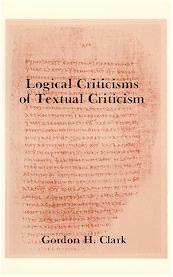
The second review is of the book Logical Criticism of Textual Criticism by Gordon H. Clark, which can be found here.

Logical Criticism of Textual Criticism

As it can be seen from this book, anyone with even a bit of knowledge on textual issues can see that there is a difference between the textual critical methodology as utilized by Westcort, Hort, Metzger, Aland etc, and the text-types (Byzantine, Alexandrian, Western etc) contributing to the variant readings of the texts.

[Btw, if anybody discovers any link whatsoever that I have missed out to the blog of that irrational, cowardly and reprobate anonymous idiot who calls himself Antithesis (fulfilling Jude 1:10 and 2 Peter 2:12), please inform me so I can delete those links.

But these people blaspheme all that they do not understand, and they are destroyed by all that they, like unreasoning animals, understand instinctively. (Jude 1:10)

But these, like irrational animals, creatures of instinct, born to be caught and destroyed, blaspheming about matters of which they are ignorant, will also be destroyed in their destruction, (2 Peter 2:12)]

Thursday, October 09, 2008

Excerpt from Above all Earthly Powers

I have been reading through David Wells' book entitled Above all Earthly Powers: Christ in a Postmodern World, before going on to his latest book The Courage to be Protestant. I don't exactly take to the sociological analysis portions, but overall the book does presents its case of the collapse of Evangelicalism as it succumbs to the Zeitgeist or Spirit of the Age. Anyway, here is a good excerpt which describes the error of the entire seeker-sensitivity philosophy and methodology and also "seeker-sensitivity version 2", as seen by some in the rush to "contextualize" the Christian faith and to be "missional".

Many in the new seeker-sensitive experiment in "doing church" have seen only the surface habits of this postmodern world and have not really understood its Eros spirituality. Theirs is an experiment in tactics in which innumerable questions have been asked about the ways the Church can become successful in this culture and they are all prefaced by the word how. How do we get on the wavelength of Generation Xers? How do we do worship so that the transition from home to church, from mall to church, and from unbelief into a context of belief, is seamless and even unnoticed? How do we speak about Christian faith to those who only want techniques for survival in life? How can we be motivational for those who need a lift without burdening them? How can we say what we want to say in church when the audience will give us only a small slice of their attention, especially if we are not amusing? And what is emerging, as the evangelical Church continues to empty itself of theology, is that it now find that it is tapping, wittingly or not, into this broad cultural yearning for spirituality, and capitalizing on that disposition's inclination not to be religious. Evangelical spirituality without theology, that even sometimes despises theology, parallels almost exactly the broader cultural spirituality that is without religion. Evangelical faith without theology, without the structure and discipline of truth, is not Agape faith but it is much close to Eros spirituality.

This, however, is not understood. Church talks about "reaching" the culture turns, almost inevitably, into a discussion about tactics and methodology, not about worldviews. It is only about tactics and not about strategy. It is about seduction and not about truth, about success and not about confrontation. However, without strategy, the tactics inevitably fail; without truth, all of the arts of seduction which the churches are practicing sooner or later are seen to be the empty charade that they are; and because the emerging worldview is not being engaged, the Church has little it can really say. Indeed, one has to ask how much it actually wants to say. Biblical truth contradicts this cultural spirituality, and that contradiction is hard to bear. Biblical truth displaces it, refuses to allow it its operating assumptions, declares to it its bankruptcy. Here, indeed, is an anti-god, dressed up in the garb of authenticity, but whose world is a world of fiction. Is the evangelical Church faithful enough to explode the worldview of this new spiritual search? Is it brave enough to contradict what has wide cultural approval? The verdict may not finally be in but it seems quite apparent that while the culture is burning, the evangelical Church is fiddling precisely because it has decided it must be so like the culture to be successful.

[David F. Wells, Above all Earthly Powers: Christ in a Postmodern World (Eerdmans, Grand Rapid, MI, USA, 2005), 162-163]

Thursday, September 25, 2008

Marketing strategy that is faithful to Scripture

Probably. But this is an interesting marketing strategy that can be used to get the malnourished sheep to come over to be fed in Bible teaching churches.


[HT: Christian Research Net]

Saturday, June 14, 2008

More on the PD paradigm: The PD Church

Well, with the dust settling on the recent controversy, I would like to serve up my review of Warren's first book The Purpose Driven Church here. After hearing Pastor Bob DeWaay's latest clarification on his visit to Saddleback and meeting Rick Warren, I decided to do a review of this book since it forms the basis of Warren's Ministry philosophy, which as it will be seen is totally antithetical to true Christian ministry, being influnced by the heretic Charles Grandison Finney and the founder of Church Growth Theory Donald McGraven.

And here is an excellent article by my friend Mike Ratliff as he looks at the situation in which Warren tries to play diaprax on his critics: Can A Leopard Change Its Spots?

Sunday, November 18, 2007

'Interesting' finds...

Well, today, I was browsing for something, and I happen to be in the Popular Bookstore near my home. Look at what I saw:

OK, this is a secular bookstore, but this just shows that Joel Osteen's heresies are available here in Singapore (and being promoted, as we can see from the 20% off sticker), where I am SURE there would be people buying, even those who call themselves Christians.

And in one New Evangelical bookstore, I saw this:

Breath prayers ... where have I heard of them before? Oh, of course, in Rick Warren's book The Purpose Driven Life. So now anyone interested or curious can find out how to start on your journey into the mists of New Age Contemplative Spirituality.

Thursday, November 08, 2007

PD 'Gospel' is self-help gospel, according to non-Christians

Seems that non-Christians have more discernment than most Christians in this regard. According to this article, which also shows how American Christianity has become commercialized while selling out the Gospel,

With the rise of the self-help gospel, popularized by the Rev. Rick Warren’s best-selling book, “A Purpose Driven Life,” evangelical Christians have shifted their message away from combating sin and hell’s fury to one of coping, of reaching full potential, of mending relationships and broken marriages.

Why am I surprised that non-Christians can see through Warren's deception, while Christians cannot?

[HT: Watcher's Lamp]

Saturday, September 22, 2007

Refusing to love the truth and be saved (part 2)

[continued from here]

As one looks upon the landscape of Christendom throughout history and throughout the world, various movements can be seen that manifest the idea of 'refusing to love the truth and be saved'. We will look at some of these movements today (which may overlap), particularly those which are prevelant in such a time as this.

Charismatism (Second wavers, Word-faith movement, Prosperity 'gospel' movement) and Third Wavers (Signs and Wonders movement, Neo-Apostolicism)

Chief error: No concern over truth

The most prevelant movement in the world today which manifests an attitude of 'refusing to love the truth and be saved' are the Charismatics and the Third Wave charismatics. By Charismatics, I am referring to those who are consistent charismatics and thus focus more on experiences, not to those who are symphathetic to the experiential form of Christianity promoted in Charismatism per se or those who believe in the sign-gifts like the Pentecostals (the first wavers). Such Charismatics would include people like Kenneth Hagin, Kenneth Copeland, Joyce Meyer and Benny Hinn of the Word-faith movement, and people such as Creflo Dollar of the prosperity 'gospel' movement. Closer to home in Singapore, we have Kong Hee of City Harvest Church for the Word-faith and Joseph Prince of New Creation Church for the prosperity 'gospel' movement. By Third wave charismatics, I am referring to those who are in the Signs and Wonders movement found in such movements such as the 'Toronto Blessing', the 'Kansas City prophets' etc, and those who are in the New Apostolic Reformation, following the ideas of modern day apostles and prophets like C. Peter Wagner and Cindy Jacobs (not to mention Ed Silvoso) etc, regardless of whether they call themselves Charismatics or Third wavers. Third Wavers in Singapore would be people like 'Apostle' Lawrance Khong of FCBC (Faith Community Baptist Church), and 'Apostle' Naomi Dowdy of Trinity Christian Center.

Such people would constitue a large part of worldwide Christianity for sure, and that is someting we should grieve over. Such people demean the Scripture and thus demean Jesus and the entire Godhead as they refuse to examine their beliefs and experiences according to Scripture, and in fact postulating a false dichotomy between the Spirit and the Word. Professing to be wise, they became fools indeed (Rom. 1:22), and as the annals of church history shows, will leade them to grow further and further into apostasy, as the Scriptures have said they would, as a judgment of God sending upon them a strong delusion because they refuse to love the truth and obey unrighteousness (2 Thess. 9:11).

Post-modern emergents

Chief error: Denial of truth

The latest fad as found in the Emerging Church movement (ECM) is marked by a blatent hatred for truth claims, of which exclusive truth claims are the most hated of all. Now, this does not of course applies to everyone within the ECM, but to most of them who glorify ambiguity and ignorance; in other words post-foundational 'christianity'. Such people can easily be seen to refuse to love the truth, since how can you love the truth if you don't even agree that it exists in the first place? As expected, the movement is evolving further and further away from orthodoxy, now embracing open theism and inclusivism.

Utiltarianism

Chief error: Love truth for its benefits only

This is one of the primary errors of New Evangelicalism, and the most prevelant in Singapore. The truths and doctrines of the Christian faith are prized only because of their value in 'doing ministry' and 'living a Christian life', whatever those two phrases are supposed to mean. Therefore, we have bible studies conducted on topics such as how to live a Christian life in the midst of trouble, learning from Jeremiah on how to live the Christian life despite facing obstacles and depression (Latest Bible study by Eagles Cmmunications correct as of 22 Sept 2007). Nevermind the original meaning of the texts and the passages; what they desire is how we can find lessons to learn that would help ME in my condition.

Such is the mindset that is sadly prevelant within much of what calls itself Evangelicalism. The Purpse Driven Life by Rick Warren is popular because 'it works', and the issue of whether it glorifies God in massacring Scripture in the book, or whether the Gospel is properly presented, is not important at all in the sight of 'Evangelicals'. The Seeker-Sensitive enterprise by Bill Hybels of Willow Creek is similarly promoted regardless of its spiritual merit, because ... again 'it works'. Women are allowed to be elders in church because ... without doing so, the church may not have enough office bearers serving; i.e. 'it works'. In other words, the biblical truths are revealed for MY benefits, such that MY life works.

Another part of such utilitarianism is seen even in being orthodox in theology. Being orthodox in theology does not make a person or movement immune from utilitarianism. I have seen for myself churches whereby the pastor preaches the Word of God because of its benefits in so doing. Passages are expounded verses by verse, precept by precept, because they build up the people of God. Now, of course, such is a good and noble goal. However, if you proclaim the Word of God because of its good and spiritual benefits alone, you are still doing it only because 'it works', just doing it in a different and God-ordained way. Instead of doing it for the glory of God ALONE, such preaching does not honor God either. Embracing the 5 points of Calvinism, or being totally orthodox in all aspects of your theology, does not help you as long as you do so because 'it works' and not for the glory of God alone.

Utilitarianism in all its forms, even using the biblical and God-ordained methods, is a form of 'refusing to love the truth', and therefore is not pleasing to God. As can be seen in the annals of church history, Neo-Evangelicalism has been degenerating throughout the history of its existence, from its formation in the 1950s/60s to the present age. The words of God in 2 Thess. 2:10 still holds true for those who refuse to love God for God's own sake. To put it simply, if a person or people in the movement CANNOT love God and His truth even if there would be no temporal benefit on this earth to it, and no eternal benefit either (ie even if you would still go to hell despite it), but to love God and His truth because He is worthy of it based on the fact that He is God and that alone, then they are 'refusing to love the truth', and thus subjected to His judgment upon His own discretion.

(to be continued)

Friday, August 24, 2007

What is this supposed to be for?

Look at this. Maybe someone can enlighten me as to what's the use of such merchandise...

Friday, July 20, 2007

Article: The Building of a Clone Army

Seems like today's pastors are being trained to behave like clones... perhaps of Rick Warren? Read this and come to your own conclusions.

Wednesday, May 23, 2007

Sermon: The Gospel of Accomodation

Here is an excellent sermon by Rev. David Wilkerson entitled The Gospel of Accomodation, and here is a video that applies it legitimately to the seeker-sensitive, purpose-driven movement.

Thursday, April 12, 2007

A Rick Warren blog

Oh my, look at this. Seems like Rick Warren requires a spin doctor these days to keep his purpose driven empire alive. Whatever happens to his former apologist Richard Abanes, writer of the book Rick Warren and the Purpose that Drives Him? Is Mark Kelly going to publish a book entilted "Why Rick Warren's tactics are not marketing" or something like that? Oh well, guess at least Rick Warren hasn't stoop to the level of suing people to silence the truth...

Oh, check this out to see why Rick Warren is indeed involved in the marketing business...

Sunday, March 18, 2007

Abomination: Sexed 'sermons'

Here is an article regarding the entrance of immorality in the form of 'sermons' porn talk into the churches, in order to 'reach people for Christ'. The article is already censored, but there are still small pictures and videos as evidences of the abomination. So, it is strongly encouraged that young children DO NOT go there. See this and weep.

[HT: Christian Research Net]

Tuesday, February 06, 2007

Article: Wanted: Ministers who preach not themselves but Christ

Good article by Dr. Michael Horton of Modern Reformation here, on the contrast between the qualifications asked for in today's ministers compared to those set forth in Scripture.

[HT: Christian Research Network]